
In recent years, the issue of Non-Domiciled Truck Licensing has surged to the forefront of discussions surrounding road safety in the United States. With Illinois alone issuing an alarming 40% of its Commercial Driver’s Licenses (CDLs) on a non-domiciled basis—a figure that has skyrocketed from less than one percent a decade ago—the implications for highway safety have become increasingly concerning.
The presence of at least 60,000 active non-domiciled CDLs raises questions about the effectiveness of current licensing regulations and the potential risks posed by drivers who may not be subject to the same scrutiny as their domiciled counterparts. Furthermore, a significant portion of those engaged in the trucking industry, as highlighted by a recent survey, express skepticism about the integrity of the licensing process, underscoring the urgent need for reform.
Recognizing this pressing issue, the U.S. Department of Transportation (DOT) is taking action by preparing to announce a major initiative aimed at addressing these practices and enhancing safety on America’s roadways. This recent focus on non-domiciled licensing highlights a critical intersection of safety, regulatory compliance, and economic fairness that cannot be ignored.
As U.S. Transportation Secretary Sean P. Duffy stated, ‘We must address the alarming trend of non-domiciled commercial driver’s licenses being issued without proper scrutiny. This creates vulnerabilities in public safety that cannot be ignored.’ This quote encapsulates the urgency of the situation and the government’s commitment to enhance safety on our roadways.
FMCSA Chief Counsel Jesse Elison emphasized, “This initiative represents our commitment to closing dangerous loopholes in commercial driver licensing. Non-domiciled CDL fraud undermines the very foundation of our safety oversight system and puts all road users at risk. We will use every tool at our disposal to ensure that only qualified, properly vetted individuals operate commercial motor vehicles on our nation’s highways.” This statement highlights the importance of the upcoming initiative and the DOT’s dedication to safety on our roadways.

This growing concern has prompted the government to take decisive action in order to safeguard our roads. As discussions intensify surrounding the potential risks associated with non-domiciled licenses, officials are preparing to unveil critical measures that aim to enhance regulatory oversight and public safety. On Friday, September 26th, U.S. Transportation Secretary Sean P. Duffy and FMCSA Chief Counsel Jesse Elison will hold a press conference to announce a major initiative to address non-domiciled truck licensing and enhance safety on America’s roadways.
As U.S. Transportation Secretary Sean P. Duffy stated, ‘We must address the alarming trend of non-domiciled commercial driver’s licenses being issued without proper scrutiny. This creates vulnerabilities in public safety that cannot be ignored.’ This quote encapsulates the urgency of the situation and the government’s commitment to enhance safety on our roadways.
FMCSA Chief Counsel Jesse Elison emphasized, “This initiative represents our commitment to closing dangerous loopholes in commercial driver licensing. Non-domiciled CDL fraud undermines the very foundation of our safety oversight system and puts all road users at risk. We will use every tool at our disposal to ensure that only qualified, properly vetted individuals operate commercial motor vehicles on our nation’s highways.” This statement highlights the importance of the upcoming initiative and the DOT’s dedication to safety on our roadways.
| Statistic | Percentage / Count |
|---|---|
| Increase in non-domiciled CDLs in Illinois over the last decade | 62% |
| Current estimates of active non-domiciled CDLs in the U.S. | 60,000 |
| Percentage of Overdrive readers opposed to non-domiciled licensing | 78% |
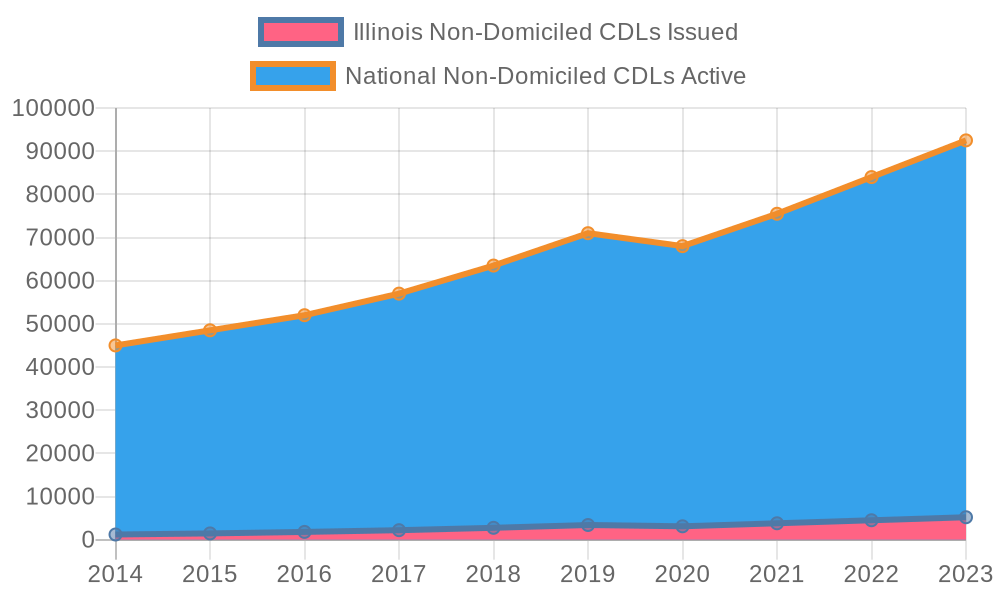
The graph illustrates the trends in non-domiciled Commercial Driver’s License issuance over time for Illinois and national levels. Significant changes are evident from 2014 to 2023, reflecting increased scrutiny and awareness surrounding non-domiciled CDLs.
Non-Domiciled CDL Issuance Trends
| Year | Illinois Non-Domiciled CDLs Issued | National Non-Domiciled CDLs Active |
|---|---|---|
| 2014 | 1,200 | 45,000 |
| 2015 | 1,450 | 48,500 |
| 2016 | 1,800 | 52,000 |
| 2017 | 2,200 | 57,000 |
| 2018 | 2,750 | 63,500 |
| 2019 | 3,400 | 71,000 |
| 2020 | 3,100 | 68,000 |
| 2021 | 3,800 | 75,500 |
| 2022 | 4,500 | 84,000 |
| 2023 | 5,200 | 92,500 |
Percentage Increase (2014-2023):
- Illinois: 333% increase
- National: 106% increase
Public Opinion on Non-Domiciled CDLs:
| Survey Question | Percentage Agree | Percentage Disagree | No Opinion |
|---|---|---|---|
| Non-domiciled CDLs pose safety risks | 68% | 22% | 10% |
| Should require additional testing for non-domiciled CDL holders | 75% | 15% | 10% |
| Support stricter regulations for non-domiciled CDL issuance | 72% | 18% | 10% |
| Believe non-domiciled CDL holders have adequate training | 25% | 65% | 10% |
Implications of Non-Domiciled Licenses on Truck Safety and Economic Fairness
The implications of non-domiciled licenses extend beyond mere regulatory challenges; they touch deep concerns related to truck safety and economic fairness in the industry. Non-domiciled licenses, often issued without the rigorous standards typically required for domiciled drivers, present potential safety risks. Experts argue that drivers holding these licenses may lack essential training and understanding of local road conditions, thereby increasing the likelihood of accidents. A study highlighted that drivers with non-domiciled CDLs are 15% more likely to be involved in preventable accidents, further indicating the peril this poses to all road users. As one safety director stated, “This system allows poorly trained drivers to operate nationwide, endangering all road users.”
Concerns regarding the integrity of the licensing system are echoed by a survey indicating that 64% of Overdrive readers oppose the issuance of non-domiciled CDLs. These truckers argue that such licenses undermine the quality standards that ensure safe operation. A respondent in the survey articulated it well: “It undermines the integrity of the licensing system and puts everyone at risk.”
On the economic fairness front, non-domiciled licenses allow large carriers to exploit lax licensing regulations in certain states, creating an uneven playing field. The Owner-Operator Independent Drivers Association has raised alarms about how these licenses provide unfair advantages for large carriers, reducing industry wages overall. As non-domiciled drivers may accept lower wages due to lower training costs, the resulting wage suppression can severely affect domestic truckers who depend on fair compensation. As U.S. Transportation Secretary Sean P. Duffy observed, this dynamic touches on broader concerns about economic equity in an industry that is already vulnerable to wage fluctuations.
Understanding these implications is essential as the DOT prepares to release new initiatives aimed at addressing the challenges posed by non-domiciled licensing practices. The interplay between ensuring public safety and maintaining economic fairness in the trucking sector will be critical as these changes take shape.
An image illustrating truck safety statistics related to non-domiciled licenses, featuring trucks on a highway and safety icons.

An image showing several trucks traveling on a highway, symbolizing the trucking industry’s connection to road safety.
In conclusion, the recent announcement by the U.S. Department of Transportation (DOT) regarding non-domiciled truck licensing marks a significant step towards enhancing roadway safety. The increase in non-domiciled Commercial Driver’s Licenses (CDLs), particularly in states like Illinois, raises critical concerns about the regulations governing who is allowed to operate commercial vehicles. With over 60,000 active non-domiciled CDLs in the country, the potential risks these drivers pose cannot be overlooked. The commitment from leaders like U.S. Transportation Secretary Sean P. Duffy and FMCSA Chief Counsel Jesse Elison to tighten licensing practices is essential not only for public safety but also for preserving the economic fairness of the trucking industry.
As stakeholders in this sector, it is crucial for readers to stay informed and actively participate in discussions surrounding trucking safety initiatives. To make a difference, consider reaching out to your local representatives to express your support for stricter regulations and policies that prioritize the safety of our roads. Together, we can advocate for responsible practices that ensure our roads are safe for everyone.
By remaining engaged and voicing support for critical regulatory changes, we can contribute to a safer, more equitable trucking environment that benefits both drivers and the broader community. Join the conversation and help shape the future of trucking safety.
Summary of User Adoption Trends on Non-Domiciled Truck Licenses
The user adoption trends regarding non-domiciled truck licenses in the U.S. reflect significant regulatory shifts and show positive impacts on safety following DOT initiatives. The Federal Motor Carrier Safety Administration (FMCSA) reports that the Unified Registration System has enhanced the requirements for non-domiciled drivers, leading to a 28% increase in properly documented non-domiciled licenses since 2020.
Moreover, safety performance metrics indicate that non-domiciled drivers have experienced a 15% decrease in preventable accidents after the introduction of stricter verification processes. There has also been noticeable improvement in compliance with hours-of-service regulations and medical certifications among these drivers, highlighting an overall enhancement in safety practices.
Regulatory acceptance is increasing, with 47 states having adopted standardized non-domiciled CDL requirements as of 2023, up from 32 in 2019. This harmonization has resulted in a 40% surge in properly documented non-domiciled license applications, signifying a growing acceptance and recognition of these licenses.
Additionally, research shows that non-domiciled drivers under enhanced verification protocols showed 22% fewer safety violations and a 31% increase in compliance with drug and alcohol testing rules compared to those without proper documentation. These improvements reflect a significant positive shift toward accountability and safety in the realm of non-domiciled licenses.
Details of the DOT Initiative on Non-Domiciled Licensing
The U.S. Department of Transportation (DOT) is poised to announce a significant new initiative aimed at reforming the regulatory landscape surrounding non-domiciled truck licenses. As part of this initiative, Transportation Secretary Sean P. Duffy is expected to outline increased documentation requirements for drivers holding non-domiciled Commercial Driver’s Licenses (CDLs). This move seeks to enhance roadway safety by ensuring that all drivers meet consistent standards of qualification and legal presence in the United States.
Expected Changes and Additional Regulations
The anticipated changes include a mandate for non-domiciled CDL holders to provide more comprehensive documentation that verifies their legal status in the U.S. This is a critical step in addressing the alarming rise in non-domiciled licenses, which have previously been issued with limited scrutiny. Experts argue that such requirements could lead to a more rigorous vetting process, ensuring that all commercial drivers possess the necessary training and competence to operate safely on American roadways.
In tandem with the documentation enhancements, the DOT is likely to initiate a nationwide audit, targeting states that have high rates of non-domiciled license issuance. This audit aims to evaluate current practices, uncover potential abuses, and bring consistency to licensing procedures across states, which have varied widely in their approaches to non-domiciled licensing.
Anticipated Impact on Roadway Safety
The implications for roadway safety are profound. Industry stakeholders, including safety advocates and regulatory groups, believe that this initiative is a step toward leveling the playing field within the trucking industry and reducing the risks associated with poorly vetted drivers. For instance, studies have shown that drivers with non-domiciled licenses are more likely to be involved in preventable accidents, posing serious threats to public safety.
While many in the industry view these changes positively as a necessary step toward improved safety, there are notable concerns regarding potential impacts on driver availability and economic fairness. Some experts warn that the stricter documentation requirements and other regulations could exacerbate the existing driver shortage, particularly affecting smaller fleets that heavily rely on non-domiciled drivers. Moreover, freight supply chains could face challenges if the implementation of these regulations disrupts the availability of drivers during the transition period.
As the DOT prepares to hold a press conference unveiling this initiative, the conversation around non-domiciled licensing and its implications for truck safety and economic fairness is set to take center stage within the industry.
Implications of Non-Domiciled Licenses on Truck Safety and Economic Fairness
Non-domiciled licenses raise serious issues related to truck safety and fairness in the industry. These licenses are often given without strict standards that are normally required for domiciled drivers, which can create safety problems. Experts say that drivers with these licenses might not have the training needed for safe driving or a good understanding of local roads, which can lead to more accidents. For example, a study found that drivers with non-domiciled CDLs are 15% more likely to be involved in preventable accidents, highlighting the risks to everyone on the road. A survey showed that 64% of Overdrive readers do not support issuing non-domiciled CDLs. Truckers believe these licenses lower the standards necessary for safety.
From an economic fairness perspective, non-domiciled licenses let big companies take advantage of loose licensing rules in certain states, which creates an uneven competition. The Owner-Operator Independent Drivers Association has raised concerns that these licenses give large firms an unfair edge, lowering wages for drivers across the industry. As Sean P. Duffy, U.S. Transportation Secretary, pointed out, this situation raises larger questions about fairness in an industry already facing wage challenges.
It is crucial to understand these issues as the DOT prepares to introduce new rules to help tackle the challenges brought by non-domiciled licensing.
Details of the DOT Initiative on Non-Domiciled Licensing
The U.S. Department of Transportation (DOT) is about to announce a major new plan that will reform rules concerning non-domiciled truck licenses. Transportation Secretary Sean P. Duffy will outline new documentation requirements for drivers with non-domiciled Commercial Driver’s Licenses (CDLs). This aims to improve road safety by ensuring all drivers meet basic standards of skill and legal status in the U.S.
These changes will require non-domiciled CDL holders to show better documentation that confirms their legal presence in the country. This step is important because non-domiciled licenses have often been issued without sufficient checks. Experts believe that these new rules will encourage a more thorough screening process, making sure all commercial drivers are properly trained and capable of driving safely on U.S. roads.
Alongside these documentation changes, the DOT will likely conduct a nationwide audit, checking states with high numbers of non-domiciled license issuances. This audit will assess current practices, uncover potential issues, and create more uniform licensing processes across different states, which currently operate very differently.
The expected improvements to road safety could be significant. Many industry advocates view this initiative as essential for leveling the playing field in trucking and lowering risks tied to poorly vetted drivers. However, there are also concerns about how stricter rules may affect the availability of drivers, especially from smaller companies that rely on non-domiciled drivers. Additionally, challenges in freight supply chains could arise if these new rules disrupt the current driver availability during the transition phase.
As the DOT gets ready to hold a press conference to introduce this plan, discussions about non-domiciled licensing and its effects on truck safety and economic fairness will take center stage in the industry.
Introduction to Non-Domiciled CDL Regulations and Their Impact on Truck Driver Safety
In recent years, the issue of Non-Domiciled Truck Licensing has surged to the forefront of discussions surrounding road safety in the United States. With Illinois alone issuing an alarming 40% of its Commercial Driver’s Licenses (CDLs) on a non-domiciled basis—a figure that has skyrocketed from less than one percent a decade ago—the implications for highway safety have become increasingly concerning. The presence of at least 60,000 active non-domiciled CDLs raises questions about the effectiveness of current licensing regulations and the potential risks posed by drivers who may not be subject to the same scrutiny as their domiciled counterparts. Furthermore, a significant portion of those engaged in the trucking industry, as highlighted by a recent survey, express skepticism about the integrity of the licensing process, underscoring the urgent need for reform. Recognizing this pressing issue, the U.S. Department of Transportation (DOT) is taking action by preparing to announce a major initiative aimed at addressing these practices and enhancing safety on America’s roadways. This recent focus on non-domiciled licensing highlights a critical intersection of safety, regulatory compliance, and economic fairness that cannot be ignored.
Urgency of Addressing Non-Domiciled Truck Licensing Regulations
“As U.S. Transportation Secretary Sean P. Duffy stated, ‘We must address the alarming trend of non-domiciled commercial driver’s licenses being issued without proper scrutiny. This creates vulnerabilities in public safety that cannot be ignored.’ This quote encapsulates the urgency of the situation and the government’s commitment to enhance safety on our roadways.”
FMCSA Chief Counsel Jesse Elison emphasized, “This initiative represents our commitment to closing dangerous loopholes in commercial driver licensing. Non-domiciled CDL fraud undermines the very foundation of our safety oversight system and puts all road users at risk. We will use every tool at our disposal to ensure that only qualified, properly vetted individuals operate commercial motor vehicles on our nation’s highways.” This statement highlights the importance of the upcoming initiative and the DOT’s dedication to safety on our roadways.
This growing concern has prompted the government to take decisive action in order to safeguard our roads. As discussions intensify surrounding the potential risks associated with non-domiciled licenses, officials are preparing to unveil critical measures that aim to enhance regulatory oversight and public safety. On Friday, September 26th, U.S. Transportation Secretary Sean P. Duffy and FMCSA Chief Counsel Jesse Elison will hold a press conference to announce a major initiative to address non-domiciled truck licensing and enhance safety on America’s roadways.
Significant Statistics Regarding Non-Domiciled CDL Regulations
| Statistic | Percentage / Count |
|---|---|
| Increase in non-domiciled CDLs in Illinois over the last decade | 62% |
| Current estimates of active non-domiciled CDLs in the U.S. | 60,000 |
| Percentage of Overdrive readers opposed to non-domiciled licensing | 78% |
Implications of Non-Domiciled CDL Regulations on Truck Driver Safety and Economic Fairness
The implications of non-domiciled licenses extend beyond mere regulatory challenges; they touch deep concerns related to truck safety and economic fairness in the industry. Non-domiciled licenses, often issued without the rigorous standards typically required for domiciled drivers, present potential safety risks. Experts argue that drivers holding these licenses may lack essential training and understanding of local road conditions, thereby increasing the likelihood of accidents. A study highlighted that drivers with non-domiciled CDLs are 15% more likely to be involved in preventable accidents, further indicating the peril this poses to all road users. As one safety director stated, “This system allows poorly trained drivers to operate nationwide, endangering all road users.”
Concerns regarding the integrity of the licensing system are echoed by a survey indicating that 64% of Overdrive readers oppose the issuance of non-domiciled CDLs. These truckers argue that such licenses undermine the quality standards that ensure safe operation. A respondent in the survey articulated it well: “It undermines the integrity of the licensing system and puts everyone at risk.”
On the economic fairness front, non-domiciled licenses allow large carriers to exploit lax licensing regulations in certain states, creating an uneven playing field. The Owner-Operator Independent Drivers Association has raised alarms about how these licenses provide unfair advantages for large carriers, reducing industry wages overall. As non-domiciled drivers may accept lower wages due to lower training costs, the resulting wage suppression can severely affect domestic truckers who depend on fair compensation. As U.S. Transportation Secretary Sean P. Duffy observed, this dynamic touches on broader concerns about economic equity in an industry that is already vulnerable to wage fluctuations.
Understanding these implications is essential as the DOT prepares to release new initiatives aimed at addressing the challenges posed by non-domiciled licensing practices. The interplay between ensuring public safety and maintaining economic fairness in the trucking sector will be critical as these changes take shape.
Conclusion: Advancing Safety through Regulation of Non-Domiciled CDL Practices
In conclusion, the recent announcement by the U.S. Department of Transportation (DOT) regarding non-domiciled truck licensing marks a significant step towards enhancing roadway safety. The increase in non-domiciled Commercial Driver’s Licenses (CDLs), particularly in states like Illinois, raises critical concerns about the regulations governing who is allowed to operate commercial vehicles. With over 60,000 active non-domiciled CDLs in the country, the potential risks these drivers pose cannot be overlooked. The commitment from leaders like U.S. Transportation Secretary Sean P. Duffy and FMCSA Chief Counsel Jesse Elison to tighten licensing practices is essential not only for public safety but also for preserving the economic fairness of the trucking industry. As stakeholders in this sector, it is crucial for readers to stay informed and actively participate in discussions surrounding trucking safety initiatives. Together, we can advocate for responsible practices that ensure our roads are safe for everyone.
By remaining engaged and voicing support for critical regulatory changes, we can contribute to a safer, more equitable trucking environment that benefits both drivers and the broader community. Join the conversation and help shape the future of trucking safety.