
For many new drivers, obtaining a learner’s license marks the first significant step towards independence and mobility. This transitional phase allows aspiring drivers to practice behind the wheel, but it comes with its own set of rules and regulations. Understanding the legal conditions, necessary safety precautions, driving restrictions, and the importance of supervision is essential for anyone navigating this phase. Furthermore, the journey from a learner’s license to obtaining a full driving permit is crucial for compliance and safety on the road. This guide delves deeply into each aspect of driving with a learner’s license, ensuring that new drivers, existing drivers, vehicle owners, and auto dealerships are well-informed and prepared.
Legal Conditions in Practice: How a Learner License Opens the Road Yet Keeps You Bound to Rules
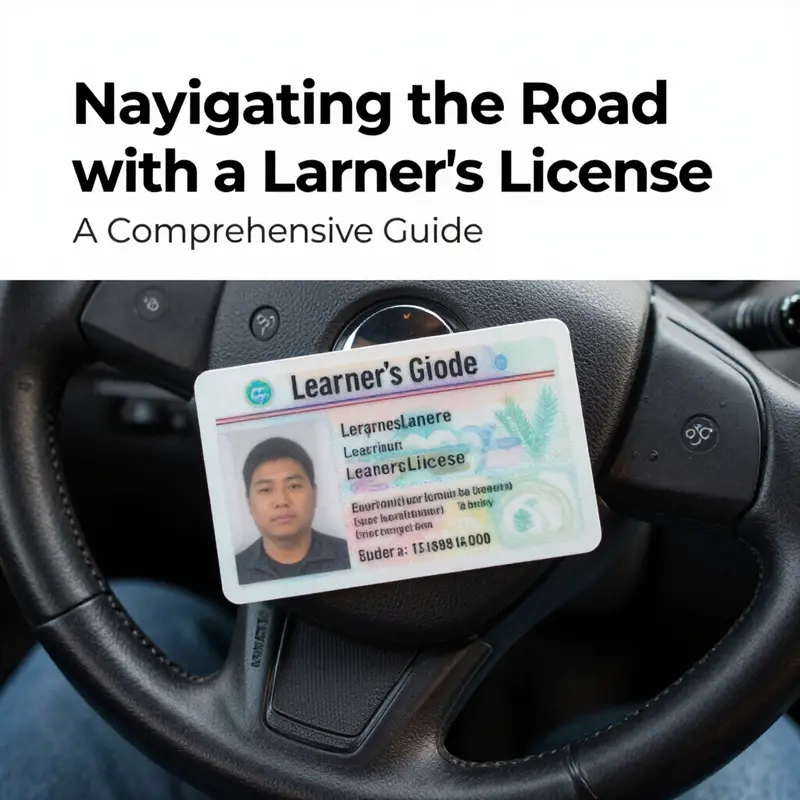
The question many first-time drivers ask is whether they can drive with a learner license. In practice, a learner license allows supervised practice under a formal safety framework.
A licensed supervisor of the same vehicle class must be present who is at least the minimum required age and holds a valid license for the same class. The supervising driver is there to intervene if a risky situation arises and to model safe driving behavior. The learner vehicle typically displays a visible red L plate on the front and rear to signal training to other road users. Restrictions commonly include limits on driving hours, avoidance of certain high speed roads or expressways unless exemptions are granted, and the need to pass tests to progress to a full license. A learner license is class specific, not universally transferable to all vehicle types, and is tethered to the class for which it was issued. The overarching purpose is safety through controlled exposure, allowing real traffic experience only under supervision until competence is demonstrated through formal assessment. Across different systems there is a shared logic: privilege without full independence, governed by rules that protect learners and other road users. For example, in a comparative context learners must practice under supervision, observe designated practice areas, and comply with licensing prerequisites before graduating to independent driving. The practical takeaway is to learn local rules, secure a qualified supervisor, practice methodically, and treat the permit as a structured training phase rather than a license to roam freely. Official statutes and regulatory texts provide the binding framework that defines what learners may do, where they may drive, and when they may advance to a full license.
On the L Plate: Safety, Supervision, and the Path from Learner License to a Full Driving Future
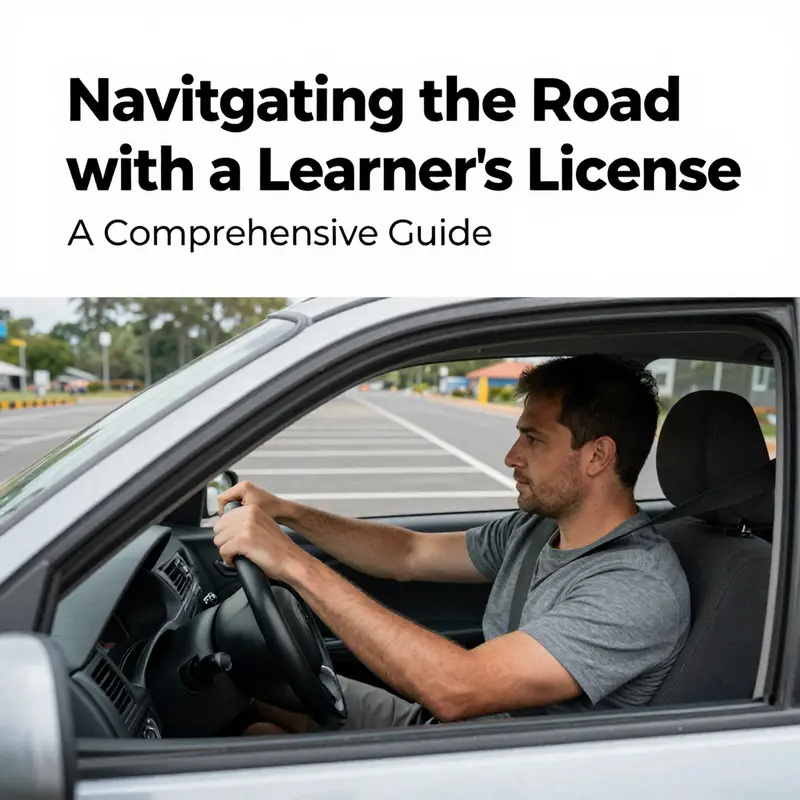
A learner’s license marks the official start of a journey rather than the destination itself. It is an invitation to practice, to observe, and to learn the rhythms of a road under close watch. In many jurisdictions, including where the Motor Vehicles Act, 1988 governs formal rules, this period is tightly prescribed. A learner driver is not yet free to roam unaccompanied; instead, the vehicle is a moving classroom where safety is the chief instruction and the supervisor is the instructor. The rules are explicit: you must be accompanied by a licensed driver who is at least 25 years old and who holds a valid license for the same class of vehicle you are operating. The vehicle itself must display a conspicuous red “L” plate on both the front and rear, signaling to other road users that the driver is still gaining experience. These requirements serve a dual purpose. They keep the student close to an experienced hand who can intervene if the learner is about to misjudge a corner, misread a pedestrian, or miscalculate a gap in traffic. They also give surrounding drivers a context to exercise extra patience and caution, which in turn reduces the potential consequences of a misstep during this learning phase.
Beyond supervision and visibility, the practical boundaries of the learner license are designed to prevent too-rapid exposure to higher-stakes situations. Time windows for driving, locations, and road types can be restricted. Highways and expressways are often off-limits until the learner has developed a foundational feel for control and coordination. The vehicle used for practice must correspond to the class of the learner’s license, so the learner does not attempt to master a class of vehicle that requires different handling, stronger command of the controls, or more complex situational judgment. In short, the learner phase is about building the foundation—sensorial awareness, coordination, and reliable habits—before stepping into the open field of full driving responsibility.
This is the heart of safety during the learner period: deliberate, guided practice that slowly expands the learner’s comfort zone. It is not a trial to see if a novice can push limits, but a structured apprenticeship where every hour behind the wheel builds a more automatic and more responsible response pattern. The emphasis falls on fundamentals—steering with smooth inputs, braking progressively, accelerating in a controlled manner, and always checking mirrors and blind spots. The supervisor’s role is critical here, not merely to supervise in a passive sense but to participate actively. They watch, correct, and explain, modeling how to anticipate the behavior of other road users and how to respond to typical edge cases—an oncoming car that drifts, a cyclist weaving through traffic, a pedestrian stepping out from behind a parked bus.
In practice, the most effective learner experiences unfold in low-traffic environments first. Quiet residential streets or empty parking lots become the initial training ground, where a learner can practice fundamental maneuvers without the pressure of constant interactions with other drivers. As confidence grows, practice can gradually migrate to busier roads, but the progression remains measured. The aim is not to accelerate the learner into challenging traffic but to ease them into it, one skill at a time. This gradual approach reduces anxiety and fosters better judgment. It also reinforces the habit of deliberate decision-making under pressure, a psychological as well as physical skill. When nerves arise—as they often do at the start—breathing exercises, brief pauses at safe spots, and a focus on small, achievable tasks help maintain composure. The road is not a place to prove speed but a place to prove control and consistency.
The safety framework extends to what might seem like mundane features but are, in fact, essential building blocks of safe driving. The vehicle’s mirrors must be checked routinely; the learner should become fluent in the sequence of glancing, positioning, and re-checking. Turn signals should be used deliberately and well in advance of any lane change or turn, with attention paid to blind-spot monitoring as part of every maneuver. The following distance is a simple yet powerful safety tool: increasing the gap to give more room for reaction time during stops or sudden maneuvers can prevent rear-end collisions and reduce the stress of a high-stakes driving moment. Keeping distractions to an absolute minimum is another cornerstone. The learner should resist the urge to use mobile phones, eat, or engage in other multitasking behaviors that degrade focus. Safety here is a learned habit, not a one-time rule.
Drivers in training must accept the reality that their vehicle may not handle as smoothly as they expect, particularly during turns or sudden maneuvers. This humility translates into speed management: drive at speeds appropriate to the conditions, even when the road seems clear. It also means recognizing limits—what the learner’s car can tolerate, what the weather can demand, and what the surrounding traffic can require. The supervisor, sharing the behind-the-wheel experience, can calibrate expectations and provide practical demonstrations of how to adjust speed and steering input in response to real-time feedback from the road. Patience is not passive; it is a deliberate practice of listening to the vehicle and the environment, and of maintaining calm so that hesitation never becomes indecision or recklessness.
Safety paperwork and compliance are part of the learning process. While the rules may appear rigid, they exist to protect both the learner and the broader community. Obeying traffic signs, signals, and speed limits is not merely about avoiding penalties; it is about embedding a discipline of legality and responsibility that will carry forward into full licensure. The learner’s license, therefore, functions as a transitional credential: it signals to the learner that a higher degree of competence is required before independent driving is granted. This is why many jurisdictions require passing a driving test after the learner phase, the test serving as the final assessment of whether the learner has mastered the necessary skills and judgment to operate a vehicle safely without supervision.
For readers who want to explore how rules can vary by location, it can be helpful to consult resources that discuss state or local variations in driver licensing requirements. The discussion on state rules impact on driver licensing provides insight into how local provisions shape the learner period, supervision mandates, and testing criteria. state rules impact on driver licensing
Beyond the legal framework, the ethos of learning to drive with a learner license centers on safety literacy. A learner must not merely emulate another driver but cultivate a proactive mindset: anticipate potential conflicts, plan ahead for possible contingencies, and continuously refine the coordination between eyes, hands, and the vehicle’s controls. Reading the road, interpreting the behavior of other users, and adjusting one’s own actions accordingly become not just practical skills but a daily habit—one that will underpin confident and safe driving once the learner progresses to a full license.
This healing of confidence through controlled exposure also has social and developmental dimensions. The learner’s journey fosters a dialogue between the supervisor and the learner about risk, responsibility, and restraint. It is an apprenticeship in which feedback is both candid and constructive. It is not only about mastering steering or braking, but about learning to manage fear, to balance caution with decisiveness, and to translate sometimes imperfect practice into reliable competence. The road becomes a teacher, and the learner a student who earns with each mile the right to assume greater autonomy. When the time comes to sit for a test, the learner will bring not just a set of polished maneuvers but an observed pattern of consistent behavior, a cadence of safe choices, and a tested ability to recover from mistakes without escalating them.
For those navigating these early stages, the broader message remains simple and powerful: respect the limits of the learner license, practice with intention, and rely on the structured guidance that supervision provides. The aim is not merely to pass a test but to build a durable habit of safety that will endure for years on the road. In this sense, the learner period is less about displaying speed, and more about proving reliability, restraint, and sound judgment. The result is a more capable driver entering the road with a foundation that will support many miles of responsible travel. As with any apprenticeship, the quality of the early practice often predicts the quality of the later competence. The learner’s license, properly used, becomes not a restriction but a carefully guarded path—the bridge between curiosity and competence, between risk and responsibility, and between a novice behind the wheel and a confident, mature driver.
External resources for universal guidance on safe driving practices during learner periods are available for reference. For more general, widely applicable safety guidelines, see the National Highway Traffic Safety Administration’s resources: https://www.nhtsa.gov
null
null
Guided Hands on the Road: How Supervisors Shape Safe Driving Under a Learner License
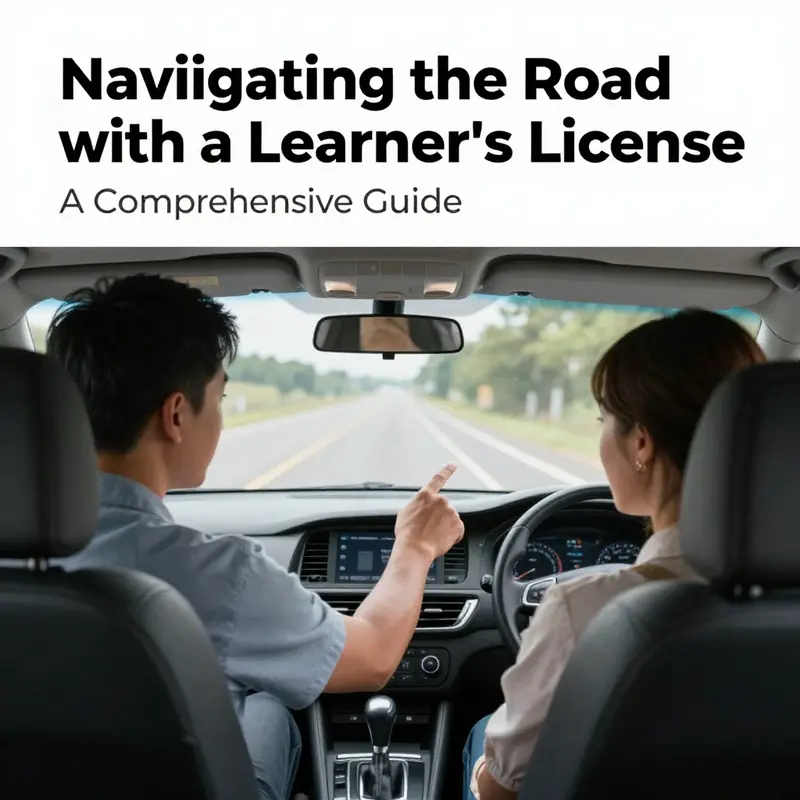
A learner license is not a permit to drive alone. It is a carefully structured doorway into real-world driving, guarded by rules and expectations that connect novice skills with seasoned judgment. The central premise of this stage is simple: the learner practices under supervision, with an adult who brings experience, calm oversight, and a steady hand when surprises arise. This guiding relationship does more than keep errors from becoming accidents; it shapes how a new driver reads traffic, negotiates space, and responds to the unpredictability of the road. When the learner sits behind the wheel with a supervisor, learning becomes a dialogue between two levels of experience, a transfer of tacit knowledge that textbooks alone cannot convey. The law encodes this relationship because it recognizes that handling a car safely requires more than knowledge of controls; it requires the development of judgment under real-world dynamics.
To understand the supervisory framework, it helps to anchor the discussion in practical constraints. A learner must be accompanied by a licensed driver who can operate the same class of vehicle. The supervisor is not a symbolic presence; they are expected to be actively engaged, vigilant, and prepared to intervene. The vehicle typically displays the red “L” plates on both the front and rear, signaling to other road users that a learner is at work inside. These cues reinforce the social contract of supervision, inviting patience from other drivers and inviting the learner to maintain humility as skills are still taking shape. Supervision thus has a public dimension as well as a personal one. It protects the learner while also teaching by example how to pace learning, how to read traffic, and how to recover from minor misjudgments without escalating risk.
The qualifications of the supervisor, while they can vary by jurisdiction, are rarely arbitrary. In many frameworks the supervisor must be an adult with a valid driver’s license for the same class of vehicle. The expectation is that the supervisor’s own driving is proficient, stable, and free from a pattern of unsafe behavior. The exact age threshold can differ. In some versions of practice, a supervisor must be at least 25 years old; in others, the threshold can be 21. The common thread is a demonstrated level of experience and a clean driving record. This is not about appointing a babysitter; it is about selecting a mentor who can recognize risk, anticipate errors, and guide a learner toward safer choices in the moment.
The supervisor’s responsibilities go beyond passive presence. They include continuous monitoring of the learner’s behavior, providing real-time feedback, and, when necessary, intervening to preempt unsafe actions. The supervisor’s voice matters in the cadence of a session: calm, precise, and constructive. Real-time feedback might focus on scanning habits, such as how the learner checks mirrors, observes blind spots, and manages pace to maintain safe following distances. It might address decision-making in complex environments, like negotiating roundabouts, merging onto a highway, or navigating a school drop-off zone where pedestrians move unpredictably. The supervisor helps the learner translate textbook rules into practiced reflexes, turning theoretical knowledge into habits that persist when adrenaline spikes or a moment demands swift choice. In this sense, supervision is the bridge between learning the controls and mastering the judgment that keeps everyone on the road safer.
The benefits of supervision extend beyond safety alone. A good supervisory relationship reduces anxiety for the learner, allowing more accurate assessment of one’s own limits. When feedback is timely and balanced, the learner gains confidence built on evidence of competence rather than bravado or luck. The learner learns to anticipate errors, to gauge risk, and to know when to slow down, not when to rush ahead. This process also cultivates an ethical stance toward driving: a commitment to accuracy, to patience, and to accountability. The supervisor models how to handle mistakes responsibly—how to pause, reflect, and adjust rather than double down on a risky path. In the long arc of developing a driver, that modeling matters as much as any technical tip, because human factors determine how well a person can apply rule-based knowledge in changing conditions.
Practical practice with supervision unfolds within a structured but flexible framework. Sessions begin with goal setting and a quick check of the learner’s readiness; as skills mature, the focus shifts to more advanced tasks, such as longer drives, night practice if permitted, or complex roadways. The plan should align with the local rules about where driving is allowed and during which times, and it should respect the learner’s pace while never letting safety be compromised. Much of the instruction occurs in the cadence of routine trips—a drive to the store, a short study of cornering on a quiet street, a calibration run in moderate traffic. The supervisor’s role is to help debrief after each session, guiding the learner through a concise reflection: what went well, what could be improved, and what new cues might help anticipate future hazards. This reflective practice cements the distinction between momentary success and enduring competence.
Despite the singular emphasis on supervision, the larger regulatory lattice that governs this phase matters. The learner is not free to roam at will; time-of-day restrictions and location limitations often apply, and highways or expressways may be off-limits to practice. The rules are designed to reduce risk while the learner’s skills are still in formation. The plate, the pace, and the permitted routes together reinforce a learning boundary that protects both the novice and other road users. In practice, most learners are encouraged to book their practice windows during daylight or in low-traffic periods, gradually expanding their operational envelope as grounding in basic control, spatial awareness, and hazard perception deepens. The supervisor, in this sense, becomes a partner who helps to schedule, calibrate, and navigate this steady expansion of capability.
For readers seeking to understand jurisdictional nuance, a closer look at the state-level rules is instructive. Different places draw the boundary lines in subtly different places, and those differences can shape how a learner’s practice is organized. To explore how these rules can vary and what they mean for supervision, you can consult discussions on state rules impact on driver licensing. This resource helps illuminate the practical consequences of policy choices, clarifying what a learner can and cannot do in a given area and how supervision must be executed within those bounds. State rules impact on driver licensing: https://drivernvehiclelicensing.com/state-rules-impact-on-driver-licensing/
Ultimately, the path from learner to licensed driver hinges on more than a single test or a set of regulations. It rests on the quality of the supervisory relationship, the learner’s readiness to accept feedback, and the ongoing alignment of practice with safety-first principles. The supervisor’s role is to illuminate the learner’s blind spots, to normalize careful decision-making, and to translate the immediacy of the road into long-term competence. The learner, in turn, accepts guidance with humility and curiosity, turning each practice session into a step toward mastery. In this light, supervision is not merely compliance with a rule; it is a disciplined partnership that cultivates the judgment, restraint, and discipline that the road demands. The learner’s eventual success—earning a full license and carrying forward the habit of safe driving—makes that partnership count in the most tangible way: by reducing risk, by enriching skill, and by reinforcing the social trust that makes everyday travel safer for everyone on the road.
External resource: https://www.dmv.org
From Learner’s Lane to the Open Road: Navigating the Path to a Full License
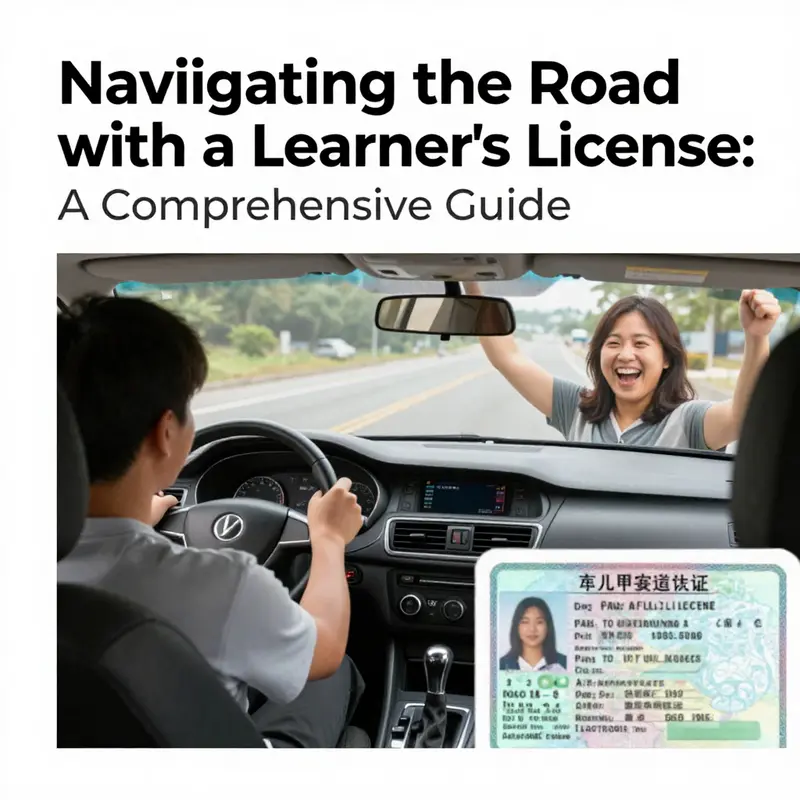
A learner’s license marks the first step on a long journey toward independent driving, but it is not a license to roam freely. The core idea behind the learner framework is safety: a new driver gains real-world experience under the watchful eye of an experienced, licensed driver and within clearly defined boundaries. In many jurisdictions, including the framework established by the Motor Vehicles Act, 1988 as amended, the learner’s license is a structured apprenticeship rather than a free pass. The practical rules are straightforward and purpose-built. A supervising driver must be present whenever the learner takes the wheel. That supervisor is typically required to be at least twenty-five years old and to hold a valid license for the same class of vehicle the learner is practicing with. The vehicle itself is marked with conspicuous L plates—usually a red version displayed on both the front and rear—so other road users can recognize that a learner is behind the wheel and may not yet have the reflexes or decision-making speed of a seasoned driver. These visual and supervisory safeguards are not mere formalities; they are essential in creating an environment where mistakes made by a learner are bounded and corrective, rather than catastrophic. The restrictions extend further: driving is often limited to certain hours and certain roads. Late-night driving may be prohibited, and highways or expressways might be off-limits for learners, depending on the jurisdiction and the level of traffic risk. Finally, the vehicle used for practice must match the learner license class. A car license, a motorcycle license, or other vehicle class must align with the learner permit. Taken together, these rules form a framework that prioritizes safety and gradual skill development. They acknowledge that experience behind the wheel is earned in steps, not in a single leap from novice to expert. The intent is not to stall the learner but to protect all road users while the learner accumulates driving judgment, spatial awareness, and the subtle art of anticipatory driving that comes from steady, supervised practice. The language and specifics of these rules can vary by country and region, but the underlying principle remains the same: a learner license is a bridge to a full license, not a ticket to autonomy before the learner is ready. In the Indian context, for instance, the official guidance emphasizes supervision, clearly marked display, and vehicle-class alignment as foundational conditions that must be satisfied before any attempt to graduate to a full license. Those conditions are complemented by the broader objectives of road safety, which include the development of safe driving habits, an understanding of traffic laws, and the disciplined execution of driving tasks under pressure. It is this combination of supervision and gradual exposure that helps to minimize risk while the learner builds competence. The process of moving from learner to full license is designed to be methodical rather than impulsive, ensuring that individuals who reach the stage of an unrestricted license have demonstrated the capacity to handle the responsibilities of driving in diverse traffic situations. The aim is not only to pass a test but to earn the reflexive confidence needed to respond to unexpected events—like a sudden pedestrian crossing, a change in weather, or an abrupt maneuver by another vehicle. The learner period, with its constraints, becomes the crucible in which safe driving habits are formed and reinforced. This careful progression—from supervised practice to a formal road test, and then to the vision and administrative checks that culminate in a full license—creates a predictable path for applicants. It reduces ambiguity about what is permitted and clarifies the expectations at every stage. Yet the narrative of progression is not uniform across all places. While the general structure—practice under supervision, demonstrate competence in a road exam, and meet vision standards—remains common, the thresholds, wait times, and required practice hours vary. Some regions specify a minimum holding period for the learner license before a road test can be scheduled, often coupled with a minimum number of supervised driving hours. Others emphasize the quality of practice and the breadth of driving scenarios encountered before attempting the road test. The variation is not a loophole; it reflects local traffic conditions, road designs, and the pace at which driver education programs are delivered. A crucial thread running through this whole journey is accountability. The learner license framework places responsibility on the learner, but it also shares that responsibility with the supervising adult, the licensing authority, and the broader road user community. Every time a learner takes the wheel with an adult supervisor, there is a tacit agreement: the learner will practice safely, follow the rules of the road, and be prepared to demonstrate mastery when the time comes. The road testing phase is a decisive moment. It is when the learner’s accumulated practice is put to the test under realistic conditions: precise parking maneuvers, smooth turning, proper signaling, compliance with speed limits and traffic signals, and a demonstrated ability to manage risk through defensive driving. Some jurisdictions also incorporate a vision screening as a prerequisite to ensure that the applicant meets the minimum visual standards necessary for safe operation. Fees, application forms, and the administrative steps to convert a learner permit into a full license form the logistical backbone of the process. These requirements may seem procedural, but they are the practical means by which the licensing system maintains consistency, fairness, and public safety. It is not unusual for the learner to encounter administrative hurdles—the need to submit documentation, pay fees, or wait for an appointment slot for the road test. Each of these steps has a purpose: to verify identity, confirm eligibility, and ensure that the applicant has met all prerequisites before being entrusted with full driving privileges. For readers who are weighing their options or helping a learner navigate this terrain, the clearest guidance is local, official, and specific to their jurisdiction. The overarching message remains stable: a learner license is only the first milestone on the road to independence. It is a structured apprenticeship that requires careful adherence to supervision, display requirements, and road-use restrictions, followed by a rigorous demonstration of driving competence. As the learner moves toward the road test and the possibility of a full license, the emphasis on safety never diminishes. It is a process that rewards diligence and responsible practice, while also acknowledging the real-world complexity of driving. For those seeking broader comparisons across regions, it is sometimes useful to explore how similar rules manifest in other places and how regional practices influence licensure timelines and preparation standards. For instance, consider how the rules shape licensure in the United States, where state-by-state differences can surface in areas like vehicle inspection requirements and other prerequisites. You can get an illustrative sense of how these regional rules influence licensure through resources that summarize state-specific requirements, such as the page on US states’ vehicle inspection requirements. This cross-border perspective helps readers appreciate the balance between universal safety goals and local implementation details. It serves as a reminder that while the learner’s journey has a common structure in many places, the exact steps, timelines, and expectations are tailored to the traffic ecosystems in which learners practice. With that context, the pathway from learner to full license becomes a coherent narrative rather than a scattered set of rules. It is a narrative built on careful practice, patient guidance, and a test that honestly assesses readiness. The end result is not merely a piece of paper; it is the confident ability to operate a vehicle safely in the diverse, dynamic environments that define modern driving. For readers who want to explore related regulatory nuances that sometimes shape how practice translates into readiness, a useful reference point is a detailed overview of state-level inspection and licensing norms. Such insights illuminate how different jurisdictions translate the same safety objectives into concrete, actionable steps for learners and new drivers. US states vehicle inspection requirements. For those seeking official, jurisdiction-specific guidance, consult the local Department of Motor Vehicles or the corresponding authority in your country. In the United States, one widely used resource is the official DMV website, which provides authoritative information on tests, hours, and eligibility. Always verify the latest rules from your local licensing authority to ensure you follow the current requirements precisely. External reference: https://www.dmv.org
Final thoughts
Driving with a learner’s license is an exciting yet challenging endeavor filled with important regulations to follow. By understanding the legalities, prioritizing safety, complying with restrictions, ensuring proper supervision, and following the path toward obtaining a full license, new drivers can confidently enter the world of driving. This commitment not only empowers learners but also ensures their safety and that of others on the road as they transition from novice to skilled drivers.