
Navigating the requirements for obtaining a Commercial Driver’s License (CDL) can be complex, especially for new drivers, existing vehicle owners, and auto dealerships. Understanding the vehicles that necessitate a CDL is critical for compliance and safety. This guide aims to clarify the types of vehicles that require a CDL in Washington State, emphasizing the weight limits and vehicle classifications. Through three detailed chapters, we will dissect the foundational requirements, the implications of various vehicle classifications, and the regulatory frameworks that govern these requirements. This holistic approach ensures that every reader, regardless of their familiarity with CDL regulations, can grasp the essential considerations when operating or purchasing large vehicles.
Demystifying CDL Requirements: The Vehicle Sizes That Mandate a Commercial Driver’s License in Washington State
In Washington State, understanding which vehicles require a Commercial Driver’s License (CDL) is crucial for both professional drivers and anyone who might operate larger vehicles. The state has clear regulations that specify vehicle size and weight as key determinants for when a CDL becomes mandatory. These laws ensure that drivers handling substantial, heavy vehicles possess the necessary skills, knowledge, and training to operate them safely on public roads.
At the core of these requirements is the concept of the manufacturer’s Gross Vehicle Weight Rating (GVWR) and the Gross Combination Weight Rating (GCWR). GVWR refers to the maximum operating weight of a single vehicle as designated by its manufacturer. This figure includes the vehicle’s chassis, body, engine, engine fluids, fuel, accessories, driver, passengers, and cargo—essentially the total loaded weight the vehicle can safely handle. Meanwhile, the GCWR encompasses the combined weight of a towing vehicle plus the weight of the towed unit(s) at their maximum loaded capacities.
Washington State stipulates that any single vehicle with a GVWR of 26,001 pounds or more requires the operator to hold a CDL. This means large trucks, buses, or other commercial vehicles that are rated to carry very heavy loads fall squarely under this requirement. For example, common commercial vehicles such as delivery trucks, larger box trucks, cement mixers, and dump trucks often exceed this weight threshold. The intent behind mandating a CDL for these vehicles is to guarantee that the driver has been properly trained to manage the complexities involved in operating such heavy, often cumbersome vehicles safely.
The rule also broadens to include vehicle combinations involving towing. Specifically, if the combination of a vehicle and its trailer(s) meets or exceeds a GCWR of 26,001 pounds, and the trailer alone has a GVWR of more than 10,000 pounds, a CDL is also required. This scenario is typical in tractor-trailer rigs, also known as semi-trucks or big rigs, which are the backbone of freight transportation. For instance, a tractor unit with a GVWR under the threshold towing a heavy trailer that tips the combined weight over 26,001 pounds or any standalone trailer of considerable size and weight will mandate a CDL.
These weight thresholds are not arbitrary; they reflect a balance between public safety and the practical demands of commercial transportation. Operating vehicles of such magnitude involves unique challenges such as managing increased braking distances, wider turning radii, vehicle stability at higher speeds, and restricted visibility. Drivers must be adept at handling these factors, which is why the CDL program includes rigorous knowledge and skill testing tailored to these vehicles.
Many drivers may wonder how to determine the exact GVWR or GCWR of their vehicle. This information is typically found on the vehicle’s certification label, usually affixed to the door frame on the driver’s side or in the owner’s manual. When dealing with vehicle combinations, you must sum the GVWRs of both the towing unit and trailer to ascertain whether the combined weight surpasses the CDL threshold.
It is important to highlight that the need for a CDL is triggered by vehicle size and weight and does not strictly depend on the vehicle’s function or freight carried. Whether the vehicle transports commercial goods, passengers, or is used for other commercial purposes, if it meets the weight criteria, the licensing requirements apply. While some exceptions exist for government vehicles or certain farm equipment, these are specific and narrowly defined by state law.
Beyond weight-based criteria, CDL classification also considers vehicle type, such as passenger-carrying vehicles (buses), hazardous materials transporters, and vehicles equipped with air brakes. These classifications involve additional endorsements that must be tested and added to the CDL. However, the initial threshold to require a CDL license still lives within the GVWR and GCWR limits.
Furthermore, Washington State takes licensing compliance seriously. Driving a vehicle requiring a CDL without the appropriate license can lead to hefty fines, penalties, and potential legal consequences. It also risks the safety of the driver and the general public due to the challenges associated with handling heavy commercial vehicles without proper training.
To maintain safety standards and regulatory compliance, drivers should regularly consult the Washington State Department of Licensing’s official resources. These resources provide up-to-date information on CDL requirements, application procedures, testing criteria, and endorsements necessary for specialized vehicle operation. They also clarify details on vehicle inspection requirements and how state regulations impact driver licensing broadly. Understanding these nuances helps drivers avoid inadvertent infractions and reinforces their responsibility behind the wheel.
In summary, any single vehicle rated at or above 26,001 pounds GVWR or any vehicle combination with a GCWR crossing that same threshold, where the trailer individually exceeds 10,000 pounds GVWR, mandates a Commercial Driver’s License in Washington State. These clear benchmarks align the state’s regulatory framework with federal guidelines, protecting all road users by ensuring qualified drivers operate these massive, powerful machines.
For further detailed and precise guidance, visit the official Washington State Department of Licensing webpage on CDL requirements: Washington State Department of Licensing.
For a broader understanding of how state regulations affect driver licensing and the roadworthiness of commercial vehicles, refer to the in-depth discussion on state rules impact on driver licensing.
Classification and Consequence: How Vehicle Size Dictates CDL Requirements on Washington Roads
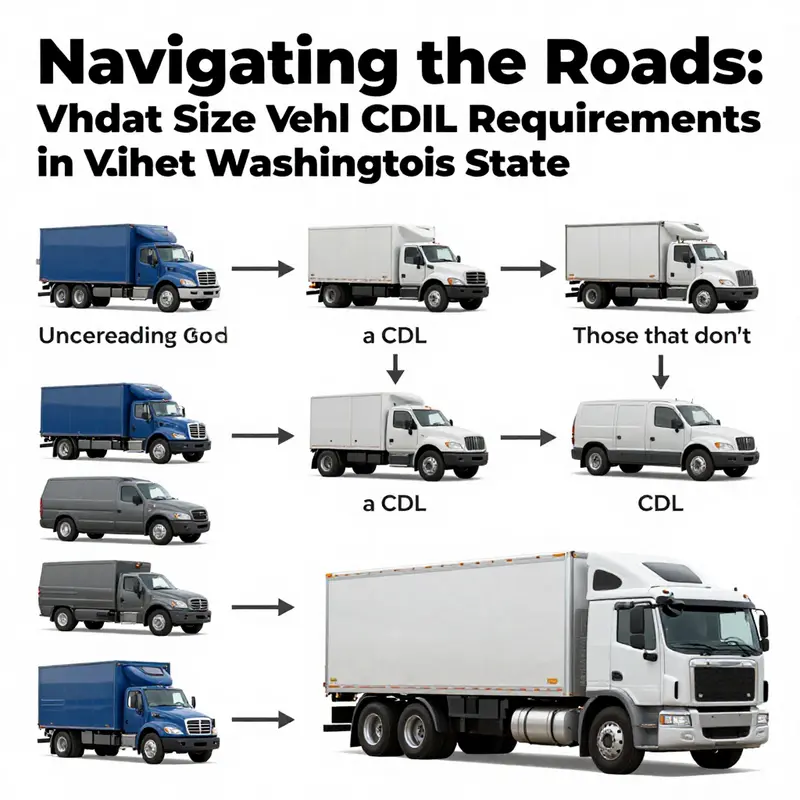
When people think of a Commercial Driver’s License, they picture long-haul trucks or buses. But CDL rules hinge on clear thresholds, not impressions. In Washington, as in the rest of the United States, a CDL is required by weight and by how the vehicle is configured. A single vehicle with a GVWR of 26,001 pounds or more generally requires a CDL. For combination vehicles, the total GVWR of the towed units plus the tractor must exceed 26,001 pounds and the towed unit must have a GVWR over 10,000 pounds. A vehicle designed to transport 16 or more passengers, including the driver, also requires a CDL regardless of weight. If hazardous materials requiring placards are involved, a CDL is required regardless of GVWR. These rules align with federal standards and are adapted by Washington. Class A covers most heavy combinations; Class B covers single vehicles over 26,001 pounds; Class C covers vehicles not meeting A or B but carrying 16 or more passengers or hazardous materials. The practical effect is that a license is tied to vehicle weight, configuration, passenger capacity, and cargo type, guiding training and endorsements. For the latest details, always check the official Washington CDL requirements page.
Sizing the Line: When Vehicle Weight and Purpose Trigger a CDL Requirement
Regulatory Framework and Practical Thresholds for CDL Coverage
Understanding when a vehicle requires a Commercial Driver’s License (CDL) hinges on a few measurable, enforceable factors: weight ratings, passenger capacity, and hazardous materials. These criteria are designed to match driver qualifications with the responsibilities and risks of operating larger or specialized vehicles. The regulatory framework set by federal authorities establishes clear numerical thresholds, while state agencies apply and sometimes expand on those rules. Together, they determine which drivers must hold a CDL and which may operate with a standard driver’s license.
At the center of the federal standard is the Gross Vehicle Weight Rating, or GVWR. GVWR is the maximum rated weight of a vehicle as specified by its manufacturer. It accounts for the vehicle itself plus the maximum load it is designed to carry: cargo, passengers, fuel, and accessories. The Federal Motor Carrier Safety Administration (FMCSA) draws a hard line at a GVWR of 26,001 pounds. Any single vehicle rated at that weight or higher requires the driver to hold a CDL. In practical terms, this threshold captures most class 3 and higher commercial trucks, many box trucks, straight trucks used for freight, and numerous specialty vehicles built on heavy chassis.
The federal rules also extend beyond single-vehicle weights to cover combinations: when a vehicle and one or more trailers are coupled, the combined weight matters. If the towed vehicle has a GVWR greater than 10,000 pounds, and the total combined GVWR of the combination exceeds 26,001 pounds, a CDL is required. This combination rule is particularly important for tractor-trailers and common commercial setups such as trucks pulling trailers with heavy equipment or cargo. A light-duty pickup towing a small trailer will not trigger a CDL, but a medium-duty truck towing a trailer whose GVWR surpasses 10,000 pounds could.
Passenger capacity is the second major trigger. Any vehicle designed to transport 16 or more passengers, counting the driver, requires a CDL to operate. This passenger threshold captures small buses and larger passenger vans used in commercial contexts—school buses, shuttle buses, and many transit vehicles fall under this rule. When passenger numbers meet or exceed 16, special driver qualifications and endorsements become mandatory to ensure safety and competence in transporting people.
The third federal trigger involves hazardous materials. A vehicle used to transport hazardous materials in quantities that require placarding under federal hazardous materials regulations requires the driver to possess a CDL with the appropriate hazmat endorsement. These materials span a wide range of substances: flammable liquids, corrosives, explosives, gases, and certain wastes. The mere presence of placards indicates a regulatory threshold has been reached, and the driver must be tested and cleared to handle the risks associated with those loads.
Together, weight, passenger count, and hazardous cargo create a framework that captures the majority of situations where additional training, testing, and oversight are justified. But regulators recognize that vehicles and operations exist on a spectrum. As a result, there are specific classes of CDL—Class A, B, and C—each aligned with certain vehicle configurations and uses. Class A CDLs cover combination vehicles where the combined GVWR exceeds the federal threshold and the towed unit exceeds the 10,000-pound GVWR. Class B CDLs typically apply to single vehicles with GVWR of 26,001 pounds or more, or smaller combinations where the towed vehicle remains under the 10,000-pound mark. Class C covers vehicles that do not meet the weight thresholds for A or B but are designed to transport 16 or more passengers or carry placarded quantities of hazardous materials.
In practice, operators and fleet managers must translate these regulatory thresholds into daily decision-making. Consider a model box truck used by a delivery company. If the manufacturer rates its GVWR at 26,500 pounds, any employee driving that truck in a commercial capacity must hold a CDL. If the same company instead uses a lighter truck with a GVWR of 25,999 pounds, no CDL is required strictly based on weight—though passenger count or hazmat loads could still trigger a requirement. Equipment specifications, not actual loaded weight, are the deciding factor: GVWR is the manufacturer’s rating, not the current on-road weight measured by scales.
States administer the federal rules through their licensing agencies, and they often add clarifications or additional requirements. Washington State, for example, follows the federal GVWR threshold of 26,001 pounds for single vehicles and applies the same combination vehicle rule related to a 10,000-pound towed unit and the combined weight threshold. States may also define processes for testing, endorsements, and medical certifications that align with or expand on federal standards. Drivers should consult their state licensing authority to confirm procedural details, such as when a skills test can be waived, the frequency of medical certifications, and how state vehicle inspection rules interact with commercial operations. For more on how state-level decisions shape licensing, see this discussion of state rules impact on driver licensing.
There are operational gray areas that frequently generate questions. One common area of confusion is the difference between Gross Vehicle Weight Rating (GVWR) and Gross Vehicle Weight (GVW). GVWR is a static, manufacturer-declared rating. GVW is the actual weight of the vehicle and its load at any given moment. A vehicle with a GVWR below 26,001 pounds might be overloaded in practice, but the federal CDL threshold remains tied to GVWR, not momentary GVW. Enforcement officers may cite overload violations under weight enforcement statutes, but those violations do not, by themselves, change licensing requirements.
Another practical consideration is the relationship between commercial and non-commercial use. The CDL threshold applies based on vehicle characteristics and, in certain cases, the cargo carried—regardless of whether the vehicle is used for hire. That said, some exemptions exist for recreational vehicles, certain farm vehicles, and specific emergency operations. These exceptions are narrow and defined by statute. Drivers who operate vehicles that hover near the thresholds should verify whether any exemption applies before assuming a standard license suffices.
Endorsements add another layer. Even when a driver holds the appropriate class of CDL for a vehicle’s size or configuration, specific endorsements may be required. Examples include the passenger endorsement for vehicles transporting large numbers of people, the school bus endorsement with specialized training for transporting children, and the hazardous materials endorsement, which requires a background check in addition to testing. Endorsements ensure drivers receive training tailored to the specific risks posed by their vehicle or cargo. A driver with a Class B CDL but without a passenger endorsement may not legally drive a bus that meets the passenger threshold.
Testing and medical fitness standards aim to ensure drivers can safely handle larger vehicles and complex operating environments. CDL holders must pass both knowledge and skills tests. Skills tests include pre-trip inspection, basic vehicle control, and on-road driving. Medical certification is mandatory for most drivers operating vehicles that require a CDL; this certification confirms the driver meets vision, hearing, and general health standards necessary for safe operation. The frequency and type of medical oversight may vary by state, but the federal standard governs interstate commerce.
For fleet managers, compliance requires a robust approach to vehicle specification, record-keeping, and training. Knowing the GVWR ratings of each vehicle in the fleet is essential. When acquiring or modifying vehicles, managers must consider how changes affect CDL requirements. Installing heavier equipment, upgrading suspension, or changing body types can alter a vehicle’s rated GVWR and thus its licensing implications. Record-keeping must capture registrations, inspection reports, and driver qualifications to defend against enforcement actions. A missing endorsement or expired medical certificate can take a driver and vehicle out of service, creating operational disruption.
Enforcement carries real-world consequences. Driving a vehicle that requires a CDL without the proper license can lead to fines, out-of-service orders, and civil liability in the event of an accident. Employers can face penalties for knowingly allowing unqualified drivers to operate commercial vehicles. Insurance claims may be complicated or denied if the operator lacked required credentials. In addition to statutory penalties, the commercial driving record can be impacted by violations, affecting a driver’s employability and the employer’s insurance premiums.
The regulatory landscape evolves. Federal agencies periodically revise guidance on medical standards, endorsements, and testing protocols. Technological changes—such as electronic logging devices, advanced driver-assistance systems, and telematics—also influence how safety standards are enforced and how skills are evaluated. Staying current with FMCSA communications and state licensing updates is essential. The FMCSA website provides official, up-to-date information on CDL requirements and related regulations.
Ultimately, the decision of whether a vehicle requires a CDL rests on three measurable factors: the manufacturer-declared GVWR, passenger capacity, and the presence of placarded hazardous materials. Those clear benchmarks help drivers, employers, and regulators apply a consistent standard across a wide variety of vehicle types and uses. Yet the full picture includes state-specific processes, endorsement requirements, medical fitness standards, and operational practices that influence what drivers must do to remain compliant.
When assessing a specific vehicle, start with the manufacturer’s GVWR. Compare that rating to the 26,001-pound federal threshold for single vehicles. For combinations, check the GVWR of the tow unit and the towed unit. If the towed unit exceeds 10,000 pounds and the combined GVWR passes 26,001 pounds, plan for a Class A CDL. If the single vehicle exceeds 26,001 pounds but the towed unit is lighter, plan for a Class B. When passenger counts reach 16 or the vehicle carries placarded hazardous materials, ensure the appropriate endorsements are obtained. Confirm any state-specific nuances, and maintain medical and training records to match.
This approach—anchored in the GVWR threshold, combined weight rules, and passenger/hazardous material triggers—creates a practical, defensible process for determining CDL needs. It gives drivers the clarity they need to pursue the right credentials, and it gives employers a checklist to manage compliance. With accurate GVWR information and attention to endorsements and medical requirements, the line between standard and commercial driving becomes measurable and navigable.
For authoritative federal guidance on these thresholds and requirements, consult the FMCSA directly: https://www.fmcsa.dot.gov
Final thoughts
In conclusion, understanding what size vehicle requires a CDL license is crucial for compliance with Washington State’s driving regulations. By categorizing vehicles based on their weight and function, new drivers, existing vehicle owners, and auto dealerships can navigate the complexities of licensing with greater ease. Familiarizing oneself with these requirements not only enhances road safety but also ensures regulatory adherence, minimizing the risk of legal penalties. As the commercial transportation landscape continues to evolve, staying informed about licensing needs will remain a vital aspect for anyone involved in operating or selling large vehicles.