
Understanding the complexities of driving company vehicles with a restricted license is essential for new and existing drivers, vehicle owners, and auto dealerships alike. As restrictions on licensed driving vary, recognizing the legal implications and the potential consequences of non-compliance is crucial. This article delves into several key aspects: the restrictions placed on drivers regarding company vehicles, the legal implications of driving with a restricted license, the responsibilities of companies when their employees drive under these conditions, and an overview of how regulations differ across various jurisdictions. By carefully exploring these elements, readers will gain a comprehensive understanding of their rights and obligations.
When the Badge Binds the Wheel: Navigating Company Vehicles with a Restricted License
The moment a company vehicle slides into view, a customary sense of opportunity often mingles with a quiet, practical tension. A vehicle at work is not merely a tool for transport; it is a responsibility enacted on the road. In this chapter, we explore a question that sits at the intersection of law, ethics, and everyday logistics: can you drive a company vehicle with a restricted license? The short answer, in most jurisdictions and under most regulatory frameworks, is no. But the real value lies in understanding why that answer exists, how it affects both employee and employer, and what pathways exist when a restriction feels like a barrier rather than a barrier that can be navigated with care.
At the heart of the issue is a straightforward principle: your license is the document that declares the scope of your driving privileges. The category listed on your license—whether it is a light-vehicle category, a passenger vehicle category, or a commercial vehicle category—defines what you are legally allowed to drive. A restricted license narrows that scope further. Restrictions can arise from a variety of sources: past violations, medical conditions that affect driving ability, or procedural cautions intended to keep the road safer for everyone. In practice, a restricted license often comes with constraints such as limited driving hours, geographic boundaries, or the obligation to use devices or measures designed to curb risk. The implication for employment is not incidental. When a company asks an employee to pilot a vehicle that surpasses their licensed scope, it steps into a line where legality and risk management collide.
The logic is simple and the principle universal: the license determines the vehicle, not the employer’s policy or the company’s want-to. If the license specifies a category that covers small passenger cars, that license cannot be stretched to cover a mid-sized van, a delivery truck, or any heavier vehicle simply because the employer needs someone to drive it. The material consequences extend beyond personal legal exposure. Insurance coverage—already a mosaic of conditions and exclusions—can be invalidated if a driver operates beyond the licensed scope. In many jurisdictions, insurance policies respond to a mismatch between a driver’s actual license category and the vehicle being operated with a kind of dissonant caution that can leave both driver and company exposed after an accident. The regulatory environment is designed to prevent precisely these mismatches: to keep the vehicle, its occupancy, and its load within the defined boundaries of license categories. When a category does not match the vehicle, the legal and financial penalties that follow are not mere formalities; they are real, tangible costs that can ripple through a company’s operations.
The practical implications become clearer when we consider the typical structure of restricted licenses. A license that has been restricted due to prior violations may also impose limitations on nighttime driving, on driving in certain zones, or on the use of ignition interlocks and other monitoring devices. A probationary license—including temporary or provisional variants—often includes additional conditions designed to ensure the driver accumulates safe experience without assuming high-risk exposure. In many cases, these conditions map directly to the types of vehicles a person is allowed to operate. For instance, operating a heavy or specialized vehicle like certain buses, trucks, or large passenger vans may be explicitly prohibited for someone with a restricted category, even if the person is employed and the employer has a fleet that would benefit from the driver’s presence. The risk, as policymakers and safety advocates emphasize, is not only the potential for an accident but the cascading risk of inadequate insurance coverage, gaps in risk management, and the erosion of a company’s compliance posture.
This is more than a technical issue; it is a culture question within organizations. Employers bear a dual responsibility: to uphold legal compliance and to maintain a safety-first ethos that protects employees and the public. When a company authorizes an employee with a restricted license to operate a vehicle, it effectively shifts some of the burden of risk management onto the employee, but the ultimate liability often remains with the organization. The legal landscape in many jurisdictions codifies this dynamic. If an accident occurs while an employee drives beyond the license’s scope, the company may face regulatory penalties, civil liability, and insurance consequences. The driver, meanwhile, faces personal exposure—fines, points on their record, and possible impairment of future licensing prospects. The larger consequence is a chilling effect on organizational safety culture: when corners are cut, the entire fleet’s integrity is compromised.
The moral and practical path forward is not denial but alignment. Most organizations recognize that their fleet is a strategic asset that requires careful governance. This means clear, documented policies that align with the license categories of every driver. It means validating each driver’s current licensing status before assigning tasks that involve specific vehicle types. It means ongoing education about what restrictions mean in practice and how to translate policy into daily decision-making when a route, a client, or a budgetary constraint would tempt someone to push boundaries. It also means building a culture of transparency, where drivers feel empowered to speak up when a role, a vehicle assignment, or a route might exceed their licensed scope. In this context, the HR department and fleet management teams play a central role. They are the gatekeepers who translate regulatory requirements into practical steps for operation. They can advise on whether accommodations are possible—such as reassigning a driver to a role that better matches their license, or seeking formal approvals for exceptions—while maintaining a robust basis of safety and legality.
For individuals navigating this landscape, there are concrete steps that preserve both personal integrity and professional viability. First, verify your license category and any restrictions with the issuing authority, and cross-check this against the vehicle you are asked to drive. This is not a one-off verification but a standing practice; licensing status can change, sometimes without obvious signs, and the vehicle landscape within a company can shift with new contracts, clients, or regulatory updates. Second, initiate a conversation with HR or the fleet manager if you believe your role might outstrip your licensed scope. There is no stigma in acknowledging a mismatch. Rather, it is a responsible act aimed at safeguarding everyone involved. Third, pursue a formal path to adjustment if possible. Depending on the jurisdiction, there might be a process to remove or alter restrictions, or to reclassify a vehicle’s category within the company fleet. This path, while sometimes slow and procedurally heavy, provides a legitimate route to align employment needs with licensing realities. It is not a shortcut; it is a legitimate, auditable process that shores up the company’s compliance posture and reduces the likelihood of later disputes when something goes wrong.
In this intricate equation, it can be helpful to consider how broader regulatory guidance frames the relationship between driving privileges and employment. In many countries, the legal framework emphasizes that driving privileges are not merely a personal convenience; they are a public safety instrument. The responsibility to operate a vehicle extends beyond the individual to the organization that employs and deploys that vehicle. The same logic that governs routine compliance—keeping records up-to-date, ensuring vehicles match the driver’s capabilities, and maintaining clear lines of accountability—also governs insurance and liability. When a company fails to observe this logic, the risks extend beyond the individual driver to the company’s bottom line, brand reputation, and operational continuity.
To ground this discussion in practical policy context, consider how a practical, policy-informed approach would unfold in a typical corporate setting. A driver with a restricted license is mapped to a role that aligns with their current category. The fleet manager confirms the vehicle types in the company’s fleet and ensures the vehicle assigned to the employee falls within the license scope. If the job requires vehicles beyond that scope, the organization either reassigns the employee within the existing safety framework or initiates a formal process to adjust licensing or vehicle eligibility. This approach protects the employee from personal liability and stigma, and it protects the company from regulatory exposure and insurance complications. It is a measure of good governance, not a punitive stance.
Within this framework, it is useful to recognize the broader guidance available to organizations as they navigate the licensing landscape. For a general understanding of how licensing restrictions intersect with employment and vehicle use, the U.S. Department of Transportation provides a comprehensive baseline. While the specifics differ by jurisdiction, the underlying principles are consistent: driving privileges are category-bound, vehicle operation must reflect those categories, and employers share a responsibility to ensure compliance and safety across their fleets. For those seeking official guidance, see the broader policy context at https://www.transportation.gov/. This external resource offers a panoramic view of how driving restrictions can affect employment and vehicle use, helping organizations develop robust, defensible policies that protect workers and reduce liability.
Within the domestic fabric of state and local regulations, there is also a useful pathway for employees and employers: consult the state rules that shape driver licensing. A concise reference point is available through the resource on state rules impact on driver licensing, which helps interpret how different jurisdictions treat restricted licenses in employment contexts. This internal anchor provides a practical doorway to understanding jurisdiction-specific nuances while keeping the central principle intact: a restricted license limits what you can drive, not just what you want to drive. For readers who want a direct route to the policy discussion that informs workplace decisions, the internal link offers a gateway to the deeper regulatory context: state rules impact on driver licensing.
The chapter thus closes not with a simple prohibition but with a clear, workable approach to harmony between licensing realities and organizational needs. A company can, and should, deploy its fleet with due regard for legal categories, risk management, and ethical considerations. An employee can, in turn, seek clarity and pursue an appropriate path that preserves both career momentum and safety on the road. In all cases, the central thread remains steady: the license category is the compass, the vehicle is the instrument, and the company’s safety culture is the frame that keeps the journey secure and lawful. By respecting license boundaries, employers safeguard their people, their assets, and the communities they drive through every day. The result is not only regulatory compliance but a stronger, more responsible corporate ethos that turns a potential point of friction into a shared commitment to safety and integrity on the road.
License Limits, Not Company Policy: Navigating the Legal Tightrope of Company Vehicles
In the operational heartbeat of any fleet, the license you carry is more than a credential. It is a legal boundary that defines not only what you may drive, but where your responsibility begins and ends. When a company assigns a vehicle to an employee, the assumption is usually smooth and practical: a driver will perform the job with the vehicle that fits their tasks. But the truth is more sobering. The vehicle you are authorized to operate is constrained by the categories and restrictions on your driver’s license. In jurisdictions with strict licensing structures, such as those described by the guiding rules of the China Ministry of Public Security – Traffic Management Bureau, the approved driving category on your license is the single source of truth. It is not the company’s policy, and it cannot be bypassed without consequence. This truth reverberates through every successful fleet operation and, if ignored, it can trigger a cascade of legal, financial, and operational hazards that threaten individuals and organizations alike. The chapter that follows is not a rhetorical warning but a practical examination of what happens when restricted credentials collide with fleet needs, and how both employees and employers can navigate that collision with clarity, accountability, and foresight.
At the core of the issue lies the simple but often overlooked fact that licensing is category specific. A driver who holds a C1 license—a category that, in many regulatory systems, permits driving small passenger vehicles with up to nine seats and a length not exceeding six meters—cannot legally operate a vehicle beyond the scope of that category, even if such a vehicle sits in the company’s yard and awaits a duty roster. The moment a company assigns a larger vehicle to that driver, or a vehicle used for public transit or commercial haul that requires broader authorization, the operation steps outside the legally permissible boundary. The result is not merely an administrative error. It is an act that can be classified as illegal driving, with all that follows in terms of penalties and civil exposure. If a temporary or probationary license carries additional restrictions, the driver faces even more limitations, and the company faces the risk of regulatory sanctions if it knowingly permits or encourages noncompliant driving. These facts are not abstract. They translate into concrete legal claims, financial exposure, and reputational risk for both employee and employer alike.
The immediate consequences for an employee who drives a company vehicle while their license is restricted or suspended can be severe. In many jurisdictions, the act can constitute a criminal offense under traffic laws, especially if the restriction explicitly prohibits driving or if the license is in a suspended state. The penalties range from fines and increased insurance premiums to, in the most serious cases, potential jail time. The criminal dimension is not merely punitive; it carries with it a long tail of consequences that can affect employment prospects, driving records, and eligibility for future licensing. When an accident occurs under these conditions, the employee’s liability becomes more complex and the fault is often scrutinized through the lens of vicarious liability. In practical terms, while the employee might have thought they were simply fulfilling a work task, the law may treat the company as partially responsible for actions that occurred within the scope of employment, especially if the employer knew or should have known of the driver’s license limitations. Civil lawsuits can follow, with property damage, bodily injury, or worse forming the legal backbone of claims that can strain a company’s finances and resources.
From the employer’s perspective, the stakes are equally high, though the contours differ. Commercial auto insurance is designed to cover typical operating risks, yet it can encounter gaps when a driver operates beyond their licensed scope. Insurers may challenge whether coverage applies when the vehicle is operated by someone who is not legally authorized to drive that class of vehicle. In the worst cases, coverage may be refused, leaving the company exposed to out-of-pocket settlement costs and extended litigation. Beyond the risk of a single accident, there is a broader duty of care: employers are responsible for ensuring that employees are legally permitted to operate company vehicles. This includes rigorous verification of licenses before any vehicle handover and ongoing monitoring to detect changes in license status. In industries with higher regulatory oversight—such as trucking, logistics, or passenger transport—records must be maintained to evidence compliance with driver qualifications. Negligence in this area can invite enforcement actions by regulatory bodies and create a regulatory paper trail that damages corporate integrity and operations.
The practical response to these risks is not a theoretical policy in a handbook, but a disciplined approach to licensing verification and fleet governance. Employers should build processes that verify the license category and status of every driver before they are authorized to operate a company vehicle. This goes beyond a one-time check at onboarding; it requires ongoing verification, especially in environments with frequent license renewals, suspensions, or changes in driving privileges. A strong policy should mandate that any driver who acquires a more advanced license category must immediately notify the fleet or HR team and transition to the vehicle class that matches the new authorization, with corresponding training if necessary. Conversely, drivers who discover limitations or changes to their license should report them promptly, recognizing that continued operation beyond limits is not a management issue to be resolved later, but a direct violation of law with immediate consequences.
To translate these obligations into everyday practice, many organizations adopt a layered risk management approach. At the first layer is license verification—the foundational gate that determines who can drive what. This includes checking the exact category, the validity period, any suspensions, and the specific conditions attached to the license. A second layer focuses on vehicle assignment and job design: ensuring that the portfolio of vehicles within a driver’s responsibility aligns with their official driving authority. If a job requires a vehicle beyond the driver’s current license, the organization must reassign the task, arrange for the driver to upgrade their license, or provide a different vehicle better suited to the driver’s category. Third, a documented policy layer drives accountability. Clear rules about who may drive which vehicle, under what circumstances, and how violations are dealt with should be included in fleet handbooks, training modules, and performance management processes. This policy layer should be complemented by practical controls, such as routine spot checks, automated license status alerts, and explicit consequence frameworks for violations. The overarching aim is to create a corporate culture where license compliance is seen not as a bureaucratic burden but as a shared commitment to safety, liability reduction, and sustainable business practice.
The narrative becomes even more persuasive when grounded in real-world implications. Consider a driver with a restricted license who is asked to operate a larger vehicle or a commercial bus-type operation. The employee may refuse, citing legal restrictions and personal risk, yet the company may still face operational disruption if the driver is essential to the schedule. In such moments, the best answer is not pressure but a well-prepared contingency plan. A robust fleet operation will include alternate assignments that fit each driver’s license category, and a process to escalate when a vehicle requires capabilities beyond a driver’s current authorization. The policy should also recognize the potential need for temporary license upgrades, providing directions on how to pursue such upgrades, what training is required, and how long the process typically takes. This keeps operations moving while preserving legal compliance and protecting all parties from unintended consequences.
Interwoven with these operational considerations is the ethical and professional dimension. Drivers are professionals who accept responsibilities along with their duties. When a driver holds a restricted license, there is an implicit understanding that the vehicle assigned must be commensurate with their authorization. Employers, in turn, owe a duty to their workers to ensure that the work environment, including the vehicle fleet, does not demand more than the license allows. When either side breaches this trust, the consequences can reach far beyond a single courtroom or a single insurance claim. They can affect team morale, public trust, and the organization’s long-term ability to attract and retain qualified drivers. A culture of compliance, reinforced by leadership and reinforced by consistent procedures, creates stability in the fleet. It ensures that every drive is a legitimate act under the law and a safer, more predictable contribution to the company’s operations.
The chapter’s focal point—whether a person can legally drive a company vehicle with a restricted license—must be answered with a clear stance: the license governs the vehicle, not policy dictates. Company policy cannot authorize actions that the license prohibits. This is not merely about avoiding penalties; it is about aligning business operations with the social contract that binds the road, the employer, and the employee. For readers seeking authoritative confirmation, consult official guidance from the licensing authority referenced earlier. The core message remains unchanged: match the vehicle type to the official driving category, and never substitute policy for license law.
For further context on how state and national rules shape driver licensing, readers can explore resources that discuss how regulatory environments influence licensing beyond simple category definitions. To link this discussion to broader industry practices, consider reviewing a resource that addresses how state rules impact driver licensing and how fleets navigate these rules in daily operations. state rules impact on driver licensing.
Finally, while the domestic specifics matter, the underlying principle travels across borders: licensing is a public trust, and it requires careful stewardship by both workers and their employers. The legal and financial stakes, as well as the human costs, are too high to treat license restrictions as mere administrative hurdles. The prudent path is transparent licensing verification, alignment of vehicle assignments with official permissions, proactive training and upgrade opportunities, and a governance framework that treats compliance as a shared duty, not a punitive policy constraint. In any fleet, the goal is to keep every trip legal, every driver safe, and every employer protected from unnecessary risk. The question remains, in every operational decision: does the vehicle fit the driver’s license? If the answer is not a confident yes, then the path forward must be adjusted—fast, fair, and firmly rooted in the law—to ensure that the journey ahead is lawful, efficient, and responsible.
External resource for broader licensing requirements and case studies can be found here: https://www.dmv.org/vehicle-accidents/driver-licensing-requirements.php
Provisional Licences and Company Vehicles: Navigating the Rules
A provisional licence is not a universal pass to drive any vehicle. In most jurisdictions, the licence category determines the vehicle type and use, not the employer’s policy. This principle means a company cannot assume permissive driving rights for a provisional holder simply because the vehicle is part of a corporate fleet.
In practical terms, a provisional driver may operate a company vehicle only within the limits set by the licence category and the additional provisional conditions, such as displaying a P plate, speed restrictions, and lane restrictions. Common rules include a capped speed (for example, up to 70 km/h where posted), restrictions on certain lanes, and in some cases prohibitions on carrying passengers for certain classes of vehicle. These constraints are designed to curb risk while the driver gains experience.
From an employer’s perspective, the duty of care requires verifying that the driver’s licence explicitly covers the vehicle category and that insurance coverage accommodates provisional drivers. Internal fleet policies may set gating criteria (which vehicles can be assigned, what training is required, etc.), but they cannot override licensing limits or create lawful operation beyond the licence scope. If a mismatch exists—such as assigning a larger vehicle to a provisional driver—risk increases for accidents, insurance disputes, regulatory penalties, and reputational damage.
To manage this risk, organisations should implement clear controls: confirm licence type before vehicle assignment, ensure P-plate and other provisional requirements are observed, document supervised driving periods if required, and provide pathways for upgrading licensing when job tasks exceed current permissions. When in doubt, reassign the driver to tasks that align with the current licence or sponsor the upgrade through the relevant licensing authority.
For readers seeking broader context, licensing rules vary by region, but the core logic remains: the ability to drive is tied to licensure, not to policy or fleet convenience. Companies can train, monitor, and restrict assignments, but they cannot upend licensing limits. Always consult official licensing and insurance guidance in your jurisdiction, and if possible, coordinate with risk management and HR to ensure consistent compliance across the fleet.
Boundaries of Permission: License Categories and Company Vehicle Use
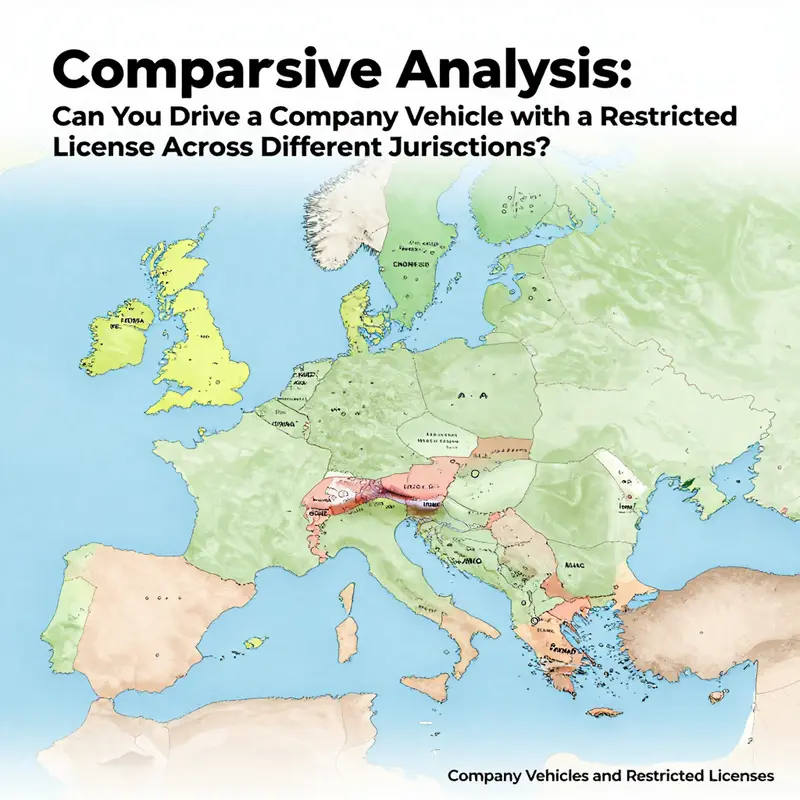
A driver’s license is a map of permission, not a promise. The category and status determine which vehicles a person may operate. Even if an employer provides a vehicle, driving a vehicle outside the licensed category is illegal. In corporate fleets, licensing aligns with road safety, training, and risk management. For instance, a C1 or equivalent passenger-vehicle license authorizes certain vehicle types and passenger capacities but does not permit operating large commercial buses, heavy trucks, or oversized vans. Temporary or restricted licenses carry additional constraints that must be respected. Companies must verify license categories against the vehicle types and service contexts used in daily operations. When a mismatch is found, the driver should refuse the task, request reassignment, or pursue license upgrade. Employers face potential penalties for enabling illegal operation and for failures in insurance coverage if the vehicle is used beyond the license scope. Licensing compliance protects public safety and protects the organization from liability, fines, and reputational damage. Practical steps include maintaining up-to-date license records, internal audits of vehicle assignments, and clear guidelines about which vehicles may be used by which employees. If the job requires a different vehicle type, upgrade or reassign rather than violate the law. The central takeaway is simple: license boundaries define what you can drive, not employer policy alone. The note for readers is to pursue appropriate training and licensing trajectories when moving to larger or more complex vehicles, and to align fleet planning with the legal framework rather than attempting to shortcut it. In short, as long as the vehicle type stays within the license scope, operations can proceed; if it does not, pause and adjust to stay compliant.
Final thoughts
In conclusion, the ability to drive a company vehicle with a restricted license is a nuanced subject governed by specific laws that vary by region. Understanding these regulations is vital for both drivers and employers to ensure compliance and avoid legal repercussions. New and experienced drivers should always verify their license limitations before operating any vehicle and remain aware of what their respective licenses permit. Employers also bear a significant responsibility to enforce these regulations and protect their employees from legal penalties. Proper awareness and adherence to these rules will promote safety and legality on the roads.