
Driving is an integral part of many professions, yet not all drivers enjoy the same privileges on the road. For individuals holding an occupational license, which typically allows limited driving post-suspension, using a company vehicle can quickly turn complicated. This article delves into the implications of driving a company vehicle with an occupational license, shedding light on the specific restrictions associated with such licenses. We will explore company policies that govern vehicle use, the legal ramifications of misuse, and best practices for employees navigating this intricate landscape. Each chapter will equip you with valuable insights to ensure compliance and safe driving.
Between Restrictions: The Real Implications of Driving a Company Vehicle on an Occupational License
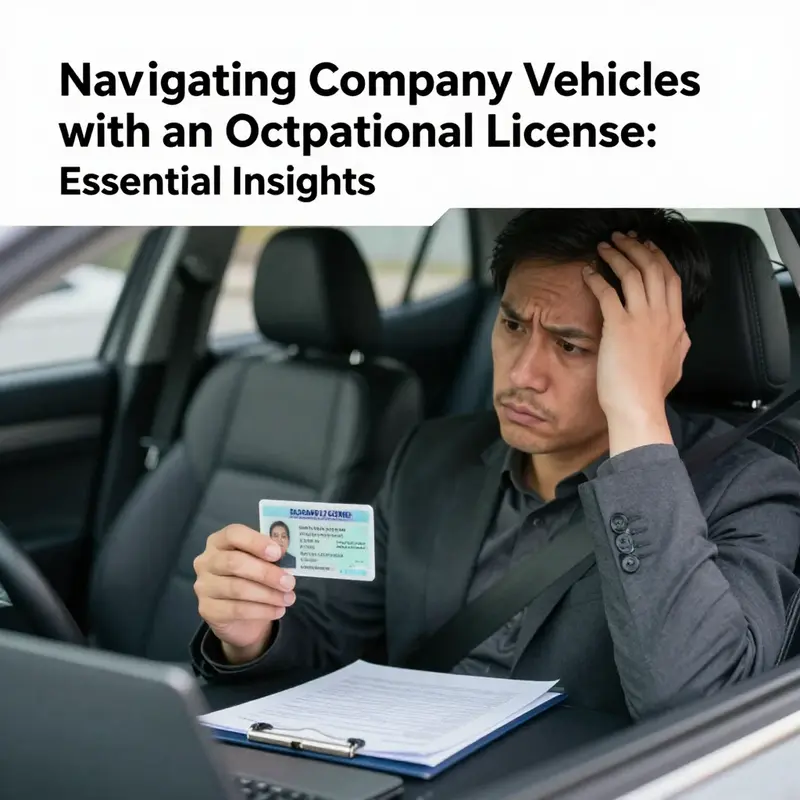
When a person carries an occupational license, the question of driving a company vehicle quickly shifts from a simple yes-or-no to a careful assessment of risk, legality, and organizational policy. An occupational license is not a blanket permission to operate any vehicle at any time. Instead, it is a tailored set of conditions that aim to balance the individual’s need to stay employed with the broader obligation to keep roads safe. The Cambridge English Corpus describes such a license as “a condition which may, now or in the future, affect their safety as a driver.” That framing matters because it highlights the core truth: restrictions exist for good reason. They may limit driving hours, the types of vehicles one can operate, or require ongoing medical monitoring. The person who holds an occupational license often does not have the same latitude as someone with a standard, unrestricted license. And when that person is asked to drive a company vehicle, the regular expectations about safety, legality, and accountability collide with the specialized terms attached to the license. This collision is not simply theoretical; it translates into concrete consequences for the driver, the employer, and the broader organization’s risk profile. It also demands a practical, policy-driven approach from both sides of the employment equation, because the simplest path—assuming the occupational license covers every necessary driving task—almost always proves too optimistic.\n\nThe distinction between a standard license and an occupational license lies at the heart of this discussion. A standard driver’s license grants broad authority to operate vehicles for a wide range of purposes, including work-related tasks. An occupational license, by design, carves out exceptions that facilitate essential movement—such as commuting to a workplace, attending court appearances, or keeping medical appointments—while constraining other driving activities. The precise terms depend on jurisdiction, and the license may impose limits on hours, vehicle classes, or the conditions under which driving is permitted. In practice, these restrictions are intended to prevent unsafe situations arising from medical, psychological, or situational factors that could impair driving ability. For the employer, this means the vehicle being used in a professional context could be operated by someone whose license status already flags heightened risk. For the employee, it means every drive must be evaluated against the explicit boundaries of the license. The gap between a typical workday’s demands and the letter of an occupational license is where problems begin if not managed with care and clarity.\n\nCompany vehicle use sits at the intersection of professional obligation and regulatory limitation. Driving a company vehicle is a work function, and most employers will expect employees to hold a full and unrestricted license to perform that function. Even if an occupational license permits driving to the workplace or to essential appointments, it does not automatically authorize operating a corporate vehicle. The vehicle may be categorized as a commercial asset, and the company’s risk management framework will typically require adherence to a standard licensing threshold as part of its driving policy. Beyond the license itself, the employer’s internal policies will dictate who may drive what, under which circumstances, and for which tasks. This means that a driver who is otherwise eligible under an occupational license could be blocked from operating a company vehicle if the license’s terms do not clearly cover commercial or fleet use. The friction here is real: the individual’s need to work and the company’s need to minimize risk can pull in opposite directions unless both sides align on policy and practice.\n\nLegal and policy compliance form a core axis of this alignment. Most occupational licenses are issued for personal, non-commercial use, with the expectation that the holder will minimize risk while fulfilling essential obligations. The moment a company vehicle enters the equation, the license terms must be reconciled with corporate policy and with applicable law. If the license does not authorize driving a commercial or company vehicle, any attempt to operate such a vehicle can breach both law and policy. The consequences are not theoretical either. Should an accident occur, the driver could face personal liability since their actions would be unauthorized. Insurance coverage may be compromised or voided if the driving activity fell outside the license’s terms, leaving the company exposed to significant financial exposure. The employer, in turn, could confront regulatory penalties, increased insurance premiums, and reputational damage for failure to enforce appropriate controls. In such an environment, the only safe path is explicit, documented permission grounded in a clear understanding of what the occupational license allows and what it forbids, coupled with a policy that states who may drive company vehicles in specific circumstances.\n\nThe potential consequences of non-compliance are stark and multifaceted. Personal liability is perhaps the most immediate concern for the driver who chooses to operate a company vehicle while their license is restricted. Even in the absence of an accident, the mere act of driving outside the license’s terms can be deemed negligent and open the driver to civil claims. Insurance coverage is another critical risk; most standard auto policies include exclusions for driving a company vehicle by someone who lacks a full, valid license or who is driving beyond the license’s permitted scope. In such a scenario, the driver may bear the costs of an incident out of pocket, and the employer could face disputes with insurers about whether coverage should apply. Beyond the financial sphere, there is the organizational hazard: disciplinary action up to termination, damaged trust with colleagues, and the possibility that the company’s fleet management program will tighten, restricting access to vehicles for a broader group of employees. The net effect is a chilling reminder that license restrictions are not merely bureaucratic hurdles; they are practical safeguards with real-world implications for safety, insurance, and employment relationships.\n\nFrom an employer’s perspective, policy design and enforcement are central to mitigating risk. The best policies are proactive, not reactive. They require routine verification of license status, reinforcement of restriction protocols, and ongoing assessment of each driver’s fitness to operate a vehicle within the company’s fleet. This means timing license checks to reflect any changes in medical status, updating records promptly when a license is suspended or restricted, and ensuring that driving assignments conform to the license terms. A thoughtful policy also delineates the boundaries of permitted use clearly for all employees, linking these boundaries to the job’s actual duties. It is not enough to rely on trust; the reality of fleet risk demands structured processes, audits, and consistent reminders about the consequences of non-compliance. In addition, employers should consider training that covers the specific risks associated with occupational licenses and the steps to take if a driver’s license status changes. The aim is not to trap or stigmatize but to protect both the worker and the organization by ensuring that every driving task aligns with what the license allows and what the company expects.\n\nTo fold this discussion into practical terms, individuals who find themselves with an occupational license and a job that requires driving need a candid assessment of what is feasible. If the task at hand involves operating a company vehicle, it is essential to secure explicit authorization from HR and fleet management. The process should begin with a clear read of the license terms, followed by a formal decision that documents whether the license permits the specific driving activity. When in doubt, alternatives such as using public transportation, rideshare options arranged by the company, or deployment of non-driving personnel should be considered. The goal is to preserve employment opportunities without compromising safety or violating legal limits. For workers, this means communicating openly about restrictions, seeking guidance when a new assignment arises, and avoiding any decision that could put them beyond the license’s boundaries. For employers, it means maintaining an accessible record of who is authorized to drive, under what conditions, and for which vehicles, and reviewing the fleet usage rules regularly to ensure they remain aligned with evolving regulations and company risk tolerance.\n\nWithin this framework, the internal link to the broader discussion of state-level licensing rules becomes part of a practical toolkit. Local rules—the state rules impact on driver licensing—often create a patchwork of requirements that complicate whether a person may operate a company vehicle. By connecting the specifics of an occupational license to the wider rule set that governs driver eligibility, teams can design policies that are both legally compliant and operationally sensible. This is not a theoretical concern; it is a core component of how modern organizations balance workforce needs with safety and compliance. It also creates a pathway for employees to understand their rights and responsibilities, reducing the likelihood of inadvertent violations and the reputational damage that can accompany them. For further contextual grounding, consult the policy discussions and guidance that outline how medical conditions and similar restrictions interface with driving privileges, while keeping in mind that the exact terms will vary by jurisdiction and by organization’s risk posture. State rules impact on driver licensing.\n\nAs this chapter closes, the central truth remains clear: occupying an occupational license does not grant a free pass to drive a company vehicle. The license is a personalized safety protocol, and the company is responsible for enforcing it with discipline and care. The safest way forward is to treat occupational license restrictions as non-negotiable terms that shape work assignments, fleet access, and risk exposure. When both employer and employee acknowledge and respect those terms, they preserve safety on the road, compliance in the workplace, and the integrity of the organization as a whole. The practical takeaways are straightforward: verify license status before any driving task involving a company vehicle, align driving duties with the license’s authorized scope, and rely on formal policies that make exceptions a deliberate, well-documented choice rather than a spontaneous risk. If there is any doubt about what a license allows, pause the assignment, seek guidance, and opt for alternatives that keep the work moving without compromising safety or legality. For official guidance on medical conditions and licensing, see https://www.gov.uk/driving-licence/medical-conditions.
Under Lock and Wheel: The Limits of Occupational Licenses When Driving for Work
When questions arise about driving a company vehicle with an occupational license, the short answer often sounds like a firm no. An occupational license exists to restore a driver’s mobility after their privileges have been curtailed for specific reasons. It is not a broad permission slip to operate any vehicle, any time, or for any purpose. The typical intent behind an occupational license is to allow essential movement—commuting to work, attending court, seeking medical care, or fulfilling other narrowly defined tasks—while restricting broader driving privileges. In practice, this distinction matters a great deal for employees who are asked to operate a company vehicle. A company vehicle is not merely a slightly larger personal car; it is often a work tool, sometimes carrying passengers or equipment, and it frequently involves regulatory obligations, safety protocols, and insurance considerations that exceed ordinary personal use. Because of that gap between personal mobility and professional operation, most occupational licenses do not automatically authorize driving a company vehicle. The consequence is not just a potential policy violation; it is a collision of law, risk, and workplace policy that can jeopardize employment as well as safety on the road. To truly understand why, we need to look at what an occupational license is designed to permit, what it forbids, and how those rules intersect with the way most employers manage fleet usage and driver qualifications.
Occupational licenses are not a universal license to drive for any purpose. They are state-regulated documents that carry explicit, sometimes narrowly defined allowances. The line between what is permitted and what is prohibited is drawn by the issuing jurisdiction and reflected in the accompanying terms of the license. In many places, the license is expressly personal and non-commercial. It is designed to restore a driver’s ability to get to work and fulfill essential obligations, not to authorize the operation of commercial or business-owned vehicles. This distinction carries practical consequences for employers who rely on company vehicles as part of daily operations. Even if the license grants the right to drive to a workplace, it does not guarantee permission to drive a fleet vehicle. The company’s own vehicle-use policy, along with broader regulatory requirements, will typically determine whether an employee may use a company car while their license status remains restricted. Thus, the question to resolve is twofold: does the license explicitly permit driving a commercial or company vehicle, and does the employer’s policy align with that permission? If the answer to either part is no, the employee remains outside the authorized bounds for operating a fleet vehicle.
This boundary is not merely theoretical. It translates into concrete policy and practical risk. A standard, unrestricted driver’s license usually accompanies broad authority to work with a company vehicle. It signals to the employer, the insurer, and the regulatory bodies that the driver is fully authorized to assume the risks associated with operating a vehicle as part of their job. An occupational license, by contrast, signals a narrowed permission set. The vehicle-use policy that an employer enforces often presumes full license status as a baseline requirement. In many organizations, fleet safety programs, driver qualification processes, and insurance underwriting are built on the expectation that anyone behind the wheel is currently licensed without restrictions. When an employee presents an occupational license, the employer faces a compliance challenge: can the license be reconciled with the company’s risk management framework? The answer frequently pushes toward a conservative stance—one that errs on the side of ensuring fleet safety, proper coverage, and clear accountability for any incident that might occur while driving a company vehicle.
The broader context is essential here. Occupational licensing has expanded far beyond the professions most people associate with safety risk. The research shows that about 30% of jobs in the United States require some form of occupational license, a figure that has grown dramatically since the mid-twentieth century. This expansion reflects efforts to ensure minimum quality and safety standards in fields where substandard work could affect public health or safety. Yet this growth also creates friction for workers whose jobs do not involve inherently high-risk activities but who need mobility to earn a living. The tension is not simply about the presence or absence of a license; it is about how licensing regimes intersect with modern labor markets, transportation needs, and employer expectations. For an employee who relies on a company vehicle to perform essential tasks, the local rules and the company’s policy must align in a precise way. If they do not, the result can be costly: undelivered work, disciplinary action, or, worse, a vehicle might be used without proper authorization, potentially voiding insurance coverage and exposing the worker to liability.
Barriers created by occupational licensing extend beyond the license itself. The process of obtaining or renewing a license often involves long, costly, and time-consuming requirements. Applicants may need formal education, specific training, supervised work experiences, exams, and periodic renewals. These hurdles are especially daunting for individuals who balance work, family responsibilities, and limited financial resources. In professions with lower direct safety risk, reform proposals have argued for targeted licensing— retaining safeguards where they are truly needed while reducing burdens on workers in less risky fields. The Puerto Rico example illustrates how reforms might unlock greater economic potential by easing entry requirements without sacrificing public protection. When policymakers consider occupational licensing reforms, they confront a delicate balance: safeguarding public health and safety while expanding access to employment and mobility. The implications for driving a company vehicle rest squarely in the middle of this balance. If a jurisdiction narrows the scope of license requirements or offers streamlined credentials that can still align with fleet safety standards, employers and employees both gain clarity and predictability about what is permissible on the road.
In practical terms, the permission to operate a company vehicle is a function of both law and policy. Some jurisdictions recognize temporary restricted or occupational licenses and provide limited driving rights under defined circumstances. These arrangements, often labeled as temporary restricted licenses, can add nuance to what is permissible on the road. Yet even when such licenses exist, they rarely translate into blanket authority to drive a commercial vehicle. The fleet remains governed by insurance terms, vehicle-safety rules, and the employer’s internal standards. These realities underscore a core truth: a license is not the only gatekeeper when it comes to driving a company vehicle. The license is one piece of the puzzle, but the company’s policy, the insurance framework, and the specific duties of the job all set the ultimate boundaries.
For readers seeking a clearer map, a careful reading of how state rules impact driver licensing is essential. Those rules vary by jurisdiction, and their interpretations can shift with changes in law or policy. A driver who holds an occupational license must consult the license terms to determine whether commercial or fleet operation is included. Then, they must consult their employer’s vehicle-use policy, which often requires a full, valid, and unrestricted license as a baseline condition for driving any company-owned vehicle. In many workplaces, the gap between personal mobility and professional operation is treated as a risk management issue rather than a simple administrative concern. Employers may require drivers to use alternative arrangements—such as ride-sharing, public transit, or a designated, licensed fleet operator—when an employee’s license status falls into a restricted category. This approach protects the company’s insurance coverage, reduces the likelihood of policy violations, and preserves the safety standards relied upon by customers and co-workers alike.
A prudent path for anyone navigating this terrain begins with open communication. Before stepping behind a wheel, an employee should discuss their license status with human resources, fleet managers, and their supervisor. They should obtain explicit written permission to operate a company vehicle if such permission exists under their license terms. If the license does not authorize fleet driving, the employee should propose alternatives or request a pathway to upgrade their license status, if feasible. Employers, in turn, must translate policy into practice with consistency. They should document eligibility criteria for fleet operation, ensure that insurance and risk management practices reflect those criteria, and provide training focused on fleet safety for any employee who might be responsible for driving a company vehicle. In short, the question is not simply “Can I?” but “Under what conditions can I legally and safely drive for work?” The answer requires careful reading of the license, a review of the company’s policies, and ongoing collaboration between employee and employer to avoid missteps that could endanger people on the road and jeopardize employment.
For further insight into how these issues play out in different legal environments, see the discussion of state licensing rules and how they shape driver eligibility. A deeper dive into the relationship between occupational licensing and professional mobility reveals that reform efforts are often framed around enhancing opportunity while preserving essential protections. Understanding this context helps illuminate why a blanket permission to use a company vehicle with an occupational license is unlikely, and why both workers and managers must approach fleet driving with clarity, caution, and a shared commitment to safety. External resources offer concrete legal scaffolding to assist readers who want to explore statutes and case law in more detail. For a concrete legal framework in another state, see Washington state’s temporary restricted, occupational license provisions at https://app.leg.wa.gov/RCW/default.aspx?cite=46.20.391. In the meantime, the most reliable guidance remains the combination of license terms, robust employer policies, and a disciplined approach to fleet safety that keeps driving for work firmly within the bounds of law and policy. And when in doubt, pause, verify, and document, so that the road ahead remains safe for everyone who shares it.
Internal link note: this discussion aligns with the broader conversation about how state rules shape driver licensing and fleet use. For a related analysis of how state rules influence licensing outcomes, you can explore a deeper look at the broader policy landscape here: state rules impacting driver licensing.
Restricted Wheels, Regulated Roads: Why Occupational Licenses Usually Block Driving a Company Vehicle
The core question often returns with quiet inevitability: can a person drive a company vehicle on an occupational license? An occupational permit is not a full restoration of driving rights; it is a narrow exception. Employers generally require a standard license for fleet use, not a restricted one. The mismatch between a restricted license and fleet requirements creates risk, liability, and policy friction. Most jurisdictions treat the occupational license as personal and limited, not business-ready. The practical reality is simple: permission to drive is rarely transferable. This chapter unpacks why that is, and what policies do in practice. It looks at centralized management, accountability, and the narrow scope of permission. It also connects these policies to the decision employees face when offered a company vehicle.
An occupational license typically keeps driving privileges for essential tasks only. It often covers commuting, court appearances, or medical appointments, not routine business trips. It explicitly restricts type of vehicle, times of day, and distances. It may prohibit carrying passengers or operating commercial equipment without special permission. The license usually requires evidence of rehabilitation or minimal risk to public safety. Many drivers view it as temporary relief, not a door to full mobility. Within a company fleet, such limitations make driving duties contingent on restrictions. The core rule is simple: verify what the license allows. If the license omits commercial use, the path to a company vehicle remains closed.
In most organizations, fleet activity is managed through a central dispatch system. The planning department schedules, prioritizes, and tracks every trip through a formal process. Employees submit a written request detailing purpose, date, time, and destination. Managers review these requests, then central administration assigns vehicles by availability. Priority is guided by urgency, importance, and operational necessity. The system encourages combining trips to improve efficiency, reducing idle time. Private use is generally forbidden unless top management grants explicit permission. Unauthorized use triggers penalties, including fines or loss of employment. The discipline is designed to prevent drift from safety standards and insurance terms. The rules also reflect a broader commitment to transparency and accountability across the fleet. The dispatch process thus acts as both control mechanism and record of responsible usage.
The policy explicitly forbids personal errands with a company vehicle. Agencies often require the employee to bear the cost of private trips. The repercussions include financial penalties and potential termination. Managers emphasize corporate liability and risk management in every decision. Even routine fleet tasks require documented authorization and traceable approval. The dispatch system serves as a paper trail in case of audits. The goal is to limit wear, fuel costs, and exposure to accidents. The broader message is clear: ownership of the asset comes with disciplined usage, not personal convenience.
The responsibility of operating a company vehicle rests with a designated driver. Each vehicle is assigned to a specific driver who bears daily responsibility. The driver handles routine checks before and after trips. Pre-trip checks include fluids, tires, brakes, and lights. Post-trip reports capture any damage, unusual sounds, or safety concerns. Accountability extends to cleanliness and proper storage of the vehicle. Drivers must report problems immediately to administration, not later. A failure to report can trigger disciplinary action and insurance questions. Regular training reinforces safe practices and compliance with traffic laws.
Fuel management is tightly controlled through company resources. Many fleets use a fuel card that requires pre-approval for every fill. Location constraints may specify approved fuel stations and routes. Reimbursements require original receipts and per-diem documentation. Incorrect or falsified claims face heavy penalties, sometimes double the amount. Drivers track mileage for maintenance and budgeting purposes. The accounting process creates an audit trail for fleet expenses. Cost control remains a core driver of vehicle policy compliance. In practice, wasteful fuel use quickly erodes trust and budgets. The fuel discipline also reinforces the boundary between personal mobility and corporate assets.
Parking and security form another layer of protection around the fleet. Vehicles are parked in designated company locations with monitored security. Overnight storage at homes or private properties is usually prohibited. Drivers lock vehicles and safeguard keys when not in use. The parking policy reduces theft risk and unauthorized access. Security protocols extend to routine checks of parking facilities. Vehicles are rotated through standard bays to balance wear. Unauthorized parking outside approved areas triggers disciplinary actions. The policy aligns with insurance requirements and loss prevention strategies. Employees learn to view the fleet as a corporate asset rather than a personal vehicle.
Maintenance and repair procedures ensure reliability and safety. Maintenance must be pre-approved and performed at authorized service centers. Drivers report issues promptly to prevent large breakdowns. Emergency repairs require permission and thorough post-repair documentation. Regular maintenance schedules are tracked by the central office. Faulty parts or unsafe conditions trigger immediate action and recalls. The company keeps detailed logs for preventive maintenance and safety audits. Driver input guides long-term planning for fleet renewal. A transparent repair process fosters trust with insurers. The aim is steady uptime, not reactive fixes after incidents.
Safety is woven into every operation of the fleet. Drivers comply with traffic laws, speed limits, and seatbelt use. Alcohol and drug use are strictly forbidden before driving. Regular safety training reinforces risk awareness and decision making. Accident response prioritizes immediate aid and police notification. Insurance processes rely on accurate, timely reporting by the driver. Documentation ensures claims can be handled efficiently. The fleet thrives when drivers combine caution with courtesy on the road. The overarching discipline keeps the company out of legal and financial trouble.
A licensed driver is not just a credential; it is a formal employment condition. The company requires employees to maintain current licenses at all times. If the license lapses, the employee becomes ineligible to operate company vehicles. Accidents tied to an invalid license fall squarely on the employee. Driving without a valid license risks disciplinary action and termination. Unauthorized drivers face immediate dismissal, no exceptions. The policy extends to license suspensions, revocations, and related penalties. The financial exposure from incidents can bankrupt a business and ruin careers. Employees should actively monitor renewal timelines and compliance. This framework clarifies that occupational licenses are not interchangeable with fleet privileges. It also highlights the practical pathway employees must follow to align licensing status with job responsibilities.
For someone holding an occupational license, the path to fleet work is often clear but narrow. Seek a standard license before applying for fleet duties, or obtain explicit fleet approval when required. HR and fleet managers collaborate to clarify eligibility and policy constraints. A simple conversation with the supervisor can prevent costly mistakes. If a license is under review, temporary reassignment keeps safety intact while rules are evaluated. The dispatch system remains the ultimate arbiter of legitimate usage. Understanding the policy protects employees, the company, and the public. Readers will find further guidance by reviewing internal policies and external resources. The aligned approach helps teams plan, budget, and operate safely on the road.
External resource for broader context on driving safety standards can be found at https://www.nhtsa.gov/.
Navigating the Legal Pitfalls of Using Occupational Licenses for Company Vehicles
A concise examination of when a corporate fleet can operate under an employee’s occupational license, and the civil, administrative, and criminal risks of credential misuse. Licenses are personal and not transferable, and attempting to reuse or substitute a borrowed credential can expose the company to civil liability for damages, regulatory penalties, license suspension, and even criminal charges for forgery or fraud. Organizations should implement practical controls, such as verifying licenses against official registries, limiting vehicle access to properly licensed drivers, obtaining written authorization for any credential use, and documenting all credential-related actions in contracting and fleet governance. While outcomes vary by jurisdiction, the core principle is clear: credential integrity protects public safety, market trust, and legal compliance.
Driving with Limits: Navigating Company-Vehicle Use When You Hold an Occupational License
A company’s fleet is more than a collection of machines; it is a system that carries risk, responsibility, and the weight of policy. When an employee holds an occupational license, the tension between operational needs and legal boundaries becomes especially acute. An occupational license is designed to restore or preserve driving privileges for a narrow set of circumstances, typically personal and essential tasks, but it rarely mirrors the breadth of a full, unrestricted license. In the context of company vehicles, this distinction matters. The question is not only whether a person can physically operate a vehicle, but whether the license itself, and the employer’s policies, permit such operation in a work setting. The answer, in most ordinary circumstances, is that permission is not automatic and must be carefully navigated through verification, training, policy clarity, and ongoing oversight. Yet the reality of modern operations often requires employers to manage exceptions with care, balancing continuity of service with the obligation to maintain safety and regulatory compliance.
From the outset, the key principle is straightforward: occupational licenses are typically issued for restricted, non-commercial use. They are not substitutes for a full license, and they do not automatically authorize operating a company vehicle. Even when the license authorizes driving to and from a workplace or to attend specific court or medical appointments, it does not automatically cover the transport of passengers, equipment, or goods in a commercial context. This distinction—between personal, restricted use and professional, commercial use—frames every decision a company makes about who may drive its vehicles and under what conditions. Employers must align their vehicle-use policies with both the letter of the law and the spirit of safety culture that keeps roadways and work sites secure. In practice, the enterprise should not rely on an employee’s occupational license as a green light to operate a company asset. Instead, it should proceed through a disciplined process that confirms what is permitted and what is not, then translates that understanding into everyday practices on the job.
First and foremost, verification of licenses is nonnegotiable. A robust program begins with a formal check of each employee’s current license status, including any restrictions or endorsements that could affect vehicle operation. This is not a one-time step but an ongoing duty. Licensing landscapes shift; suspensions can arise from a variety of causes, and endorsements can alter the type of vehicle an employee may operate. Employers should proceed with a process that flags expirations, suspensions, or changes in privileges and integrates these alerts with human resources and fleet management systems. A modern approach combines periodic audits with automated status updates, ensuring that the driving eligibility of each employee remains aligned with the legal framework and the organization’s risk appetite. The verification process also requires attention to specifics beyond the broad category of “licensed.” Certain jobs demand endorsements for hazardous materials, passenger transport, or commercial vehicle operation. If an employee’s job tasks involve any of these activities, the license must be scrutinized for those particular endorsements, and any mismatch between job requirements and license privileges must be resolved before driving a company vehicle is allowed. In this light, a careful, documented verification process is not merely administrative routine—it is a shield against misalignment that could expose the employee, the employer, and the public to unnecessary risk. It also provides a clear record for audits and insurance reviews, demonstrating that the company does not authorize improper use of its assets.
Secondly, training is the bridge between a license and safe, compliant operation. Occupational licenses restrict timing and context, but they do not substitute for the practical, on-the-road judgment and vehicle-specific knowledge that professional driving demands. When an employee is cleared to drive a company vehicle under a restricted license, training must go further than general defensive driving. It should cover the company’s vehicle inspection procedures, the specific operational characteristics of the fleet, and emergency response protocols tailored to the work environment. Training should include scenarios that reflect real tasks—loading and securing cargo, interacting with customers or field teams, and navigating common work-site hazards. Maintaining a training log that records dates, topics, and attendees is not merely bureaucratic; it creates a tangible trail of accountability and a resource for audits or investigations. Importantly, the training should explicitly address the boundaries created by the occupational license. That means instructors must clarify what is and is not permissible under the license and how that translates into day-to-day driving tasks. When employees understand both the rights their licenses grant and the responsibilities they carry, the likelihood of inadvertent policy violations diminishes significantly, and the organization’s safety culture is strengthened.
Clear policies are the backbone that ties verification and training into consistent practice. A well-crafted policy makes explicit the prohibition of personal use of company vehicles, the conditions under which driving is allowed, and the disciplinary consequences of policy violations. It should also specify expectations around maintenance checks, reporting of mechanical issues, and the immediate cessation of driving if any licensing status change occurs. The policy must acknowledge the practical realities of how work gets done: sometimes drivers need to dash between sites, meet with clients, or run essential errands. The critical factor is clarity—employees should never have to guess whether a particular activity is permissible. They must be able to consult a concise set of guidelines that plainly distinguishes authorized activities from those that require alternative arrangements, such as using the employee’s personal vehicle (with appropriate insurance considerations) or arranging a different transport solution. The policy should also address the issue of alcohol and drug use before operating a vehicle, a non-negotiable safety norm that stands regardless of license type. Establishing this baseline helps prevent any ambiguity that could otherwise lead to unsafe decisions, and it safeguards both the individual and the organization from liability and reputational harm.
Monitoring license status is not an arcane control; it is a practical, proactive safeguard that supports continuity. For employees whose licenses are up for renewal or subject to disciplinary action, employers can implement proactive monitoring that flags approaching expirations and triggers timely reviews. A calendar-based alert system, combined with a defined escalation path, ensures that a lapse in driving privileges does not occur unnoticed. In addition, routine checks can capture changes in endorsements or the removal of restrictions, which, if discovered too late, could render a previously authorized driver in violation of policy. The monitoring process benefits from collaboration across departments—fleet management, human resources, safety, and legal—so that any licensing shift is interpreted through a consistent framework. This coordination is essential because it turns a potentially disruptive administrative cue into a controlled, reversible decision: if a license change alters the driver’s eligibility for a particular vehicle or task, the fleet can reassign duties or pause driving activities without compromising safety or compliance.
Equally important are open, transparent communication channels. Employees must know precisely where to report licensing concerns, vehicle defects, or questions about policy applicability. Management, in turn, must respond promptly with clear guidance, updates to assignments, or referrals to alternative transportation arrangements. Effective communication reduces the anxiety that often accompanies restricted-use scenarios and reinforces trust between staff and leadership. It also creates a feedback loop that improves policy over time. If drivers encounter recurring situations where the license status or endorsements complicate essential tasks, those patterns should prompt a policy review and, if necessary, adjustments to training content or verification procedures. The objective is not to polices- for-polices’ sake but to cultivate a practical, safety-forward approach that keeps operations moving while respecting legal boundaries.
Record-keeping ties all these elements together into a measurable, auditable system. Comprehensive records of licenses, training, vehicle inspections, and incident reports form the backbone of accountability. For the employee, these records provide confirmation that the company has acted with diligence and fairness. For the organization, they deliver defensible documentation in the event of audits, insurance reviews, or legal inquiries. The discipline of meticulous record-keeping also supports continuous improvement: trends in license-related incidents or near-misses can reveal gaps in training, gaps in policy interpretation, or fleet-specific risks that require attention. In short, a well-maintained archive is not a passive repository; it is a dynamic tool that helps the organization learn how to operate more safely within the constraints of occupational licensing.
Yet the practical reality remains that, in most jurisdictions, driving a company vehicle with an occupational license is not permitted unless the license explicitly authorizes commercial operation or the employer can demonstrate a legally compelling exception. The best-practice framework described here does not promise a loophole; it provides a path to safe and compliant operation where it might be necessary for organizational needs. In cases where the license’s scope and the vehicle’s role align—where, for example, a license includes a specific work-related endorsement or the job description involves tasks that the license legitimately covers—the formalized verification, targeted training, precise policy, proactive monitoring, and rigorous record-keeping become indispensable. For those readers exploring the variability of licensing rules across states, a helpful resource outlines how state rules can impact driver licensing and the permissibility of certain driving activities. You can refer to state-specific guidance here: state rules impacting driver licensing.
The conversation about occupational licenses and company vehicles cannot be reduced to a single rule or a one-size-fits-all solution. It requires a mature, nuanced approach that respects the letter of the law while acknowledging operational realities. When the organization commits to verification, training, clear policies, monitoring, communication, and meticulous record-keeping, it creates a culture where safety and accountability are visible in every mile driven. Employees understand the boundaries, managers understand the risks, and the fleet operates with a level of discipline that protects people, assets, and reputation. The result is not mere compliance; it is a sustainable practice that treats mobility as a managed capability rather than an unexamined privilege. And in the broader landscape of workplace safety and motor-vehicle regulations, this disciplined approach aligns with guidance from national safety authorities that emphasize preventive controls, clear communication, and evidence-based practices as foundations for preserving health and safety in the workplace.
For readers seeking broader context on how workplace safety standards intersect with licensing and vehicle operation, consider the guidance from the U.S. Department of Labor on occupational health and safety, which underscores the importance of structured programs to identify hazards, implement controls, and maintain a safe working environment. This external resource provides additional perspective on how organizations translate regulatory requirements into practical safety programs that protect workers and reduce liability in high-risk operational settings.
Final thoughts
Driving a company vehicle with an occupational license is fraught with complexities that require understanding both legal and company-specific regulations. The implications can affect your employment, personal liability, and insurance coverage. To navigate this challenging landscape, employees should familiarize themselves with occupational license restrictions and their employer’s vehicle policies. Staying informed and compliant is not merely about adhering to the law; it is essential for professional responsibility and safety on the road. Always prioritize understanding your legal status and company guidelines to drive responsibly and legally.