
The prospect of vehicle ownership often brings along a set of responsibilities, particularly in terms of legalities such as licensing. In China, one might be surprised to learn that registering a vehicle can be achieved without holding a driver’s license. This surprising fact is crucial for new drivers, current vehicle owners, and dealerships alike. As we delve into the specifics of China’s vehicle registration process, we will explore the legal framework and requirements involved, implications for ownership and usage, as well as the legal consequences of driving without a license. Each chapter will provide detailed insights aimed at fostering a comprehensive understanding of vehicle registration and legality for all stakeholders.
Registration Without a Driver’s License: Navigating Vehicle Ownership and Driving Rights in China

Ownership and operation ride on different tracks in China. The common question is whether a person can register a vehicle without holding a driver’s license—this distinguishes vehicle ownership from the right to drive. Vehicle registration focuses on the vehicle itself: proving ownership, origin, and eligibility to circulate on public roads. Driving, by contrast, is tied to a person’s licensing regime. The process to register a vehicle does not require a driver’s license; as long as the applicant submits the required documents for ownership, proof of tax payment, and insurance, registration can be completed and a vehicle registration certificate or license plate issued. The license to drive is governed by the Regulations on the Management of Motor Vehicle Drivers’ Licenses; Article 3 clarifies that registrations are based on documentation and law, not solely on whether the applicant already holds a license. The separation has practical implications for families, businesses, and foreign residents. A parent can register a car for a teenager; a company can own vehicles while assigning driving duties later. Foreigners may own and register vehicles under certain conditions, with driving still requiring a local license. In sum, you can register a vehicle without a driver’s license, but you must obtain a license to operate the vehicle on public roads. The practical takeaway is to secure the ownership, tax, and insurance documentation for registration, and pursue driving qualifications when needed.
Ownership as Asset, Not License to Drive: The Nuanced Boundary Between Registration and Operation
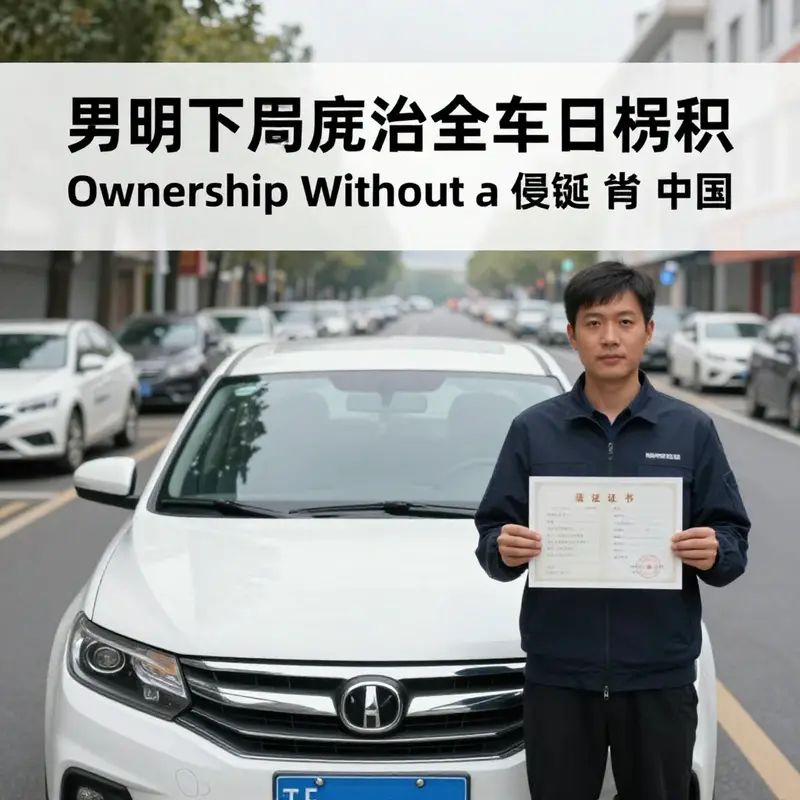
Ownership and registration of a vehicle stand on a different axis from the right to operate that vehicle. In many places you can legally own and register a car without holding a driver’s license, yet you cannot legally drive it without one. This distinction shapes not only how people manage a vehicle within a family or a business but also how states and nations design their road-use and tax systems. The chapter that follows investigates this boundary with careful attention to the Chinese framework, where the rules are explicit about what documents establish vehicle legitimacy, and to the United States experience, where state-by-state variation creates a mosaic of practical possibilities and legal constraints. The overarching idea is simple in theory: the vehicle’s identity, proof of origin, and the registration certificate confirm ownership and the vehicle’s eligibility to be operated on public roads, while a driver’s license governs who may actually steer the car behind the wheel. The tension between these two domains—ownership and operation—shapes everyday decisions for families, small businesses, and individuals who borrow, gift, or lend a vehicle. It also highlights how insurance, taxes, and road safety laws interlock to police the use of the machine rather than merely its existence as an asset on a shelf or in a garage. Across different jurisdictions, the same vehicle can be both a registered asset and a potentially non-operable object, depending on who holds a license and what the local rules require for operation in public spaces. This chapter does not simply catalogue rules; it traces the logic behind them and the consequences they carry for ownership, use, and responsibility. In doing so, it invites readers to consider how their own context—whether in a large urban county, a suburban town, or a distant province—maps onto the shared principle that registration is a matter of ownership and legitimacy, not a license to drive. The two domains, though overlapping in practice, are governed by different aims: registration is a declaration of the vehicle’s standing in the public registry, a statement that the vehicle is a legally traceable asset with a verifiable chain of ownership. Driving, by contrast, is a function of capability and safety, a set of behaviors regulated to protect other road users. When these aims diverge, the law steps in with precise rules and penalties that reflect social priorities—curbing unqualified operation while allowing ownership to be established for purposes such as transfer, storage, lending, or temporary use under supervision. The implications of this distinction ripple through daily life. In many households, a parent may register a car in the child’s name to simplify ownership, tax obligations, or insurance arrangements when the child reaches a certain age, while the parent continues to manage the practical aspects of driving within the bounds of supervision and local law. In small businesses, a fleet vehicle might be registered to a company or an individual who does not hold a license, enabling the asset to be acquired, financed, and insured without necessarily transferring the right to operate to a person who must meet professional qualifications or licensing requirements. In this sense, registration acts as a formal acknowledgment of an asset’s existence and provenance, a necessary step for sale, transfer, or long-term storage, and a crucial trigger for compliance checks—be they tax-related, safety-oriented, or insurance-driven. The Chinese framework offers a clear lens on this dynamic. Regulations on motor vehicle registration specify the documents required to apply for registration: proof of ownership such as a purchase invoice, identification, certificates related to the vehicle’s conformity, proof of vehicle purchase tax payment, compulsory traffic accident liability insurance, and other documents required by law. Crucially, the owner’s driver’s license is not among the required documents. This separation underscores a fundamental policy choice: the state is concerned with who owns the vehicle and whether it can be legally placed on the road, not necessarily with whether the owner can or will drive it immediately. Yet the same framework dooms a vehicle to a different fate if the operator—whether the owner or a third party—drives without a license. The Road Traffic Safety Law of the People’s Republic of China makes this explicit. It punishes driving without a license with fines and potential detention, signaling the enduring public safety rationale: the privilege to drive carries responsibilities that the law hopes to ensure by careful policing. In practice, this means you can stand at the threshold of road legal ownership without possessing a license, but you cannot cross the threshold into driving without meeting the licensing prerequisite. In the Chinese context, ownership and registration are about ensuring legal possession, traceable origins, and safe, tax-compliant status of the vehicle itself. The vehicle registration certificate serves as the legal anchor linking the vehicle to its owner and to the state’s tax and insurance frameworks. The system thus makes it possible for an individual to be the registered owner while ruling out, in no uncertain terms, unregulated use by an unlicensed driver. The practical effect is a clarifying boundary: you may be the person who signs for the vehicle, pays the taxes, secures the liability insurance, and holds the registration certificate, but you are not free to operate the vehicle on public roads unless and until you satisfy the licensing condition. This separation helps explain why many households, particularly those investing in a vehicle for a teenager, choose to register the car in the parent’s name or in a trust or company name while arranging a supervised, licensed driving program or a designated driver to handle the day-to-day operation. The policy intent becomes clearer when one considers the lifecycle of a vehicle: it exists first as an asset with a chain of title, a set of safety checks, and tax obligations; only later does its use on public roads require the operator to demonstrate competence, knowledge of the rules, and the capacity to respond to emergencies. The outcome is a structured dance between ownership and operation, with the state providing two guardrails: a robust system for recognizing and transferring ownership, and a parallel system for ensuring that the act of driving is performed by someone who has earned the privilege to do so. The situation in the United States adds another layer of complexity. Here, the question of whether a person can register a vehicle without a driver’s license is often answered with a jurisdiction-specific nuance. Many states allow the registration of a vehicle in the name of an individual who does not hold a license, as long as the vehicle is properly insured, and all required documentation—proof of ownership, tax status, and sometimes a separate proof of compliance with safety inspections—are in order. The driving prohibition that follows in the Chinese model does not automatically apply on the registration front; rather, the ability to obtain license plates or to drive legally is constrained by whether the driver’s license is valid. In practical terms, this means that a parent might register a car for a teenage driver, or a person might own a car that is used by others, perhaps a rideshare driver or an employee, under an arrangement that does not require the owner to have a license themselves. The core takeaway is that ownership and operation are not one and the same; the law often accepts ownership separate from the capacity to operate. Insurance follows this logic yet interacts with it in important ways. Across jurisdictions, liability insurance is a universal requirement for operating a vehicle on public roads. Even if the owner is not licensed to drive, liability coverage remains a critical protection against the risks associated with use. The insurance policy binds the named insured or policyholder, the vehicle, and the drivers who may operate it, within the scope allowed by the insurer and by law. The existence of insurance can influence how a vehicle is used, who may drive it, and how riders or occasional drivers must be supervised. Owners must consider what happens if they lend the vehicle to someone who does hold a license and is allowed to drive, versus lending it to someone who cannot legally operate it. The difference in risk exposure is not purely theoretical: accidents, injuries, and liability claims are evaluated against who was authorized to drive, who was licensed, and the extent to which supervision or oversight was present at the time of the incident. In some states, the relationship between ownership and operation is reinforced by specific provisions that tie registration to the person who has a valid driver’s license, at least when a vehicle is used for personal transportation rather than storage or occasional use. Other jurisdictions permit registration in the name of a non-licensed individual with the understanding that licensed drivers will operate the vehicle and that the owner remains responsible for ensuring compliance with safety and insurance requirements. For families and businesses alike, these distinctions shape planning: how to structure ownership for tax purposes, how to arrange insurance for multiple potential drivers, and how to navigate the process of upgrading or transferring ownership when circumstances change. They also affect practical choices—whether to buy a vehicle outright or to lease, how to designate a primary operator, and how to manage the vehicle’s registration when it is loaned to another person, such as a family member living elsewhere or an employee who has occasional driving duties. The practical implications extend into day-to-day life. A parent who registers a car for a teenager, while the teen learns to drive with supervision, will still need to arrange for a licensed operator to take the wheel as required by law. A person who owns a car and wishes to let a friend borrow it without the friend having a license must communicate clearly the limits to use and ensure that the insurance coverage does not exclude such use. These decisions are never purely technical; they are social and safety decisions. They require honest assessment of risk, responsibility, and the local regulatory environment. The state, or the country, may require that the vehicle be inspected to verify roadworthiness, that the registration be renewed on schedule, and that the vehicle remains in compliance with emission and safety standards. In some places, the owner’s license status can influence the issuance of license plates or the vehicle’s eligibility to be operated in specific contexts, such as commercial use, school transportation, or fleet management. The intersection of ownership and operation thus emerges as a delicate balance of legal risk, personal responsibility, and practical necessity. For the reader trying to chart a course through this landscape, a pragmatic approach is essential. Begin with a clear inventory of the vehicle’s intended use: Is it a family car, a vehicle for a teen learner, a company asset, or a project car that will be used only under supervision? Next, map the documents needed for registration or title transfer, and verify what the local tax obligations might be. Then, scrutinize insurance requirements, including who must be listed as the insured and whether the policy can be under the owner’s name when the actual driving will be performed by someone else, such as a licensed family member or employee. It is also important to anticipate the possibility that the rules may change. Jurisdictional landscapes evolve as policymakers respond to road safety concerns, insurance market dynamics, and enforcement priorities. What holds true in one city may not hold in another, and what is permitted for a teen in one state may be restricted for a non-driver in another. The questions to ask are straightforward, yet they demand careful attention: What documents are required to register the vehicle in my jurisdiction, and is a driver’s license among them? If I own the vehicle but cannot drive, how will ownership be protected if the vehicle is involved in an accident or used by others? How does insurance respond to a scenario in which the registered owner lacks a license? What penalties apply if someone drives without a license, and who bears liability when the vehicle is operated by a non-licensed individual? And crucially, what are the implications for the vehicle’s ongoing registration itself—does the owner’s status influence the likelihood of plate suspension, tax penalties, or registration renewal challenges? These questions invite a careful, jurisdiction-specific inquiry rather than a one-size-fits-all answer. The path forward is to consult official sources that spell out the local rules for registration, licensing, and insurance. In practice, this means reviewing the official guidelines of the relevant motor-vehicle authority or department of public safety, and where possible, seeking counsel from an attorney or a licensed professional who specializes in vehicle regulation. For readers seeking a practical starting point, a reliable approach is to compare the broad principle across contexts: ownership and registration confirm who owns the vehicle and its legal standing, while licensing confirms who may legally operate it. Keeping this distinction in mind helps to navigate the complexities of ownership structures, lending arrangements, and the day-to-day realities of driving. In the end, the question of whether you can register a vehicle without a driver’s license is less a legal anomaly and more a reflection of how modern road systems separate asset management from active operation. It invites careful planning, prudent risk management, and a clear-eyed understanding of the regulatory terrain. To those readers who want to explore how these rules play out in their own locale, the idea of linking to state-specific resources can be helpful. See for instance the resource that discusses how state rules interact with driver licensing and registration, which can provide a concrete sense of the regulatory variability that shapes real-world decisions. state rules impact on driver licensing. Finally, for broader, research-based guidance on vehicle regulations and related concerns, consulting official public resources and up-to-date state portals is wise. These resources can help clarify whether a given jurisdiction permits vehicle registration in the absence of a license, what the practical limitations are, and how to align ownership, insurance, and operation with the law. External resources that deepen this understanding can be found on government and policy-oriented sites, and a widely used consumer resource offers a practical overview of how these rules are implemented in different states. For a consolidated starting point, you may consult standard reference sites that summarize state requirements and provide links to the relevant agencies. External resource: https://www.dmv.org
Registration Without a Driver’s License: Paper Ownership, Road Rights, and the Delicate Boundary Between Paperwork and Permission
Registration Without a Driver’s License is not a contradiction so much as a measured distinction that keeps ownership, accountability, and public safety in their respective lanes. In many places, the act of putting a car on the road begins not with permission to drive, but with proof of ownership, legitimacy, and compliance with vehicle standards. This separation is not a modern curiosity; it reflects a long-standing logic in road administration. The logic is straightforward in theory: you document who owns the vehicle, you verify that the vehicle itself is legitimate and roadworthy, you confirm that the vehicle is taxed and insured, and you issue a registration that permits the vehicle to exist on public roads under the state’s regulatory umbrella. The actual right to operate, by contrast, derives from the operator’s fitness to drive, evidenced by a valid driver’s license. This bifurcation is essential for public safety and for maintaining a system where vehicle ownership can be transferred, taxed, and tracked without automatically granting a driver’s privilege to every owner. The practical upshot is that a person can become the legal owner of a vehicle and receive the registration documents needed to operate or transfer ownership, even if they do not hold a driver’s license. The road use part, however, remains controlled by a separate credentialing process that requires learning, testing, and ongoing compliance with traffic laws. This division—ownership certification separate from driving certification—appears in many jurisdictions around the world, though the specifics differ from country to country and even within regions of a single country. In China, for example, the Regulations on Motor Vehicle Registration lay out a clear set of documentary requirements that center on the vehicle and the owner’s identity rather than the owner’s ability to drive. The applicant must present the owner’s identification document, the purchase invoice or proof of vehicle origin, a certificate of conformity or import documents, proof of payment of vehicle purchase tax, a compulsory traffic accident liability insurance policy, and other documents as required by law. Notably, a driver’s license is not listed among the required documents. This statutory detail underscores a widely observed principle: registration confirms the vehicle’s legitimacy and the owner’s entitlement to possess a vehicle, not the owner’s competence to operate it on public roads. The vehicle registration certificate, sometimes exchangeable for or associated with a license plate, serves as the public record of ownership and eligibility to use the vehicle on the road, but it does not itself authorize driving. The absence of a driver’s license in the registration checklist is not an invitation to disregard licensing; it simply reflects a different regulatory track—the track that governs vehicle identity, origin, and tax compliance rather than driver proficiency. The same principle—separating ownership from operation—appears in other jurisdictions as well, including the United States, where registrations can be issued even if the registrant does not hold a valid license. In many U.S. states, the registration process is grounded in demonstration of ownership, proof of insurance, and sometimes proof of residence and vehicle compliance, while the driver’s license remains the gatekeeper for road use. The underlying logic is that the public authorities must know who owns a vehicle, that the vehicle meets safety and tax requirements, and that a driver is properly trained and licensed before allowing the vehicle to be driven on public streets. This separation protects the integrity of ownership records and the funding streams that support road infrastructure and safety programs, while still enforcing driver competency as a separate, essential public safety measure. The practical mechanics of vehicle registration—identification, ownership documentation, proof of tax payment, proof of insurance, and conformity or import documentation—are designed to ensure the vehicle is legitimate, trackable, and properly taxed. The process incentivizes compliance with environmental and safety standards, bridging the gap between commerce and public safety without conflating the duties of ownership with the duties of operation. Yet the distinction between owning and driving can become a source of confusion for individuals who, for various reasons, circle around the edge of licensing while owning a car. Suppose a person buys a car, registers it, and then discovers that they cannot obtain a driver’s license for months or even years. They may legally own and register the vehicle, but the moment they sit behind the wheel, they cross from ownership management into the realm of driving law. This is not merely a theoretical line; it has concrete consequences for planning, liability, and day-to-day life. It is in this space—the space between registration and license—that most people encounter the real-world implications of possessing a vehicle without a driver’s license. The consequences are multifaceted and can be stark. On the ownership side, the registration process ensures that the vehicle’s identity and origin are verifiable, the purchase tax has been paid, and the vehicle is insured for the times it may be on the road. On the driving side, the absence of a valid license means that operating the vehicle on public roads is illegal, with penalties designed to deter unsafe behavior and to uphold the integrity of the licensing system. The mechanics of penalties and enforcement vary across jurisdictions, but common threads run through the fabric of most legal systems. Violations often begin with a traffic stop or a roadside check that reveals the absence of a valid license. In many places, the violation may trigger fines, which can range from modest to severe depending on the jurisdiction and the offender’s prior record. The possibility of mandatory court appearances adds another layer of disruption to daily life, potentially leading to additional costs, time off work, and legal fees. Even when a license exists elsewhere in the life of the driver, driving without it can accumulate points on the license record, affecting premiums, even if the driver has no ownership or registration issues in the same jurisdiction. If the unlicensed driver is stopped repeatedly or if a DUI offense occurs while unlicensed, jurisdictions may impose harsher penalties, including longer fines or even jail time. The concept of liability becomes more complex when the driver is unlicensed. In the event of an accident, the driver’s lack of a license can complicate insurance claims. Some insurers will refuse to cover unlicensed drivers, while others may offer policies but with higher premiums or specific limitations. The risk of civil liability increases as well, with the unlicensed driver potentially bearing more of the financial burden for damages and injuries caused. The insurance landscape itself can become a paradoxical landscape for the unlicensed vehicle owner. Even if the vehicle is registered and insured under some arrangement, the absence of a licensed driver can challenge the practicality of obtaining or maintaining insurance coverage. In some cases, insurers require that the registered owner designate a licensed driver who will be the primary operator, or they may require the installation of telematics or other monitoring devices to mitigate risk. This adds an additional layer of complexity to the ownership scenario and can limit the ways in which a car is used. The risk calculus intensifies when the unlicensed owner needs to transport family members, run errands, or manage regular commutes. The natural inclination may be to hire a licensed driver or to rely on alternative transportation, but both options introduce costs and scheduling constraints that can erode the perceived convenience of vehicle ownership. A further dimension concerns the broader policy rationale for allowing vehicle ownership without an immediate path to licensing. Some states and countries acknowledge that ownership and the purchase process can be separated from driver licensing for practical reasons. New residents may need time to obtain tests, appointments, or eligibility waivers; first-time buyers may be路 waiting on insurance coverage while awaiting license issuance; or a person may be in a transitional phase where a license is temporarily unavailable due to medical, legal, or administrative reasons. In such cases, permitting registration while licensing is pursued can facilitate timely access to mobility once the driver becomes licensed. It can also support the broader economy by enabling the sale and transfer of vehicles, enabling not just individuals but families to participate in trade and commerce without getting stalled at every rung of the regulatory ladder. The regulatory landscape, however, is careful to keep this dual pathway from morphing into a loophole. Even when registration is possible without a license, driving without a license remains illegal in most jurisdictions. The penalties are designed to deter unlicensed driving while allowing ownership to proceed in a manner that does not penalize the vehicle’s existence in the registry. In practical terms, this means that a person can walk through the door of a DMV office, present the necessary documents to establish ownership and vehicle legitimacy, pay the taxes, secure the insurance, and receive the registration and plates, all without a driver’s license in hand. But as soon as the key turns and the ignition fires, the law asserts a different order. The license requirement, with its tests, renewals, and compliance obligations, stands as the gatekeeper to road use. This gatekeeping is not merely punitive; it is a safeguard designed to ensure that drivers have demonstrated competence, knowledge of traffic laws, and the ability to maintain control of a vehicle in a range of conditions. The enforcement paradigm supports this separation. Traffic enforcement officers are trained to verify not only the vehicle’s documents but also the driver’s license status during roadside interactions. If a driver is found operating without a license, the enforcement response is typically swift and consistent with established penalties. The robust public safety rationale behind these rules is reinforced by the wider ecosystem of vehicle regulation: registration taxes, insurance requirements, and vehicle safety standards all operate in concert to reduce risk on public roadways. The interplay among these elements becomes particularly visible when considering scenarios like non-driver ownership. Some jurisdictions have carved out provisions that permit non-driver owners to register vehicles under specific conditions. These may include designating a licensed operator, limiting use to private property, or requiring periodic verification of the driver’s license status. While such provisions exist, they are not universal, and they do not signal a relaxation of driving rules. They reflect a nuanced balance between freedom to own and responsibility to operate. The practical takeaway for someone navigating this landscape is that registration exists to formalize ownership and ensure compliance with vehicle-related obligations, while driving rights are protected through licensing. If you do not hold a driver’s license, you can register a vehicle, but you should plan to meet licensing requirements if you intend to drive. If licensing is delayed or not possible, you may need to arrange for a licensed driver to operate the vehicle or to keep it in a non-driving status—parked or stored in a manner that complies with local rules and does not pose public safety concerns. In the end, the chapter of ownership and operation remains two pages in the same book, written with different purposes in mind. The owner’s documents verify meaning, origin, and responsibility; the driver’s license verifies ability, knowledge, and behavioral safety. Maintainers and policymakers recognize that people sometimes move through life without immediately securing the privilege to drive, and they design systems that allow ownership to proceed while safeguarding the public right to be protected by trained and licensed drivers. If you find yourself on the threshold of ownership without license, the path forward is not to drift into the legal gray zone, but to engage with the regulatory framework thoughtfully. Gather your proof of ownership, your tax proof, your insurance, and the vehicle’s conformity documentation. Prepare to complete the registration process so that the vehicle can be legally owned and recorded in the public registry. Then, take the parallel path toward licensing. Reserve time for the testing process, training, and the learning required to become a competent driver. This two-track approach—ownership and operation—reflects a prudent design in the governance of mobility, one that respects individual circumstances while maintaining the safety and structure essential to a thriving road system. In practice, many people will experience the limits and opportunities of this arrangement at different moments in life. A new resident may need to register a vehicle while beginning the licensing process. A student or temporary worker may own a vehicle but not yet have a license valid in the jurisdiction. In these cases, the rules are most intelligible when they are viewed not as a contradiction but as a careful balance: ownership can be documented and taxed; driving can be earned through a license. To navigate this balance successfully, one should consult the official, jurisdiction-specific guidance—the precise requirements for each state or country—while remaining mindful of the penalties that accompany unlicensed driving. For those seeking more detailed exploration of how states define and apply licensing rules, the topic extends beyond merely registering or not registering a vehicle. The regulatory landscape encompasses not only driver licensing but also how rules intersect with vehicle inspections, transfer of ownership, insurance requirements, and the broader tax and safety regime. In particular, the interplay between registration and licensing is shaped by a constellation of provisions that vary by region, and understanding these rules can help avoid costly missteps. For readers who want to delve deeper into how state-level rules shape driver licensing and vehicle ownership, a closer look at the evolving landscape through official channels can be illuminating. As with any legal framework, there are always edge cases and evolving statutes, and staying informed helps ensure compliance and peace of mind. A good starting point for more generalized guidance is to explore the concept of state rules that impact driver licensing, which can provide a framework for interpreting how your local system weighs ownership against operation. state rules impacting driver licensing. And for practical state-specific guidance on registration, insurance, and related regulatory components, you can consult broad, official resources that summarize the operating rules across jurisdictions and offer direct links to the relevant departments. In many places, those official resources are complemented by consumer-facing portals that explain how to register a vehicle, how to obtain or verify insurance, and how to proceed if you are waiting for license issuance. These resources often emphasize that registration is not a license to drive and that the two processes, while interconnected in the broader system, serve different ends. The overarching message remains clear: ownership legitimacy and road-use eligibility require separate, sequential steps, and recognizing this separation helps prevent missteps that could otherwise lead to penalties, liability, and a compromised legal position. If you are examining this landscape from the perspective of policy analysis or personal planning, the key takeaways are simple and enduring. Registration confirms who owns what, ensures that the vehicle is properly taxed and insured, and verifies its eligibility to be on the road in compliance with safety and environmental standards. Driving rights, however, are earned through a licensing process designed to measure competence, knowledge, and practical driving ability. The two tracks run parallel, but they converge in the shared objective of safe, lawful mobility. This is not just an abstract doctrine; it is a practical framework that guides millions of decisions every year—from the moment a car is purchased to the moment a driver passes a test and receives a license plate that reflects their readiness to operate. For those who want a clear, field-tested sense of how these rules play out in everyday life, the most reliable guidance comes from official sources that reflect the current laws and administrative practices in your jurisdiction. The core idea remains consistent across borders and over time: you can own and register a vehicle without a driver’s license, but you cannot legally drive it on public roads without one. This is the central, enduring distinction that underpins modern road regulation and the safety that the system seeks to secure. To support practical understanding and help you avoid missteps, consult the relevant DMV or transportation authority in your area, and keep in mind that penalties for unlicensed driving can be severe, while the freedom to own and register a vehicle without a license is a separate but intimately connected piece of the mobility puzzle. External resources can provide the most current, jurisdiction-specific guidance, and they should be consulted as you navigate the nuances of ownership, registration, and licensing. For official guidance on state-specific regulations, consult formal DMV resources such as https://www.dmv.org.
Final thoughts
Ultimately, while registering a vehicle in China without a driver’s license is legally permissible, it comes with important caveats regarding the actual operation of the vehicle. Understanding the distinction between registration and driving legality can empower individuals, whether they are new to the driving experience or existing vehicle owners contemplating additional vehicles. The legal framework allows for ownership and participation in vehicle registration, yet it underscores the critical mandate of holding a valid driver’s license while on public roads. It is this intersection of rights and responsibilities that defines the landscape of vehicle ownership in China.