
Navigating the process of licensing a vehicle in another state can be complex for various vehicle owners, whether new drivers, learners, or seasoned auto dealership professionals. This guide will delve into key factors that impact your ability to register your vehicle out-of-state. Each chapter will explore essential topics: establishing residency, gathering necessary documentation, understanding associated fees, and recognizing the diverse regulations that vary from state to state. By the end, readers will have a holistic understanding of how to successfully license a vehicle across state lines.
Residency as the Gatekeeper: Navigating Vehicle Licensing Across State Lines
When you ask whether you can license a vehicle in another state, the short answer is yes in some cases, but the long answer is nuanced. Licensing a car in a state where you do not live is not a simple matter of owning a vehicle overnight or keeping a car in a different state for convenience. The rules hinge on the state’s definition of residency, or domicile, and on the practical proof you can provide that you have made a new state your permanent home. Across the country, departments of motor vehicles and their cousins look for a clear signal of intent to reside, not just possession of a vehicle. That signal typically starts with where you hang your hat, where you receive mail, where you vote, where you work, and where you file taxes. The upshot is that licensing in a new state is less about the car and more about the person who lives in that state and the documents that prove it.
To understand the path, it helps to break residency into the practical steps that states commonly require. First, you must establish a local address that is more than a mere mailing drop. A residence, lease, or ownership one can actually inhabit is often the baseline. Then you update your mailing address with the state. You apply for a state-issued ID or driver’s license, which acts as a durable proof of residency. Consider also the more public signals: driver’s license, voter registration, and state tax obligations. These steps are not just bureaucratic hoops; they are the practical hallmarks of establishing presence in a community that will become your legal home for purposes of licensing vehicles, paying taxes, and participating in civic life. States scrutinize intent as much as the paperwork you provide. So the journey toward licensing a vehicle in a new state begins with demonstrating that you intend to stay, rather than merely passing through.
You will hear terms like domicile, residency, and principal place of residence. In most jurisdictions, the legal notion is that you are a resident of the state if you physically reside there and intend to remain there for a substantial period. The paperwork you collect acts as proof of that intent. One important nuance is timing. Many states offer a window after moving during which you must complete the licensing and registration steps. The exact timeframe varies: some states require action within 30 days, others within 60, 90, or more. The practical effect is that delays can complicate both insurance coverage and vehicle registration. If you delay, you may encounter penalties or a mismatch between your license, registration, and insurance. The goal is to align all these pieces quickly so you can operate legally and confidently in your new home state.
Within this framework, the process often follows a predictable arc. You secure a local address that you actually use. You update your mailing address with the state so correspondence from agencies reaches you in your new location. You apply for a state driver’s license or state ID, which is a formal recognition of your residency. You may be asked to provide a combination of documents: proof of identity, proof of social security, and two proofs of residency such as a lease, utility bills, or bank statements showing the new address. Some states require a vehicle title or proof of insurance in the state’s name. You might also face emissions testing or safety inspections as part of the registration process. The exact mix of requirements changes by state, but the rhythm is familiar: move, establish a domicile, demonstrate residency, then register the vehicle and license in the new state.
Because the discussion centers on licensing a vehicle in a state you do not permanently call home, it is essential to understand how states interpret “residency.” Residency is not simply a matter of where you keep a car or where you drive most of your days. It is about where you intend to live, where your life is centered, and where you will vote, pay taxes, and receive government services. A common practical framework is that residency is demonstrated by establishing a local address, updating state records, and obtaining a state ID or driver’s license. These actions signal the state that you have shifted your center of gravity and that you are prepared to bear the responsibilities of living there. The documentation you collect should reflect this shift, and you should be prepared to present it when you approach the licensing process.
In practice, how this plays out can look different from state to state. Take, for instance, the standard approach you’ll encounter in many places: you must live in the state and register your vehicle there in the county or region you reside. Often there is a move-in window—commonly a month or two—alongside the task of aligning your vehicle’s records with your new address. The purpose of the timing rule is to prevent a person from using a temporary address to shield local registration or insurance requirements. It also reduces ambiguity about where a vehicle should be registered for tax and regulatory purposes. While the specific time limit varies, the underlying principle remains the same: residency must be established in a tangible, verifiable way, and that residency anchors your licensing decisions.
A concrete illustration of how these principles unfold can be seen in practice in a state where the process is well defined and documented. Suppose you have moved to a new state, and you intend to make that state your home. You should begin by obtaining a local address. This address is more than a mailbox; it is a place where you receive mail, store belongings, and receive deliveries. Then you update your mailing address with the state and begin the process of obtaining a state ID or driver’s license. The documents you assemble should show that you now live in that state on a long-term basis. The steps you take in parallel—registering to vote, filing taxes, signing up for local utilities, and perhaps leasing or buying a home—form a coherent narrative of residency that the DMV or its equivalent will accept as evidence of intent to reside.
The practical consequences for licensing a vehicle in the new state are straightforward: once you have established residency, you can register the vehicle there and obtain a local license. The registration process will usually require proof of insurance from the state where you will be registered, plus the vehicle title and a bill of sale if you recently acquired the vehicle. Some states add a layer of complexity with vehicle inspections or emissions testing that must be completed before registration can be approved. The result is a cycle that begins with residency and ends with legal vehicle documentation that reflects your new home. It is a cycle that must be completed thoughtfully, with attention to both the letter of the law and the practical realities of life in the new location.
To illustrate the residency-to-registration pathway with a concrete example, consider the guidance commonly summarized for a state that has a clear 30-day requirement after moving. In that jurisdiction, you are expected to establish residency, switch to a local address, and complete the vehicle registration within 30 days of your relocation. The exact steps would typically include visiting the local DMV office or its website to arrange an appointment, gathering the necessary documents such as proof of identity and residence, and presenting the vehicle’s title and proof of insurance. The goal is to ensure that the vehicle is properly tied to the new state for tax, insurance, and regulatory purposes. For those seeking more detailed guidance, a resource that discusses how different states structure driver licensing and related residency rules provides a useful cross-check on the approach you would take in your own state of relocation. You can consult information on how state rules impact driver licensing at this URL: state rules impacting driver licensing.
Beyond the Texas example, which is often cited in discussions of state residency and vehicle registration due to its clear timeframes and county-level registration requirements, other states follow similar logic but with their own flavor. Some states emphasize the need to demonstrate physical presence by maintaining a primary residence and using it for official correspondence, while others place more weight on tangible activities such as obtaining a state driver’s license and registering to vote. In all cases, the central thread remains intact: residency is the hinge, and licensing or registering a vehicle in a new state is the mechanism by which you formalize that residency in law and practice. This is why people who live part of the year in one state and work in another, or who relocate temporarily for a job, often encounter a tangle of deadlines, inspections, and documentation. The more you plan ahead and ground your actions in verifiable residency, the smoother the process will be.
A note on the practical realities that accompany this transition: even if you own a vehicle in a state where you now spend the bulk of your time, you are generally expected to re-register that vehicle in your new state of residence. You cannot rely on a non-resident registration just because you keep a car in a different state. Insurance coverage can also become a point of friction if your insurer accounts for residency in a particular state. If you fail to align your registration with your residency, you risk penalties, lien concerns, or coverage gaps should a claim arise. The resolution is to treat residency as the organizing principle and to align your address, your licenses, your vehicle registration, and your insurance accordingly. The paperwork may feel repetitive, but it is the most reliable path to staying compliant across state lines.
As you plan the transition, it helps to view the residency requirement as a cohesive narrative rather than a checklist of isolated tasks. The steps—establish a local address, update state records, obtain a state ID, and then register the vehicle—are not isolated actions. They are interlocking parts of a single story: you are now a resident of a new state with a home, a life, and a legal footprint there. When you approach the DMV, you bring this narrative with you, along with the documents that prove it. Your intent to remain, demonstrated by real-life actions and official records, is what seals the deal for licensing and registration. And if you find the landscape confusing, consulting the official sources for your chosen state remains essential. For broader context on how states can differ in this domain, you can review a resource that explores how state rules shape driver licensing. This link takes you to a discussion of the interplay between residency criteria and licensing across states: state rules impacting driver licensing.
In the end, the question of whether you can license a vehicle in another state comes down to whether you have established residency there. The car is the ticket, but the residency is the passport. The path is practical and navigable when you approach it with a clear sense of where you actually live, not just where your car happens to be kept. The documents you gather, the tests you may undergo, and the timing you observe all flow from the same fundamental idea: residency anchors your legal status in a state, and licensing or registering a vehicle follows from that anchor. By coordinating address changes, identity verification, and proof of domicile in a cohesive strategy, you create a legitimate path to licensing in your new home state while maintaining compliance with the old one until you complete the transition. For those who want a distilled reference point, turning to official state guidance remains the best practice, since the precise requirements and timelines are what ultimately determine your steps and your peace of mind. As a practical reminder, the process is state-specific and built around the concept of residency—and understanding that concept is usually the most reliable way to begin.
External resource: For official guidance on Texas residency and vehicle licensing, see the Texas Department of Motor Vehicles guidance here: https://www.dmv.texas.gov
null
null
Crossing State Lines: The Hidden Costs and Considerations of Licensing a Vehicle in a New Jurisdiction
When you relocate or spend significant time in a new state, you may assume your car can stay put on its current plates and registration. In practice, licensing a vehicle in a different state hinges on more than where the car sits or how fancy the ownership papers look. It rests on establishing a legal domicile or principal residence in the new state and then meeting that state’s specific requirements for vehicle licensing. The process is as much about proving residence as it is about the paperwork for the car itself. You may not be able to register in the new state simply because you own a vehicle there while continuing to live elsewhere. Residency rules, timeframes, and the exact steps differ from one state to the next, so a careful, informed approach is essential before you make the switch.
Once residency is established, the costs begin to accumulate in layers that are both predictable and surprising. The most visible layer covers the basics: registration fees, title transfer charges, and any applicable taxes. In many cases, you should anticipate a total in the broad range of roughly one hundred to three hundred dollars. That range is a general guide for standard passenger vehicles and typical situations. But the exact figure shifts with the state, the vehicle’s value, and the type of registration you select. Luxury or high-value vehicles can push costs well beyond that baseline, and commercial vehicles may incur additional surcharges or special handling fees. The sum you pay may include several discrete line items—each with its own rationale—so the total can feel opaque unless you break it down carefully.
The registration fee is rarely a single number. It often comprises a base fee, a factor tied to the vehicle’s weight or value, and sometimes a regional or tax component that reflects local policy. A title transfer or title issuance fee is typically added when you move the registration to a new state or when ownership changes. Some states require taxes to be paid at the time of registration, sometimes calculated as a percentage of the vehicle’s value, sometimes as a blended rate that factors in local levies. Emissions testing, safety inspections, or other regulatory steps can add further costs. In states with strict environmental or safety standards, the inspection itself can impose a separate fee, plus any maintenance or repair needed to pass. If you are transferring plates rather than obtaining new ones, there may still be plate-related fees for reissuance or plate exchange, and those can vary considerably.
To illustrate how these pieces fit together, consider the cautionary note often shared by jurisdictions that enforce nonrefundable elements once you begin the process. In Western Australia, for instance, when a vehicle is re-licensed in another state or territory, the original WA licence is cancelled, and no refund is provided for the previous registration. This example underscores why it matters to anticipate all financial obligations before you commit to transferring licensing across state lines. While that particular case is jurisdiction-specific, the underlying principle is universal: the moment you move assets and rights across borders, the accounting for fees, taxes, and potential refunds changes in ways that may not be immediately obvious.
Another area where costs can creep in is the plate scenario. If you bring plates with you, you may still face fees for plate replacement or reissuance in the new state. In many regions, your old plates must be surrendered, and new plates issued, with the associated administrative charges. The price of a new plate can be modest, but add it to the other line items for licensing, and the total becomes more meaningful. If you plan to relocate a vehicle between states within a short window, understanding these plate dynamics ahead of time helps prevent sticker shock at the counter.
The question of timing is not merely about readiness; it is about compliance. Most states set a window during which you must license the vehicle after establishing residency. That window often sits somewhere between 30 and 90 days, depending on the state. Failing to meet the deadline can trigger late fees, interest, or even penalties that compound as the registration lags. In practice, the sooner you align with the new state’s licensing timetable, the more control you retain over the total cost and the administrative burden. The cost calculus therefore includes not just the sticker price, but the risk of late fees, potential prorations, and the possibility of having to duplicate documents if you have delayed processing.
To estimate your costs accurately, start by listing each potential expense. Determine the base registration fee for your vehicle in the destination state, then add any title transfer fee and taxes. Assess whether your vehicle will require an emissions test or a safety inspection, and include the associated inspection fee if applicable. If your plates must be replaced, factor in those replacement costs as well. It helps to know the vehicle’s current value, as some states calculate certain fees on that basis, while others rely on fixed schedules. If you plan to retain or transfer plates, confirm whether plate transfer fees apply and whether the new state will require distinctive plates.
Beyond the numbers, there are practical steps that help you navigate the process smoothly. Gather the standard documents early: a proof of identity, proof of state residency (which may be demonstrated by a domestic address and a driver’s license issued in the new state), the vehicle title, your current registration, proof of insurance accepted in the new state, and a bill of sale if you recently acquired the vehicle. Some states require you to present proof of a local address, not just a mailing address. Others expect you to show a relationship between your residency status and your vehicle ownership—such as registering to vote, paying state taxes, or obtaining a new driver’s license there. The exact combination of documents varies by jurisdiction, so check the official DMV or transportation authority site for the new state.
An important practical rule is to budget for more than the obvious costs. Even when you think you’ve covered everything, there may be ancillary charges, processing fees, or environmental surcharges that appear only in the fine print. This is the moment to consult the state’s official licensing resources and to cross-check any estimates with the actual forms you will complete or the fee schedules you will encounter. The research path is straightforward but can be lengthy: the quickest route to clarity is to go straight to the destination state’s licensing authority and read the latest fee chart and requirement list. The process is often transparent and standardized, but the details differ enough to make a mistaken assumption costly.
Within the broader guidance on licensing across state lines, it is helpful to consider the role of vehicle inspections and what those costs might entail. In many states, an inspection is a prerequisite to licensing, or at least a de facto requirement if the vehicle is being registered after moving from out of state. The inspection itself can carry a fee, and in some regions, passing the inspection may require repairs or adjustments to bring the vehicle into compliance with local standards. For readers who want to understand how inspection requirements vary across jurisdictions, a resource that compiles state-by-state inspection expectations can be a useful companion to your budgeting and planning. See the overview on US states vehicle inspection requirements for a concise summary of common expectations and potential costs.
The question of residency also informs when you can and should license. Establishing residency is not merely a technical step; it is the act that unlocks the right to register and title the vehicle in the new state. The residency criteria typically involve establishing a physical address in the state, obtaining a local driver’s license, and often demonstrating engagement with the state’s system—such as registering to vote or filing taxes. Once residency is established, the licensing path becomes clearer, but you still need to assemble the required documents and budget for the fees. The timing of registration can influence the amount you owe, because many states assess prorated taxes or fees depending on your registration period. Planning the move with a clear calendar helps you anticipate the moment you need to switch the registration and, consequently, the charges you will incur.
For readers who want to compare experiences and prepare for a smooth transition, the practical takeaway is to treat licensing as a staged process rather than a single, one-off payment. Start with residency and license requirements, then map out the vehicle-related costs in the destination state. Confirm whether any plate transfers are possible, and whether those will affect your timing or total cost. As you gather documents, prepare a checklist that includes proof of identity, proof of residency, the vehicle title, current registration, proof of insurance in the new state, and any paperwork showing the vehicle’s value and purchase history. When you have a complete packet, you can approach the licensing authority with confidence and minimize the risk of delays that could accrue additional fees.
In summary, licensing a vehicle in a different state is a process shaped by residency, regulatory requirements, and a bundle of fees that extend beyond the simple registration price. The total cost is a function of the state’s base fees, plate or title charges, taxes, inspections, and the specifics of your situation—whether you are transferring plates, changing ownership, or establishing domicile. The prudent approach is to begin with the official state resources, confirm every line item on the fee schedule, and prepare for possible extras that may not be obvious at first glance. By anticipating these elements, you can avoid unexpected costs, comply with the law, and gain a clearer picture of the true price of licensing your vehicle in a new jurisdiction.
Internal link for deeper context: for insights on how inspections may influence costs across states, you can review the page on US states vehicle inspection requirements. US states vehicle inspection requirements.
External resource: practical jurisdictional guidance and up-to-date procedures can also be found on Transport WA’s official site, which provides comprehensive guidance on vehicle licensing, including fees and procedures related to selling and transferring vehicle licences. https://www.transport.wa.gov.au
Across State Lines: Residency, Regulation, and the Realities of Licensing a Vehicle When You Live in One State and Drive in Another
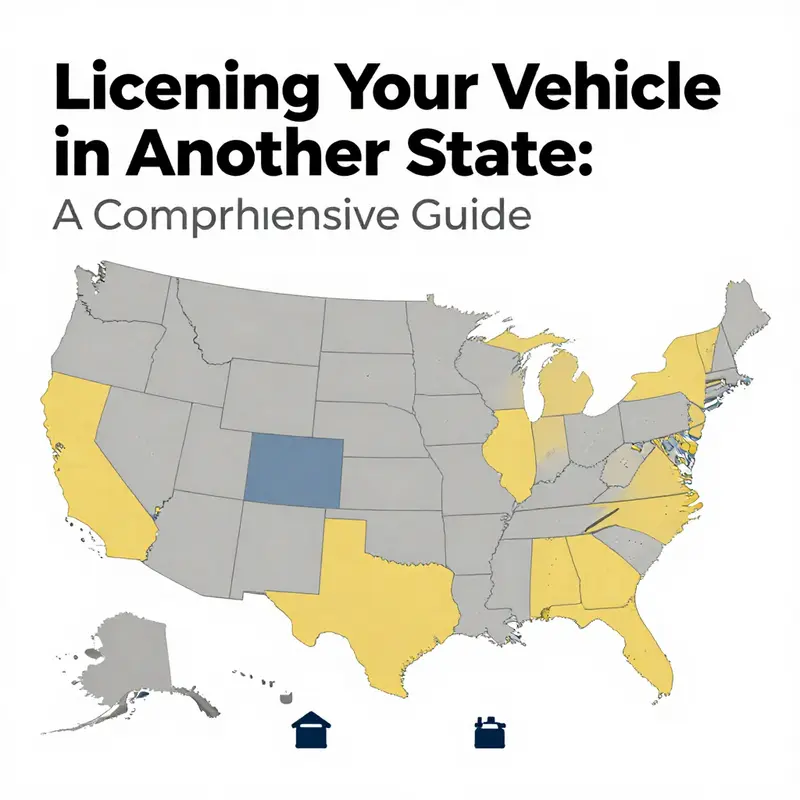
The idea that you can simply own a car in one state and license it somewhere else is a misreading of residency and regulatory authority in the United States. Licensing a vehicle rests on where you truly establish your domicile, not merely where your vehicle happens to be titled. This distinction matters because the laws that govern vehicle registration and driver licensing are anchored in state perspectives on residency, taxation, voting, and the administration of public safety. The result is a patchwork system in which the rules you must follow depend on the state in which you claim residence, the state where the vehicle is kept, and the duration and pattern of your presence in each state. The general rule is straightforward enough: you should register and license vehicles in the state where you primarily reside. Yet the path to proving that residency and meeting the state’s regulatory expectations can be anything but simple, especially for people who split time between homes, work locations, or frequent travel schedules. To navigate this landscape, it helps to ground the discussion in the core concepts of residency, the common documentation that states require, and the practical realities of how the process plays out in different jurisdictions.
Residency, in the legal sense, means more than owning a house, a car, or a mailbox in a given place. It usually hinges on your domicile—the place you consider your permanent home and where you intend to remain indefinitely or for a substantial period. States commonly assess residency through a combination of factors: the location of your principal residence, where you receive mail and services, where you intend to return after travel, and where you hold a driver’s license, register to vote, or file state taxes. Some jurisdictions codify a specific time frame, such as a 30- to 90-day window after moving, during which you must establish residency and begin the process of re-titling and re-registering your vehicles. Others have more flexible interpretations, taking a broader view of your ties to the state. The practical implication is that simply keeping a car in a different state—while living elsewhere part of the year—does not automatically grant you the right to license or register the vehicle there.
When you are preparing to license a vehicle outside your principal state of residence, the first step is to determine where you actually reside for regulatory purposes. The DMV and its analogs in other states typically want proof of a domicile that supports a sustained presence. That may include obtaining a local driver’s license, enrolling children in a local school, paying taxes to the state, establishing a permanent address, or voting in state elections. Each state blends these indicators in its own way, and the thresholds differ. Some require a formal declaration of residency, others allow a more nuanced assessment of intent and activity. The crux is consistency: the state wants to see a genuine tie to the place you claim as home, not a temporary arrangement designed to sidestep registration requirements. Once residency is established, the vehicle you drive and the license you hold are expected to align with that state’s rules. If you move again, the process repeats, with new proofs, new fees, and potential adjustments in insurance, inspections, and even emissions standards.
In practical terms, most states expect you to switch both your driver’s license and your vehicle registration to your new state of residence within a defined window after you move. The required documentation typically includes proof of insurance that meets the new state’s minimums, a title or ownership document, a bill of sale or proof of purchase if you recently acquired the vehicle, and sometimes an inspection or emissions test. Fees vary widely—from modest to several hundred dollars—and the exact documentation can depend on whether the vehicle is leased, financed, or owned outright. Emissions testing is a common requirement in parts of the country, often tied to environmental zones or older vehicles. While the specific steps differ, the overarching pattern is consistent: establish residency, provide the necessary documentation, and complete the state’s required inspections or tests before the vehicle can be legally registered and operated under the new state’s system.
The regulatory landscape across states is not uniform, and tensions between state autonomy and federal oversight add another layer of complexity. A striking example emerges from California’s approach to commercial licensing. California has, at times, pursued policies that allowed non-citizens to obtain commercial driver licenses (CDLs) under certain conditions. This practice has attracted considerable national attention, particularly after incidents that prompted calls for tighter scrutiny of CDL issuance. The federal response has included proposed rules aimed at narrowing eligibility for non-citizens and requiring states to verify immigration status through federal databases. The procedural fate of those proposals has been contested in court, illustrating how federal policy and state administration can collide when public safety concerns, immigration policy, and transportation efficiency intersect. The legal process highlighted that even when a policy is framed as a safety measure, its practical impact hinges on how it is implemented and challenged within the federal court system. In the reported disputes, proponents argued that stricter controls would address safety concerns, while critics questioned the balance between safety gains and the civil rights of non-citizens and lawful residents. The courts highlighted that the data available did not clearly demonstrate a direct link between broadened or narrowed eligibility and measurable improvements in highway safety, underscoring the difficulty of crafting universal safety rules across diverse states with different populations and traffic conditions.
Beyond California, the regulatory environment in other states reflects a spectrum of approaches. Some states emphasize verification—routinely checking immigration status or requiring evidence of lawful presence in the U.S.—as a baseline for issuing or renewing licenses and registrations. Others focus on consolidating administrative processes to reduce fraud and improve road safety, while still others balance the needs of new residents with concerns about public safety and resource constraints. The federal government has used funding leverage and policy messaging to influence state action, as seen in cases where significant federal funds have been proposed for reallocation or withdrawal in response to perceived shortcomings in licensing practices. The trucking industry’s stance in this debate has been nuanced as well; many professional drivers and associations advocate for tightened controls to ensure only qualified drivers operate heavy vehicles, arguing that such measures would raise safety standards and public confidence. Yet the industry’s support for tighter controls does not always align with the logistical realities of moving goods and people across state lines, especially for migrant workers or long-haul operators who must navigate multiple jurisdictions.
For individuals trying to license a vehicle in a state where they do not spend the majority of their time, these macro-level debates translate into concrete daily decisions. If you split your time between homes, if you maintain a primary address in one state while keeping a vehicle registered elsewhere, or if you travel extensively for work, the safest path is to treat residency as the anchor of your licensing strategy. Start by confirming where you are legally domiciled, then map out the steps for both the current state of residence and the state where the vehicle is currently located. This often means a careful review of the two states’ DMV guidance, taking stock of required documents, and budgeting for potential inspections, emissions tests, and varying fee schedules. The layering of these requirements means the process can take weeks, not days, and it often demands careful scheduling and a readiness to respond quickly to requests from the DMV for additional information.
The landscape described above is not a one-size-fits-all map. Even as the core principle remains stable—license and register in the state of domicile—the path to doing so is shaped by the specific language in each state’s statutes, administrative codes, and practice guides. For people who live and work across state lines, this means a proactive, rather than a reactive, approach to planning. It means recognizing that a vehicle’s registration is not just a matter of where the car sits, but a declaration of where you intend to anchor your daily life, financial obligations, and civic participation. When in doubt, consult the official DMV resource corresponding to the state you plan to use as your home base. These resources are updated to reflect changes in legislation, court decisions, and administrative policy; they offer the most reliable guidance for the precise docs required, the timelines to follow, and the fiscal impact of registration and licensing activities.
If you want a quick way to orient yourself to the broader idea that state rules impact driver licensing across jurisdictions, you can explore a concise primer on how different states frame licensing decisions. This resource highlights how residency definitions, immigration status considerations, and verification practices influence who can drive legally and under what circumstances. It’s not a substitute for the exact state forms and steps, but it provides a useful frame for understanding why the rules feel inconsistent from one state to the next and why the question of whether you can license a vehicle in another state depends on more than mere vehicle ownership.
For readers facing the day-to-day reality of this decision, the best approach remains grounded in a clear plan: determine your true domicile, align your licensing and registration with that domicile, and prepare for the possibility that you may need separate arrangements for a vehicle you keep in another state for work or travel. While the federal landscape and high-profile state actions may create headlines, the practical steps you take in the DMV lane—your proofs of residency, your auto insurance, your titles, and your inspections—will determine whether you can legally license a vehicle where you live for the long term. And if you find yourself negotiating the gray areas of residency—perhaps you split time between two households or you are in transition between states—the safer choice is to err on the side of establishing a clear, durable residency in the state you intend to call home, and then reflect that decision in your vehicle’s registration and your driver’s license.
For those seeking a concrete, state-by-state sense of how these rules play out, consider exploring the broader discussion of how state rules impact driver licensing, which digs into the nuances that shape decisions like where to license a vehicle when you live in one state and drive in another. state rules impact on driver licensing.
External resource: when researching the exact steps for a particular state, one reliable starting point is the official driver licensing and vehicle registration information published by state departments of motor vehicles. These pages spell out the required documents, the order of operations, and the current fees and testing requirements. To supplement this state-by-state guidance, broader overviews can be helpful, such as general registrational guidance available at government or consumer information portals that summarize residency requirements, proof of address standards, and the timing of license transfers. For practical guidance on a general, cross-state approach to vehicle registration when you’re moving residence or handling multi-state living arrangements, see external overview resources that compile common requirements and offer planning checklists.
Final thoughts
Successfully licensing a vehicle in another state involves understanding residency requirements, gathering proper documentation, budgeting for costs, and complying with each state’s unique regulations. It is crucial for vehicle owners and auto dealerships to familiarize themselves with these factors to ensure a seamless registration experience. Armed with the insights from this guide, readers can confidently navigate the complexities of vehicle licensing across state lines, ensuring legal compliance and peace of mind in their driving endeavors.