
In a significant crackdown on commercial driving regulations, the U.S. Department of Transportation has introduced new CDL regulations for non-citizens, igniting urgent discussions across the trucking industry. This regulatory shift is not merely a procedural update; it carries profound implications for the operational backbone of American logistics.
Recent estimates suggest that up to 194,000 drivers currently holding commercial driver’s licenses (CDLs) may be forced off U.S. highways, a number that underscores the critical nature of these new rules. As this policy takes effect, carriers and non-citizen drivers alike face uncertainty about their livelihoods, while potential disruptions loom large across supply chains that depend heavily on a diverse and skilled driving workforce.
This imminent change raises questions about the balance between safety and accessibility in the transportation sector, inviting a closer look at its potential impact on truck driver shortages and overall road safety. As we delve deeper, understanding these regulations is essential for all stakeholders involved—whether they are industry leaders, policymakers, or truck drivers themselves. The time for action and awareness is now.

Background on Current CDL Regulations for Non-Citizens
The landscape of Commercial Driver’s License (CDL) regulations for non-citizens has dramatically shifted, primarily driven by concerns of safety and immigration compliance. Historically, the issuance of CDLs has varied by state, with the Commercial Motor Vehicle Safety Act of 1986 setting the foundation for standardized requirements. Non-citizens were generally able to obtain CDLs, as long as they met the specific documentation and residency criteria set by individual states.
However, following the terrorist attacks on September 11, 2001, the focus on national security intensified, prompting federal oversight to tighten regulations surrounding licensing. The REAL ID Act of 2005 further strengthened these measures by requiring that state-issued identification, including CDLs, rise to federal standards concerning identity verification.
On May 9, 2022, the Federal Motor Carrier Safety Administration (FMCSA) issued an emergency final rule mandating that non-domiciled CDL applicants, i.e., those without permanent residency in the U.S., must now show evidence of lawful presence in the country. This rule arose amid increasing concerns that some states were issuing CDLs without verifying applicants’ immigration status, which could jeopardize public safety on highways. Under this legislation, states are restricted to issuing CDLs only to non-citizens who possess valid immigration documents, such as an unexpired foreign passport or Permanent Resident Card. This alignment with federal compliance aims to prevent fraudulent licenses from being issued and to hold states accountable for rigorous verification processes.
The implications of this rule are profound, as it is estimated that nearly 194,000 non-citizens holding CDLs will likely lose their licenses, drastically affecting the trucking industry, which relies heavily on these drivers. The American Trucking Associations highlighted that this regulation could exacerbate the ongoing driver shortage by displacing many qualified drivers who provide essential services in logistics and transportation. Moreover, there are challenges regarding compliance and the processing of applications, as carriers express concerns over delays in the verification process, which could further impact supply chain operations.
Lawful non-citizens with visas such as H-2A, H-2B, or E-2 remain eligible for CDLs, but those without lawful documentation are barred. The final rule has spurred discussions within the industry regarding the balance between enforcing safety and ensuring the operational capacity of trucking fleets.
| Feature | Current Regulations | New Regulations |
|---|---|---|
| CDLs Issued | Approximately 200,000 non-domiciled CDLs issued | States expected to issue only 6,000 non-domiciled CDLs |
| Restrictions | Non-citizens can apply with valid documentation | Must provide evidence of lawful presence |
| Safety Implications | Mixed safety records; focus on individual state laws | Enhanced verification process aimed at improving safety |
| Impact on Industry | Non-citizens play vital role in trucking workforce | Potential loss of 194,000 drivers from the industry |
Impact on the Trucking Industry
The recent crackdown on Commercial Driver’s Licenses (CDLs) for non-domiciled holders, orchestrated by the U.S. Department of Transportation, is expected to have a profound and multifaceted impact on the trucking industry. These regulations aim to restrict approximately 194,000 non-citizen drivers from operating in the U.S. market, a move that raises urgent concerns over potential job losses and operational changes within trucking companies.
First and foremost, the anticipated removal of nearly 5% of the nationwide CDL workforce signals a looming crisis for an industry already grappling with a severe driver shortage. According to the American Trucking Associations, this regulation is poised to exacerbate an existing deficit of drivers, potentially leading to heightened delivery times and increased freight costs. Companies may face challenges in maintaining operational efficiency, which could ultimately trickle down to consumers in the form of higher prices for goods and logistics services.
Moreover, the restriction of CDL issuance to only a limited number of new applications will limit the influx of fresh talent into the field. As trucking companies rely heavily on a diverse pool of drivers to navigate the complexities of the logistics landscape, the elimination of non-domiciled drivers may hinder their ability to deploy necessary resources effectively. Various states are expected to issue only around 6,000 non-domiciled CDLs under the new rules, severely constraining the available workforce.
In addition to the labor market shakeup, the new regulations could lead to significant shifts in company operations. Trucking firms may need to reassess their hiring criteria and adapt training programs to incorporate more domestic candidates, potentially illustrating gaps in skills and experience compared to their non-domiciled counterparts. The industry’s competitive landscape may also see changes, with domestic drivers likely commanding higher wages due to increased demand.
Insights from industry experts underscore the urgency of addressing these regulatory challenges. Many trucking companies advocate for a gradual implementation of such regulations to allow for a smoother transition and to cushion the economic impact on individuals and businesses alike. The regulation’s emphasis on safety and compliance is paramount; however, balancing these factors against the operational realities of trucking is crucial to sustaining industry health.
In conclusion, while the objective of the new CDL regulations is to enhance safety and accountability, the ripple effects on the trucking industry could lead to significant operational disruptions, job losses, and escalating freight costs. Stakeholders must remain vigilant and collaborative to navigate these changes as the industry moves forward.
Impact on the Trucking Industry
The new restrictions on Commercial Driver’s Licenses (CDLs) for non-domiciled holders will greatly affect the trucking industry. Approximately 194,000 non-citizen drivers may be prevented from operating in the U.S. market. This change raises serious concerns over job losses and shifts in operations for trucking companies.
Key Points:
- Nearly 5% of the CDL workforce may be removed.
- The American Trucking Associations believe this will worsen the existing driver shortage.
- Companies might face longer delivery times and increased freight costs.
- Limited issuance of new CDLs will restrict the flow of new drivers into the industry.
- States will only issue around 6,000 non-domiciled CDLs, reducing the available talent pool.
- Companies may need to revise their hiring practices and training programs.
The new regulations may require trucking firms to adapt to a changing landscape. Many believe a gradual implementation would help ease the transition. While the regulations focus on safety, it is crucial to consider their impact on trucking operations. The industry must prepare for possible disruptions and higher costs as it navigates these regulatory changes.
Expert Opinions on CDL Regulations and Implications for Public Safety
The recent tightening of Commercial Driver’s License (CDL) regulations for non-citizens has attracted significant scrutiny from industry experts and stakeholders. Sean Duffy, the U.S. Transportation Secretary, has been vocal about the importance of these regulations in ensuring public safety and maintaining high standards for driver qualifications. He stated, “Today’s actions will prevent unsafe foreign drivers from renewing their licence and hold states accountable to immediately invalidate improperly issued licenses.” This emphasizes the government’s focus on rigorous licensing practices as a safeguard against unqualified drivers entering the workforce.
Duffy’s criticisms extend to claims about the dangers posed by drivers who may lack the necessary skills or fluency in English essential for safe operation on U.S. roads. After a tragic incident involving a bus crash linked to a non-citizen driver, he noted the increased need for proficient English skills, highlighting that “the current regulatory framework does not provide a sufficient margin of safety to protect the traveling public.” This statement underscores the urgency of instilling driver qualifications that align with safety standards.
Moreover, Sean Duffy’s reference to California’s non-compliance with federal rules serves as a stark reminder of how inconsistencies in regulations can jeopardize safety. “California’s issuing of CDLs to potentially dangerous drivers must be reviewed,” he remarked, reflecting concerns about state-level decision-making that contradicts national safety objectives.
The implications of these regulations are far-reaching. The elimination of approximately 194,000 non-domiciled drivers is expected to intensify the existing labor shortage in the trucking industry, complicating logistics and delivery systems. Experts highlight that while these regulations aim to enhance safety and compliance, they must also consider the operational realities many trucking companies face. Overly stringent regulations could exacerbate driver shortages, leading to delayed deliveries and increased costs for consumers.
In summary, the tightening of CDL regulations not only seeks to protect public safety but also seeks to address gaps in driver qualifications. The ongoing dialogue surrounding these policies emphasizes the delicate balance that must be maintained between ensuring safety and fulfilling the industry’s labor needs. As the trucking landscape continues to evolve, the insights and advice from industry experts like Sean Duffy will play a crucial role in shaping future regulatory approaches.
Statistics Regarding Non-Domiciled CDL Holders
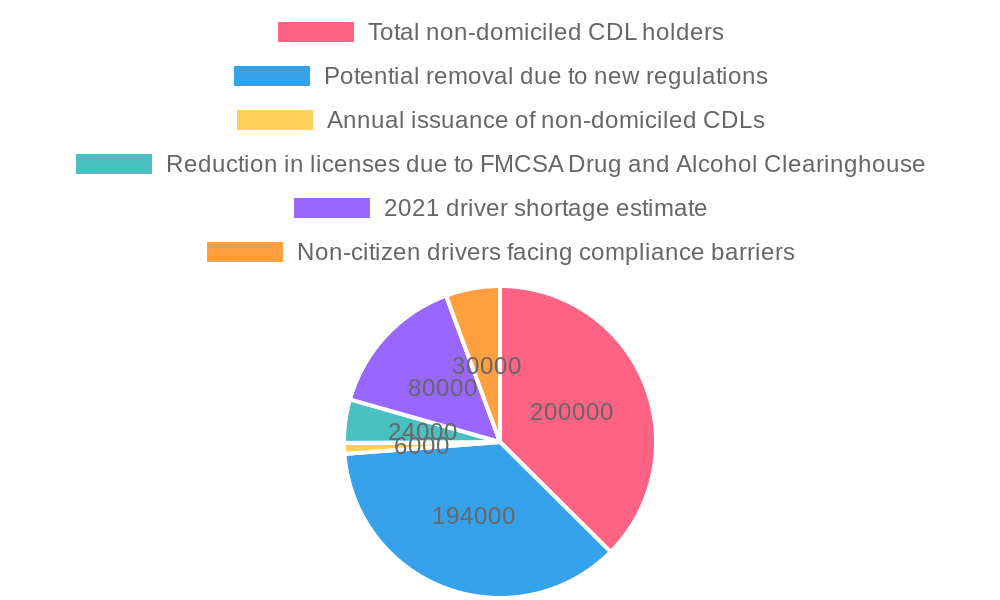
Statistics and insights on non-domiciled CDL holders show that the trucking industry is facing a potential crisis due to recent regulatory changes. The U.S. Department of Transportation estimates that nearly 200,000 non-domiciled CDL holders could be displaced by tougher regulations, representing about 5% of all active CDL holders in the country. These regulations are projected to reduce the number of non-domiciled CDLs issued annually to only 6,000, drastically limiting the workforce of eligible drivers.
In 2021, the American Trucking Associations reported that non-citizen drivers contribute significantly to the industry, with approximately 30,000 non-domiciled holders being forced to comply with new mandatory training. As a result of these changes, approximately 15,000 non-domiciled drivers have already exited the industry due to compliance barriers, deepening an existing driver shortage that had reached 80,000 by 2021.
Additionally, the enforcement of the FMCSA’s Drug and Alcohol Clearinghouse has caused further diminishment of valid licenses among non-domiciled drivers, adding a 12% reduction to the already decreasing driver pool. With an aging workforce and increasing retirements among domestic drivers, the situation poses a grim outlook for trucking operations and efficiency across the nation.
Conclusion: Implications and a Call to Action
As we stand at a crossroads with the U.S. Department of Transportation enacting these stringent CDL regulations, the implications for the trucking industry are not just statistics but deeply personal stories intertwined with the lives of real people. Approximately 194,000 non-domiciled CDL holders are facing the stark possibility of being pushed off the roads, effectively severing their livelihoods and impacting countless families dependent on their income. This drastic loss, representing about 5% of our driving force, underscores a looming crisis in an industry already strained by a driver shortage that has reached alarming levels.
The emotional toll on these drivers, many of whom have worked tirelessly to secure their place in the logistics ecosystem, cannot be overstated. They have dedicated years to honing their skills, contributing to the very fabric of American commerce. Yet, with the new regulations in place, it is imperative to recognize the nuanced interplay between safety and the operational viability of trucking. Striking a balance that upholds rigorous safety standards while allowing these skilled professionals to thrive is essential for the health of our economy and the well-being of our communities.
Moreover, as drivers lose their livelihoods, the ripple effect will extend far beyond families to the entire supply chain, potentially leading to increased freight costs and longer delivery times for consumers. It is a cycle that points to larger questions about the way we view labor in our economy—particularly in an industry that relies heavily on a diverse workforce.
Looking forward, it is crucial for all stakeholders—carriers, policymakers, and the community at large—to join hands in advocating for more inclusive, fair, and supportive regulatory frameworks. Engaging in discussions that promote solutions, such as better training programs and a smoother transition for non-domiciled drivers, is not just a regulatory necessity; it is a moral imperative.
The call to action is clear: let us not remain passive observers in this critical juncture but rather active participants in shaping an equitable future for all drivers. Together, we can champion policies that safeguard public safety while ensuring that no one is left behind as we work toward a more robust and integrated trucking industry.
Introduction
In a significant crackdown on commercial driving regulations, the U.S. Department of Transportation has introduced new CDL regulations for non-citizens, igniting urgent discussions across the trucking industry. This regulatory shift is not merely a procedural update; it carries profound implications for the operational backbone of American logistics, particularly its impact on the trucking industry. Recent estimates suggest that up to 194,000 drivers currently holding commercial driver’s licenses (CDLs) may be forced off U.S. highways, raising critical concerns regarding the driver shortage. As this policy takes effect, carriers and non-citizen drivers alike face uncertainty about their livelihoods, while potential disruptions loom large across supply chains that depend heavily on a diverse and skilled driving workforce. This imminent change raises questions about the balance between safety and accessibility in the transportation sector, inviting a closer look at its potential impact on the driver shortage and overall road safety. As we delve deeper, understanding these regulations is essential for all stakeholders involved—whether they are industry leaders, policymakers, or truck drivers themselves. The time for action and awareness is now.
Background on Current CDL Regulations for Non-Citizens
The landscape of Commercial Driver’s License (CDL) regulations for non-citizens has dramatically shifted, primarily driven by concerns of safety and immigration compliance. Historically, the issuance of CDLs has varied by state, with the Commercial Motor Vehicle Safety Act of 1986 setting the foundation for standardized requirements. Non-citizens were generally able to obtain CDLs, as long as they met the specific documentation and residency criteria set by individual states.
However, following the terrorist attacks on September 11, 2001, the focus on national security intensified, prompting federal oversight to tighten regulations surrounding licensing. The REAL ID Act of 2005 further strengthened these measures by requiring state-issued identification, including CDLs, to rise to federal standards concerning identity verification.
On May 9, 2022, the Federal Motor Carrier Safety Administration (FMCSA) issued an emergency final rule mandating that non-domiciled CDL applicants, i.e., those without permanent residency in the U.S., must now show evidence of lawful presence in the country. This rule arose amid increasing concerns that some states were issuing CDLs without verifying applicants’ immigration status, which could jeopardize public safety on highways. Under this legislation, states are restricted to issuing CDLs only to non-citizens who possess valid immigration documents, such as an unexpired foreign passport or Permanent Resident Card. This alignment with federal compliance aims to prevent fraudulent licenses from being issued and to hold states accountable for rigorous verification processes.
The implications of this rule are profound, and it is estimated that nearly 194,000 non-citizens holding CDLs will likely lose their licenses, drastically affecting the trucking industry, which relies heavily on these drivers. The American Trucking Associations highlighted that this regulation could exacerbate the ongoing driver shortage by displacing many qualified drivers who provide essential services in logistics and transportation. Moreover, there are challenges regarding compliance and the processing of applications, as carriers express concerns over delays in the verification process, further impacting supply chain operations.
Lawful non-citizens with visas such as H-2A, H-2B, or E-2 remain eligible for CDLs, but those without lawful documentation are barred. The final rule has spurred discussions within the industry regarding the balance between enforcing safety and ensuring the operational capacity of trucking fleets.
Impact on the Trucking Industry
The recent crackdown on Commercial Driver’s Licenses (CDLs) for non-domiciled holders, orchestrated by the U.S. Department of Transportation, is expected to have a profound and multifaceted impact on the trucking industry. These regulations aim to restrict approximately 194,000 non-citizen drivers from operating in the U.S. market, a move that raises urgent concerns over potential job losses and operational changes within trucking companies.
First and foremost, the anticipated removal of nearly 5% of the nationwide CDL workforce signals a looming crisis for an industry already grappling with a severe driver shortage. According to the American Trucking Associations, this regulation is poised to exacerbate an existing deficit of drivers, potentially leading to heightened delivery times and increased freight costs. Companies may face challenges in maintaining operational efficiency, which could ultimately trickle down to consumers in the form of higher prices for goods and logistics services. This potential increase in costs underscores the trucking industry impact on the economy as a whole.
Moreover, the restriction of CDL issuance to only a limited number of new applications will limit the influx of fresh talent into the field. As trucking companies rely heavily on a diverse pool of drivers to navigate the complexities of the logistics landscape, the elimination of non-domiciled drivers may hinder their ability to deploy necessary resources effectively. Various states are expected to issue only around 6,000 non-domiciled CDLs under the new rules, severely constraining the available workforce when the driver shortage is already a pressing issue.
In addition to the labor market shakeup, the new regulations could lead to significant shifts in company operations. Trucking firms may need to reassess their hiring criteria and adapt training programs to incorporate more domestic candidates, potentially illustrating gaps in skills and experience compared to their non-domiciled counterparts. The industry’s competitive landscape may also see changes, with domestic drivers likely commanding higher wages due to increased demand.
Insights from industry experts underscore the urgency of addressing these regulatory challenges. Many trucking companies advocate for a gradual implementation of such regulations to allow for a smoother transition and to cushion the economic impact on individuals and businesses alike. The regulation’s emphasis on safety and compliance is paramount; however, balancing these factors against the operational realities of trucking is crucial to sustaining industry health.
In conclusion, while the objective of the new CDL regulations is to enhance safety and accountability, the ripple effects on the trucking industry could lead to significant operational disruptions, job losses, and escalating freight costs. The ongoing driver shortage emphasizes the need for all industry stakeholders to remain vigilant and collaborative to navigate these changes moving forward.