
Understanding the legal landscape surrounding vehicle operation is crucial, especially for new drivers and vehicle owners. This article addresses a common concern: Can you legally drive a commercial vehicle with a private (non-commercial) driver’s license? We will delve into the crucial regulations governing this subject, exploring the definitions and classifications of commercial vehicles, along with the corresponding implications for private license holders. Finally, we will highlight the serious consequences and risks involved in violating these laws. By the end, you will gain a comprehensive understanding of the complexities surrounding driving commercial vehicles with a private license.
Legal Lines and Open Roads: Why a Private License Isn’t a Pass for Commercial Trucks and Buses
Across the world, the act of driving a vehicle that moves goods or people for profit is governed by a lattice of laws designed not just to test skill, but to manage risk on the road. The question implied by the chapter’s title—whether a private license can cover the responsibilities of a commercial vehicle operator—navigates a core tension: the separation of personal mobility from professional transportation. The answer, in most jurisdictions, is a firm no. A private license, even when it grants broad access to private cars or light-duty vehicles, is not a blanket permit to run a commercial operation. The road is public, but the rules that regulate commerce on that road are specific, layered, and enforceable with real penalties when crossed. The logic behind this distinction is not merely about who is behind the wheel; it is about who is empowered to carry risk, who bears responsibility for safety, and who contributes to public protection through training, qualification, and ongoing oversight.
To understand why, it helps to start with definitions that frame the entire conversation. In many countries, a commercial vehicle is anything used for profit-making activities. This includes freight trucks, delivery vans, passenger shuttles, taxis, and buses. The very nature of commercial work elevates duty of care: load securement, hours of operation, vehicle maintenance, and driver fitness all must meet standards that reflect the greater risk inherent in moving goods or large groups of people. The distinction is not merely about vehicle size or weight; it is about purpose. A C1 license in one system might legally permit you to drive a certain class of vehicle, but only if you are not engaged in business activities with that vehicle. The moment the vehicle becomes a tool of commerce, the license structure typically shifts toward a higher tier, with stricter qualifications and additional certifications.
Consider the Chinese framework as a concrete illustration of this logic. Official regulations describe a careful separation: ordinary or private-use vehicles are distinct from those used in commercial transport. A C1 license, in particular, allows driving small and micro-sized passenger vehicles (up to nine seats) and light or micro-sized cargo vehicles, but only when they are not used for commercial operations. The key phrase is the purpose of use, not merely the vehicle type. This is not a minor loophole to be exploited with clever planning; it is a fundamental boundary that, if crossed, triggers serious legal consequences. The same regulatory text introduces an additional, explicit requirement for anyone who intends to operate commercial transport: the Road Transport Personnel Qualification Certificate. This certificate signals that the driver has undergone professional training and passed examinations related to safety, regulations, and the operational procedures specific to commercial transport. In practice, this means that a person cannot simply decide to transition a private vehicle into a commercial instrument by changing the license sticker or the vehicle’s registration. The professional ethos of the industry—stringent training, compliance checks, and ongoing oversight—remains non-negotiable.
The penalties for crossing that line are designed to be clear and meaningful. Violating the rule—operating a commercial vehicle without the requisite qualification—carries legal penalties, often including fines, points on the license, and, in the most serious circumstances, revocation of the driver’s credentials. Insurance arrangements typically reflect the risk profile of commercial operations as well. When the proper qualification certificate is missing, many commercial insurance policies explicitly exclude coverage for the operation in question. A cited case in the literature underscores this risk: a client with only a private, ordinary license faced heightened risk because the enclosed truck fell squarely within the scope of commercial insurance exemptions. In short, the legal and financial consequences of misclassifying or misapplying a license in a commercial context are not abstract—they are operationally real and practically enforceable.
This narrative of boundaries does not exist in a vacuum. It echoes across jurisdictions, including the United States, where the regulatory architecture is framed by federal and, in some respects, state-level requirements. The Federal Motor Carrier Safety Administration (FMCSA) defines a commercial motor vehicle (CMV) in precise terms: vehicles weighing more than 26,001 pounds, or designed to transport 16 or more passengers (including the driver), or carrying hazardous materials require a valid Commercial Driver’s License (CDL). The implications are far-reaching. The CDL is not merely a tougher driving test; it is a credential that accompanies a professional career path, one that includes federal safety standards, medical qualifications, periodic training, and rigorous record-keeping. The FMCSA’s website stands as the central repository of these requirements, exemptions, and the layered regulations that guide commercial operation across the United States. Its guidance makes clear that the line between private and commercial driving is both formal and enforceable, and that crossing that line without the proper credential is a serious infraction with potential criminal consequences if accompanied by an incident or violation.
The difference between private and commercial driving is thus a matter of risk, responsibility, and regulatory depth rather than a simple question of what a license class permits. A private license may authorize the vehicle’s operation in everyday, non-business contexts; it does not confer authority to manage the additional duties that come with commercial transport. Those duties include adherence to hours-of-service rules, proper vehicle maintenance and inspection regimes, securement of loads, safeguarding of passengers or goods, and a higher standard for operator fitness. In many systems, the job of keeping a commercial fleet on the road—ensuring that drivers are current on training, testing, medical requirements, and qualification certificates—relies on a dedicated framework of oversight that is beyond the scope of private-use licensing.
From the lens of someone weighing a career in transportation or a business owner assembling a fleet, the practical implication is straightforward: if your plan involves moving goods or people for compensation, your path must align with the appropriate licensing and training tracks from day one. The process is not about bureaucratic hoops; it is about embedding safety and reliability into the chain of supply—where a single lapse can ripple through an entire operation. This is why the road to legality involves not one, but a combination of credentials. For many jurisdictions, including China, the combination is clear: the license that allows private use and the professional certification that validates capability to operate commercially are distinct and both are necessary for lawful operation. In the United States, the CDL functions as the indispensable minimum credential for CMV operation, supplemented by training, testing, and ongoing compliance with safety regimes that the FMCSA administers. The logic is the same in spirit across borders: private permission does not automatically translate into commercial permission.
The safeguards attached to commercial operation are also practical, not merely punitive. They serve as assurances to the public that drivers handling heavy, long-haul, or passenger-laden vehicles have demonstrated an appropriate level of competence and have been prepared to manage the unexpected. A driver who has delivered goods across multiple jurisdictions, or who ferries dozens of passengers daily, faces a different risk profile than a private motorist who uses a similar vehicle only for personal trips. The training pathways, the qualification certificates, and even the vehicle inspection repertoires reflect this reality. They are designed not to hinder entrepreneurship, but to foster reliable service, reduce accident risk, and secure the financial health of businesses that rely on transportation as a core capability.
The international dimension adds another layer of nuance. While this chapter centers on the China-China-US contrast to illustrate the mechanics of regulatory boundaries, the central principle remains universal: commercial vehicle operation intertwines vehicle type with purpose, safety, and professional standards. Different legal systems might label licenses differently or structure training in their own unique sequences. Yet the underlying doctrine—private use versus commercial use, with corresponding qualification requirements—remains a common thread. For anyone contemplating a move from private to commercial driving, the most prudent approach is to map out the licensing path before taking the wheel in a business setting. That path typically involves identifying the correct license category, understanding whether a professional qualification certificate is mandatory, arranging the required training, and preparing for the examinations that confirm knowledge of safety, regulatory compliance, and operational procedures. It also means recognizing the consequences of non-compliance, not as abstract penalties but as real risks to personal safety, corporate liability, and the integrity of the transport ecosystem.
Within this framework, the discussion about state rules and licensing often emerges as a practical matter for multi-jurisdictional operations. Some regions place a heavier emphasis on state-level variations in licensing rules, inspections, and enforcement strategies. For readers curious about how these local differences affect their careers or their business, there is value in examining the ways state rules shape the requirements for driver licensing and operational eligibility. A resource that delves into this question, titled in a way that mirrors the topic of this chapter, provides a window into how regional rules can oscillate around the same core principle: commercial driving requires credentials that certify competence and compliance with safety standards, regardless of how plain the road might appear on a map. For further exploration of how state rules influence licensing, see the discussion on state rules impact on driver licensing. state rules impact on driver licensing.
The practical implications for an individual are straightforward, but the path to compliance can be intricate. In China, meeting the minimum license requirement means obtaining both a C1 license and the Road Transport Personnel Qualification Certificate before any vehicle used in commercial activity can be operated in that capacity. In the United States, the road to legality requires a CDL, which is more than a badge of authority; it is a gateway to a regulated professional pathway that integrates medical standards, knowledge tests, and ongoing safety compliance. Across other jurisdictions, the pattern may differ in nomenclature but remains consistent in purpose: to ensure that drivers who move people or goods for profit have demonstrated appropriate training and the capacity to uphold safety on busy, mixed-use roads. The stakes are not abstract; they are about preventing accidents, ensuring accountability, and aligning every transportation operation with a framework built to manage the consequences of heavy vehicles on public space.
As readers weigh the decision to pursue commercial driving, a broader perspective is useful. The licensing architecture is part of a system that includes vehicle maintenance standards, inspection regimes, hours-of-service rules, and insurance structures that reflect the risk profile of commercial operations. Even the simplest commercial scenario—delivering a package along a short route—unfolds within a regulatory context that ensures the driver has the necessary training and the vehicle meets safety and maintenance benchmarks. That is why the idea of “driving with a private license” is increasingly understood as a misalignment with the demands of professional transport. The license is a gateway that signals commitment to the standards of the field; the certificate, test, and ongoing education that accompany it are the currency that keeps fleets safe, compliant, and trusted by the public.
In evaluating the legal landscape, it is important to separate the excitement of entrepreneurial opportunity from the sober requirements of the road. The private license grants access to personal mobility, but it does not automatically confer the legal right to assume the responsibilities that come with commercial transport. The separation is not a denial of progress; it is a guarantee that progress occurs within a framework designed to protect lives and livelihoods. If the goal is to operate commercially, the prudent path is to follow the established licensing trajectory, prepare for the required examinations, and anticipate the safeguards that accompany professional transport work. The alternatives—driving down the legal edges, or ignoring the boundaries—carry heavy risks that extend far beyond personal consequences. They threaten public safety, the viability of insurance arrangements, and the integrity of the transport system itself.
The broader takeaway is not a call to bureaucratic caution alone, but an invitation to alignment: align purpose with credentials, align training with risk, and align business ambitions with the regulations that govern the road. This alignment is what turns a private license into a legitimate platform for private mobility and keeps the commercial sector functioning with predictable safety and reliability. In that sense, the question—can we drive a commercial vehicle with a private license?—invites a nuanced answer that transcends a simple yes or no. It asks for a clear understanding of the role that licenses and professional qualifications play in transforming private vehicles into tools of commerce, and for recognition that the road deserves a framework that supports safe, accountable, and sustainable transportation across a complex and interconnected economy.
External reference for the regulatory framework in the United States: https://www.fmcsa.dot.gov/.
Class Boundaries and Private Licenses: How Commercial Classifications Shape Your Driving Rights
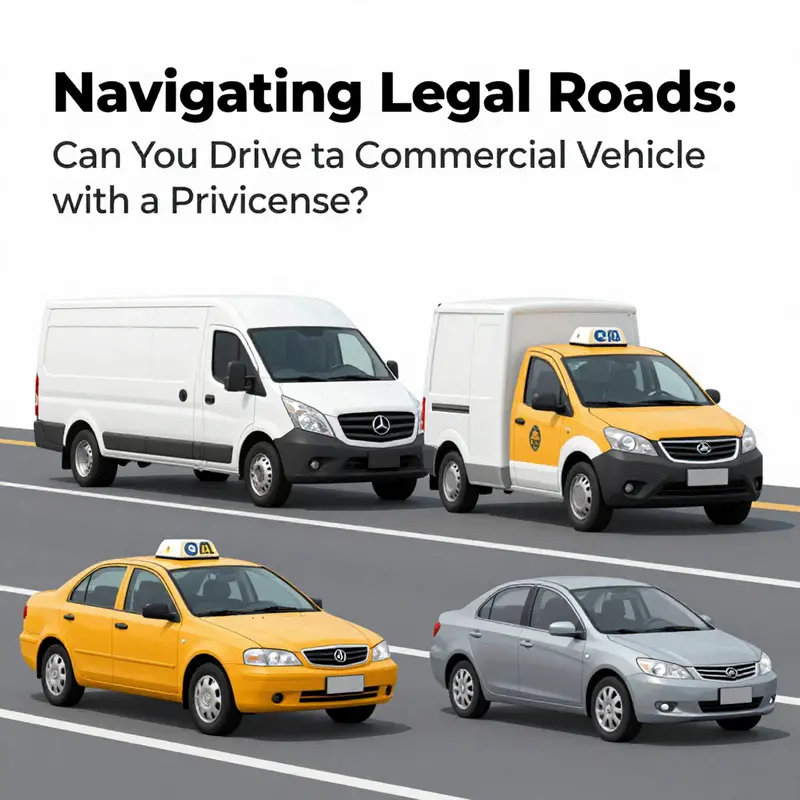
The regulative lines that separate private driving from commercial operation are rarely visible in everyday driving, yet they are the spine of how a road fleet operates, who may drive it, and under what conditions. In countries where road transport is tightly governed, classifications based on vehicle purpose, size, and weight become practical rules that protect safety, insurance integrity, and fair market competition. For a private license holder, understanding these classifications is not a theoretical exercise but a practical necessity. It clarifies when a vehicle is simply a personal conveyance and when it becomes a tool of business. It also reveals why a license that seems to permit broad freedom may, in fact, impose strict limits once commercial intent enters the equation. The core idea is straightforward, yet the consequences are real: classifications decide who can operate what kind of vehicle, for what purpose, and under what regulatory umbrella. When the line is crossed—whether knowingly or accidentally—the risks multiply, touching legal liability, insurance coverage, and even the integrity of the license itself. This chapter explores those boundaries with a focus on how private-license holders navigate the shifting ground that separates private use from commercial transport, and it considers how similar boundaries operate beyond one national border to illuminate common challenges and dangers that arise for drivers who assume their personal license covers business needs.
A practical way to grasp these boundaries is to picture a family car that is occasionally pressed into service for a small business need—say, delivering a pallet of goods for a weekend sale or shuttling customers in a private vehicle that suddenly grows into a makeshift courier. In many regulatory frameworks, that shift in use changes the vehicle’s classification—and, crucially, the license required to operate it. The crux of the matter lies in two related determinants: the vehicle’s technical identity (its size, weight, and capacity) and its intended use (private enjoyment versus commercial activity). While a private license may grant broad authority to operate a vehicle in everyday life, the same document does not automatically confer permission to carry passengers for hire, move goods for remuneration, or operate in a commercial fleet. The transpiring reality is that many jurisdictions maintain a layered system: a basic license governs your ability to drive the vehicle type, while commerce-specific credentials govern your ability to transport for profit.
Take, for instance, the framework most readers will recognize from several regulatory traditions. In some systems, a vehicle is classified and then licensed according to its Gross Vehicle Weight Rating (GVWR) or its rated payload, with additional classifications that reflect whether the vehicle is designed to carry passengers, freight, or hazardous materials. A separate endorsement or certificate may be required if the vehicle crosses certain weight thresholds, exceeds a specified passenger count, or is used in a business context such as delivery, taxi, or bus operations. This separation serves multiple purposes: it ensures that drivers who operate heavy or high-risk vehicles have completed targeted training and testing relevant to safety and regulatory compliance; it compels operators to maintain higher standards for maintenance, insurance, and accident reporting; and it helps public authorities monitor and regulate the impact of commercial transport on road networks and economies.
In the specific regional context highlighted by recent regulatory discussions, the private license category often demarcates not just what you can drive, but how you can use it. A license that permits the operation of light or micro-sized trucks may explicitly prohibit those vehicles’ use for commercial purposes. The reason is simple: commercial operation introduces risk and complexity that personal use does not. The owner-operator driving a small cargo vehicle for personal errands stands in a different regulatory position from someone who uses the same class of vehicle to haul goods for a business, with responsibilities that include safety oversight, record-keeping, insurance delineations, and compliance with commercial transport law. This divergence protects both the public and the business ecosystem by ensuring that operators meet specialized qualifications appropriate to the scale and risk of their work.
China’s regulatory landscape, for example, makes this distinction explicit and practical. A C1 license, which governs small and micro-sized passenger vehicles and light or micro-sized cargo vehicles, is not a free pass for commercial activity. The purpose of use matters, not merely the vehicle’s technical classification. The same C1 license, held by a private individual, may legally authorize the operation of certain vehicles only when those vehicles are not engaged in commercial operations. To move goods or people for remuneration, a driver must also obtain the Road Transport Personnel Qualification Certificate. This credential attests that the driver has undergone professional training and passed examinations focused on safety, regulatory acumen, and the operational procedures that accompany commercial transport. The consequence of ignoring these rules is not hypothetical. Legal penalties, points on the license, or even license revocation may result, and commercial insurance coverage can be invalidated for claims arising from the use of a vehicle in a commercial context without the appropriate qualification. A common but often overlooked reality is that insurance policies frequently exclude claims that arise when a vehicle is used for commercial purposes without the proper credentials. In one illustrative scenario, a client who held only a C1 license and lacked the required qualification certificate faced heightened risk in commercial work, underscoring why insurers and regulators regard the gap as more than a technicality. The licensing ecosystem functions precisely to prevent such gaps from becoming systemic risks on the road.
This is not a claim unique to one country; it reflects a broader, cross-border pattern in which jurisdictions set thresholds that trigger higher regulatory scrutiny as the potential harm increases. In North America and parts of Europe, for instance, the push toward more stringent operative criteria for trucks and buses has produced a parallel structure of endorsements and certificates. The Federal Motor Carrier Safety Administration (FMCSA) in the United States, for example, requires specific endorsements for operating vehicles above weight thresholds, or for carrying hazardous materials. A private-license holder who attempts to drive a delivery van that falls into a higher weight class without the appropriate Commercial Driver’s License (CDL) or endorsements would be in violation of the law. The underlying rationale is consistent with the Chinese example: commercial operations demand specialized competencies and oversight that are not fully captured by a standard private license. The aim is not merely to enforce compliance for its own sake but to ensure that heavier, more complex, or risk-laden operations are conducted under a framework that explicitly recognizes and mitigates the additional risks involved.
To understand these classifications in a more granular way, it helps to consult standard references that codify what constitutes a Class A, B, or C vehicle and how those classes map onto practical operations. SAE International’s Dictionary of Commercial Vehicles is one such reference. It provides a clear taxonomy that defines classes not merely by the vehicle’s appearance but by its GVWR and its intended use—often in ways that are useful even to private-license holders who need to plan career shifts or business ventures that might involve vehicle operations beyond their current permissions. Class A, for example, covers trucks towing trailers with a combined GVWR that exceeds a certain threshold, while Class B covers single vehicles beyond a heavier GVWR, and Class C encompasses passenger vehicles that carry a larger group of people or hazardous materials. These definitions matter in practice because they determine what kind of training, testing, and endorsements a driver must hold to lawfully operate the vehicle in a commercial setting. For private-license holders contemplating any move toward commercial activity, becoming acquainted with these definitions helps illuminate what credentials are necessary before stepping behind the wheel in a professional context.
The practical implication of these classifications, then, is that private license holders must assess not only the vehicle they own or intend to operate but also the purpose for which they intend to use it. If the vehicle’s technical profile and the intended use align with a private, non-operational role, a standard license may suffice. If, however, the business side of the operation enters the picture—delivering goods, transporting passengers for hire, or moving freight in a way that generates revenue—the license must be accompanied by the appropriate commercial endorsements or qualifications. In the China-focused example, that means the C1 license plus the Road Transport Personnel Qualification Certificate. In other jurisdictions, it might involve a CDL with a specific class designation or a separate endorsement for passenger transport or hazardous materials. In every case, the license evolves from a personal permit to a gateway that certifies capability to operate within a particular risk framework and under precise regulatory conditions.
An essential point for private-license holders to recognize is that classifications are more than bureaucratic hurdles. They carry implications for insurance coverage and liability in the event of an incident. If a driver uses a private vehicle in a way that falls within a commercial use category without the corresponding credentials, insurers often deny coverage or substantially limit their liability. This outcome compounds the legal penalties and could leave a driver financially exposed in the wake of an accident. The risk calculus changes when a vehicle’s use crosses into commerce, because the potential consequences—ranging from vehicle damage to injuries to third parties—increase with the scale and speed of operations. Companies that run fleets face a parallel calculus: misclassifying operations or misusing personnel credentials can trigger audits, penalties, and reputational damage, alongside the obvious legal and financial penalties for the individuals involved. In short, classifications help align individual responsibility with systemic safety and economic considerations and serve as a practical framework for ensuring that drivers are prepared for the specific risks posed by commercial transport.
For readers who are contemplating how their day-to-day driving might evolve into a business activity, the chapter’s throughline is clear: do not assume that a private license guarantees access to commercial operations. Take stock of the vehicle’s technical profile and the intended use, and then align those factors with the appropriate licensing path. If a commercial operation is on the horizon, plan for the necessary professional qualifications before stepping into the driver’s seat in a business context. The process often involves formal training, examinations, and periodic renewals, all designed to maintain a standard of safety and regulatory compliance that private-use driving does not require. This is not a purely punitive regime; it is, at its core, a safety-first framework designed to ensure that the complexity and risk of commercial transport are matched by driver competency, vehicle maintenance discipline, and a transparent regulatory record.
Within this broader landscape, the distinction between private and commercial driving becomes a practical, navigable boundary rather than an abstract principle. The boundary helps individual drivers assess their current rights and obligations while offering a clear path for those who decide to expand their activities. The decision to move from private to commercial driving is thus a decision about training, certification, and the willingness to operate under a different set of safeguards. It is a decision that can bring new opportunities for work and independence, but it also carries responsibilities that must be acknowledged and honored. For those who choose to stay within the private-use lane, the classification system still matters. Understanding where personal vehicle use ends and commercial use begins can prevent inadvertent violations, protect the driver’s license, and maintain safe operation on the roads where many lives depend on the clear, predictable behavior of every vehicle and driver.
To bring the discussion full circle, consider the practical implications for a reader who is juggling personal mobility with a budding interest in small-scale commerce. The private license does not automatically confer the right to engage in commercial transport. Even if a vehicle seems classifiable as a light or micro-sized model appropriate for everyday tasks, the act of using it to earn money invites the full apparatus of commercial regulation. The right to move goods or passengers for pay under a private license is, at best, a misalignment of intent and capability. The appropriate response is to pursue the correct certification, to understand the relevant weight and passenger thresholds, and to recognize that a license is not a static permission but a living credential that must reflect the scope of one’s driving activity. In this way, the classification system operates not as a punitive gatekeeper but as a practical mechanism for ensuring safety, accountability, and market integrity across the road transport sector.
For readers seeking more detailed mappings of these rules, it is worth consulting authoritative sources that spell out the exact definitions and requirements. In the broader cross-border context, the SAE Dictionary of Commercial Vehicles provides an typology that helps both professionals and private individuals clarify the boundaries between personal and commercial use. This resource, cited in the chapter’s context, offers precise definitions that can guide decision-making and risk assessment when contemplating any shift toward commercial driving. It is a useful reference for anyone who wants to understand the vocabulary regulators use when they classify vehicles and operations, and it helps demystify the language of weight classes, payloads, and passenger capacities that underpins licensing policies. As readers explore these definitions, they should remember that they describe a regulatory system designed to balance mobility with safety, accountability, and the practical realities of road use across different economies.
In closing, the central idea remains consistent: private license holders must respect the boundary that separates personal mobility from commercial transport. Vehicle classifications embody that boundary, and they determine the appropriate licensing pathway. Whether you are planning to keep driving as a private individual or you are considering a step into commercial transport, your decision should be guided by a clear understanding of how your vehicle’s classification aligns with your intended use and the licenses or certificates that the regulatory regime requires. This awareness protects you, your passengers, your cargo, and the broader traveling public. It also clarifies for planners and students of transport policy how a seemingly simple question—can I drive a commercial vehicle with my private license? often yields a nuanced answer that depends on where you are, which vehicle you operate, and what you intend to do with it. The road to compliant, safe operation is paved by knowledge, preparation, and a willingness to align one’s driving privileges with the responsibilities that come with commercial transport.
Internal link for further reading: readers curious about how state rules can impact driver licensing in different jurisdictions can explore a practical discussion at the page titled state rules impact on driver licensing, which offers concrete considerations for drivers moving between private and commercial practice. state-rules-impact-on-driver-licensing.
External resource for precise definitions: for a scholarly and practitioner-facing taxonomy of commercial vehicle classes, see the SAE International Dictionary of Commercial Vehicles, which provides authoritative definitions and context for Class A, Class B, and Class C designations. https://www.sae.org/publications/books/content/dictionary-of-commercial-vehicles/
Privilege Is Not a Permit: The Legal and Safety Case Against Driving a Commercial Vehicle on a Private License
In the practical calculus of driving, many people assume that the vehicle category alone determines what kind of license they need. Yet the regulatory landscape for commercial transport tells a more nuanced story: a private license does not automatically morph into a ticket to operate for hire, carry goods for profit, or transport passengers as part of a business. The assumption that a private driver’s license, even a relatively permissive one, covers commercial operations is not merely mistaken—it risks public safety, substantial legal penalties, and serious financial exposure. This chapter unspools the core logic behind that boundary and illustrates why the line between private mobility and commercial transport is drawn not by vehicle type alone but by the purpose of use, the training that undergirds professional operation, and the legal certificates that verify both competency and accountability.
At the heart of the matter is a precise but frequently misunderstood distinction: a vehicle can be physically capable of performing commercial tasks, yet the law may still require a different credential if the vehicle is used to generate revenue or to provide a service in exchange for compensation. In many regulatory regimes, the same model of practical flexibility that allows private individuals to use smaller vehicles for family errands and weekend projects does not extend to the business world of freight, logistics, or passenger services. In places where commercial transport is tightly regulated, this distinction is codified in official rules that separate vehicle eligibility from operational purpose. The effect is simple but powerful: a C1- or similar private license, by itself, usually enables you to drive certain small passenger or light cargo vehicles for private use, but it does not authorize commercial operations. The logic is not arbitrary; it is grounded in risk management, public safety, and the safeguarding of users who rely on professional transport networks for daily life, commerce, and supply chains.
A close look at the regulatory framework reveals an essential requirement that sits alongside the private license in many jurisdictions: the Road Transport Personnel Qualification Certificate (or its local equivalent). This certificate is not a mere formality. It represents a formal recognition that the driver has undergone specific professional training and has demonstrated competence in safety protocols, regulatory compliance, and the operational procedures that distinguish commercial transport from private usage. The certificate acts as a public assurance that the driver can handle the heightened complexities of commercial operations. In practical terms, it means safety training that encompasses route planning for cargo and passengers, weight and load management, hours-of-service rules, risk assessment for different weather and road conditions, and the management of emergencies that can arise on longer or heavier transports.
The difference between private use and commercial use is therefore anchored in purpose, not just in the vehicle’s size or weight. This distinction is reinforced by the example of how a license class is paired with operational intent. In jurisdictions where private licenses permit only non-operational or privately used vehicles, attempting to engage in business activity with that same vehicle becomes a breach of the licensing regime. The consequences extend beyond minor sanctions: the integrity of the licensing system depends on each operator complying with standards designed to prevent harm and to ensure accountability when things go wrong. The idea that a private vehicle can be converted into a commercial asset simply by switching the business model on a resume or a business plan ignores the practical realities of road safety, vehicle management, and traffic law enforcement.
The practical implications of this separation become clearer when considering the consequences of non-compliance. If a person drives a vehicle for commercial purposes without the required qualifications, the spectrum of penalties rapidly expands from administrative fines to more serious consequences. Financial penalties can be substantial, and in some jurisdictions, the offense carries points that accumulate toward license suspension or revocation. The risk is not only to the driver but to all road users who share the road—passengers, pedestrians, other commercial drivers, and private motorists who rely on predictable, professional behavior from commercial operators. Insurance implications compound this risk. Many insurance policies explicitly exclude coverage for activities that fall outside the scope of the insured driver’s license or certification. If an accident occurs while operating a commercial vehicle without the necessary qualifications, the insurer may deny claims, leaving the driver personally liable for damages, medical expenses, and the costs of vehicle repair. A widely cited scenario in this space centers on the absence of the required qualification certificate when operating an enclosed truck within the commercial realm. The resulting exposure is not only financial but cultural: it signals a lapse in the professional standard expected of anyone who handles freight or passengers for hire.
The social contract aspect is equally important. Public safety relies on an ecosystem of trained professionals who understand the higher responsibilities that come with moving goods and people in larger quantities and at higher speeds. Commercial transport amplifies risk factors that private driving typically minimizes: longer vehicle lengths, greater stopping distances, heavier loads, and more complex maneuvering in urban and rural environments. In emergency moments—whether navigating a sudden downpour on a mountain road or braking at the end of a long descent—experienced professional drivers can draw on targeted training to reduce risk. When drivers operate without the proper qualifications, the likelihood of misjudgments rises; the consequences can be severe, not only for the driver but for the many people whose lives intersect with those heavy and commercialized movements.
Enforcement behavior around licensing reflects the seriousness of these concerns. Authorities treat the practice of driving commercial vehicles without the appropriate credentials as a violation of traffic laws, with typical enforcement actions including fines, penalties, vehicle impoundment, and, in more serious cases, criminal proceedings. The legal machinery is designed to deter people from using private licenses as a back door into commercial operations. The reputational damage to drivers who are found operating without the proper certificate can be long-lasting, complicating future attempts to secure legitimate driving roles and eroding trust in the broader transport system.
Public safety concerns extend to the safety of infrastructure and property. Commercial vehicles—freight trucks, delivery vans, and buses—are involved in accidents with consequences that can be enormous. Large vehicles often have significantly longer braking distances than private cars, and their handling characteristics differ substantially, particularly under adverse weather conditions. The risk profile changes with load distribution and center of gravity, which means that a driver without professional training may not adequately assess stability or the need for special loading procedures. The ripple effects include road closures, damage to urban infrastructure, and secondary accidents that can cascade through traffic networks, undermining both efficiency and safety.
Against this backdrop, the insurance dimension cannot be overstated. Insurance agencies design policies around expected risk profiles associated with commercial operations. When a driver lacks the required certification, insurers may either refuse coverage or impose higher premiums, asserting greater risk or nullifying coverage entirely if an accident is deemed to have occurred within the bounds of illegal operation. This reality places a heavy financial burden on individuals who attempt to compress private driving into a commercial use case. The logic is straightforward: the combination of untrained handling and the potential severity of outcomes makes the risk unacceptable to underwriters, who must protect their balance sheets and other policyholders from disproportionate losses.
The regulatory environment is not static, and local variations matter. In some places, the frameworks are explicit about the alignment between license type, qualifications, and the permitted use of vehicles for commercial purposes. In others, the lines may appear blurred due to differences in enforcement emphasis, the pace of regulatory change, or the existence of transitional provisions. What remains constant across jurisdictions is the central premise: operating a commercial vehicle requires more than a valid license. It requires proof of professional training, a formal qualification certificate, and ongoing compliance with a suite of regulations designed to ensure safe, predictable, and accountable service. The cost of not meeting these standards far exceeds the financial penalties; it endangers lives and undermines the trust people place in the broader transport ecosystem.
These points are not merely theoretical. They translate into concrete, real-world decisions about career paths, business models, and personal risk. For a driver contemplating whether to use a private license for commercial work, the question is not simply whether the vehicle is small enough or if the route seems straightforward. It is whether the operation is supported by the credentials that a profession demands. If the answer is uncertain, the prudent choice is to pause, pursue the necessary qualifications, and pursue a legitimate authorization to operate within the commercial sphere. While it may require time, effort, and investment, the payoff is a stable professional status, access to legitimate work opportunities, stronger protections under insurance provisions, and, crucially, safer roads for everyone.
An awareness of the potential loopholes in licensing practice adds another layer to this discussion. The temptation to circumvent standards—whether through misrepresentation of qualifications, exploiting ambiguities in local rules, or engaging in schemes designed to bypass established procedures—poses a direct threat to safety and accountability. Such behavior has been documented elsewhere in the broader discourse on driver licensing and professional qualifications. It underscores why the system emphasizes verification, record-keeping, and ongoing professional development. It also highlights why the public and policymakers should remain vigilant about the integrity of licensing processes. When the public trusts that commercial drivers are properly vetted and trained, accidents become less likely, and the consequences of mistakes are mitigated by predictable professional practices. For those who wish to explore how some attempts to skirt licensing requirements have been addressed, consider the broader discourse on licensing integrity, including discussions framed by cases like the CDL cheating scheme exposed, which serve as cautionary exemplars of what can go wrong when safety and accountability are compromised. CDL cheating scheme exposed.
Beyond legal and safety considerations, the practical path to legitimacy is surprisingly straightforward, though it does demand commitment. In many regulatory regimes, individuals who want to drive for commercial purposes must first acquire the appropriate driver’s license category that aligns with the type of vehicle they will operate. Then, they must obtain the Road Transport Personnel Qualification Certificate or its equivalent. This process typically involves a course of professional training that covers not only the mechanics of driving but also the rules governing professional operations: load management, packaging and securing cargo, vehicle maintenance basics, route planning, hours-of-service compliance, and incident response. The examination typically consists of written components on regulations and safety and a practical assessment of driving competence under controlled conditions. The certificate then becomes a credential that operators carry with them as evidence of their ability to meet professional standards. The availability of these qualifications varies by jurisdiction, but the underlying model is consistent: a dual requirement—proof of driving competence and proof of professional training—protects the public from the random risks that arise when private-driving habits are applied to commercial tasks.
For those navigating this landscape, the steps toward compliance can be viewed as an investment in a sustainable, lawful, and safer career. The process is not merely about ticking boxes; it is about earning incremental safety capital through training, testing, and certification. It is also about recognizing that the standard of care in commercial transport is higher because the impact of errors is magnified by the scale of operations and the number of people who can be affected. While the administrative process may feel onerous, the payoff is a more robust professional identity, clearer career pathways, and a more secure foundation for business operations that rely on dependable freight and passenger services. In addition, alignment with these standards often opens doors to legitimate contracts, insurability, and compliance with broader logistics and transportation requirements that govern modern economies.
The broader public conversation around licensing and professional qualifications is not limited to one country or one regulatory regime. Yet the core lesson remains consistent: the boundary between private and commercial driving should be respected, not tested. The vehicle’s physical capabilities or the operator’s intent cannot by themselves override the safeguards designed to keep road traffic safe. When a private license purports to cover the responsibilities of commercial transport, the system’s safety net is breached, and everyone bears the cost. This is why the core rule—drive a commercial vehicle only with the proper license and the mandatory qualification certificate—is not simply bureaucratic red tape; it is a safeguard for road users, a framework for professional accountability, and a foundational element of a fair and functioning transport economy.
The subject also invites reflection on how licensing policies relate to broader questions of regulatory fairness and public trust. People who invest time and money to obtain the correct licenses and certificates should not be placed in competition with those who circumvent rules. The integrity of licensing programs depends on public confidence that the rules are applied consistently and that penalties are adequate to deter non-compliance. When businesses or individuals choose to operate outside the official framework, they not only risk legal penalties but also threaten the equitable conditions that legitimate operators rely on. The consequences of non-compliance thus extend beyond the individual driver, affecting fleets, insurers, clients, and the traveling public who depend on reliable, professional transport services. The ethical dimension—protecting the public from unnecessary risk—grounds policy decisions and reinforces the practical rationale for strict compliance.
As this chapter connects the dots between private licensing and commercial responsibility, it is useful to consider how readers might apply this understanding in real life. If a reader is contemplating a career in trucking, logistics, or passenger transport, the prudent path is to map out the licensing ladder in their jurisdiction. Start with the class of license that governs the intended vehicle type, then identify the required professional qualification for commercial operation, and finally plan the training and testing steps that lead to certification. For those already operating, a review of one’s credentials and a readiness for the compliance audit can be an essential defensive move. Public safety is not a theoretical concept; it is a continuous practice that begins with recognizing the limits of private licensing when public and commercial responsibilities are at stake.
The regulatory narrative is enriched by regional contrasts, which illuminate how different jurisdictions balance freedom of choice with safety and accountability. In some places, the path to legal commercial driving is explicit and relatively streamlined, while in others, it is layered with additional attestations, medical checks, or periodic renewals to ensure ongoing competency. Regardless of where one is, the principle endures: private licenses enable private travel, but commercial travel requires professional credentials that certify competencies beyond basic driving. The distinction protects road users and builds trust in the systems that keep the supply chains moving and the passenger networks operating smoothly. It is a discipline grounded in public service, not a punitive afterthought; it is, in effect, the margin of safety that accompanies the responsibility of moving people and goods at scale.
In closing, the question Can we drive a commercial vehicle with a private license? receives a clear and practical answer grounded in safety, legality, and economic integrity. The short response is no in most regulated frameworks, but the longer answer explains why this is the right policy. The private license is a starting point, a personal credential that demonstrates basic driving ability. The commercial world, however, sits on a platform of verified qualifications, standardized training, and enforceable standards that uphold public safety and fair competition. This layered approach ensures that those who operate heavy or passenger-carrying vehicles are prepared for the responsibilities that come with professional transport and that the broader travelling public can rely on consistency, predictability, and accountability on every road—and in every driveway that feeds into the commercial flow of goods and people. The distinction may seem subtle, but the outcomes are tangible: safer roads, more reliable service deliveries, and a licensing system that serves the public good rather than private convenience.
External resource for licensing standards: Transport Department of Hong Kong: https://www.td.gov.hk
Final thoughts
Navigating the nuances of driving regulations is essential for any driver, especially those considering operating commercial vehicles with a private license. This comprehensive examination has reinforced the legal boundaries set by regulators and highlighted the need for the appropriate qualifications. Understanding that a private license restricts commercial vehicle operation is vital for compliance and safety. Always seek the right qualifications and certifications to avoid severe penalties and insurance complications.