
Navigating restrictions on your driver’s license can be complex, particularly when it comes to driving a work vehicle. The constraints imposed by a restricted license can vary widely based on individual circumstances and state regulations, raising many questions for new drivers, existing drivers, and vehicle owners alike. Understanding the types of restrictions that exist, how they affect the nature of work vehicles you can operate, and the regulations specific to your state is crucial. This guide will define these elements in detail, empowering you to make informed decisions regarding your driving privileges and responsibilities.
When Restrictions Shape the Road: How Different License Limits Reframe Driving a Work Vehicle
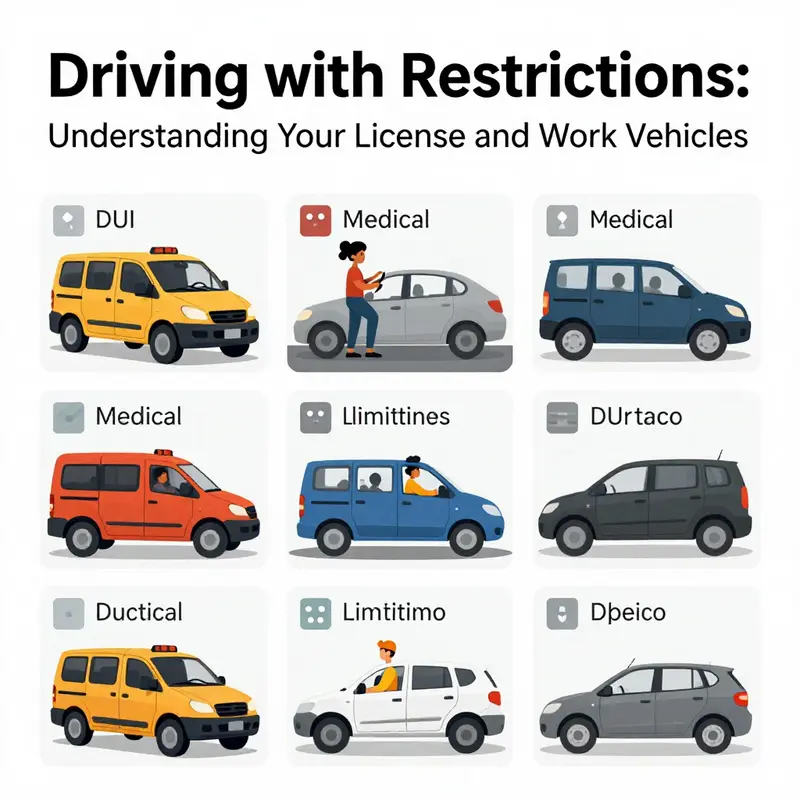
The question of whether you can drive a work vehicle with a restricted license sits at the intersection of safety, law, and practical employment needs. A restricted license is not a blanket ban or a loophole; it is a precise set of conditions designed to limit risk while preserving mobility where possible. In workplaces that rely on driving as a core function, that balance proves both essential and challenging. To navigate it well, you begin not with the job you do but with the restriction you carry. The type of restriction matters as much as the vehicle you intend to drive, because the two shapes are inseparable when it comes to legality and safety on the road. The road map is not a single rule but a spectrum of limits that can either align with your daily tasks or block entire swaths of the work you were hired to perform. Understanding this map requires looking closely at the most common categories of restrictions and then translating those rules into practical consequences for daily duties.
One of the clearest fault lines runs along the medical border. When a restriction is tied to medical conditions such as vision impairments or a history of seizure activity, the gatekeeping is explicit. In many places, those medical concerns can translate into a prohibition on driving any vehicle, not just the kinds you might use for work. The logic is structured around the risk of harm, and the consequences are proportionate to the threat placed on the road and on those who share it. If a health status makes operating a vehicle unsafe, the licensing authority may require surrendering the privilege altogether, or it may permit driving only under very narrow conditions, such as specific medical surveillance or a physician’s clearance. In a sense, the medical restriction functions as a shield for the public, but it can also be a personal and professional obstacle, especially when your job depends on mobility.
A separate, equally consequential category stems from history or behavior—restrictions that emerge after violations or as a condition of probation. A DUI or similar restriction can, in many jurisdictions, allow limited driving under tightly controlled circumstances. Often this means vehicles equipped with an ignition interlock device or a requirement to drive only to specific destinations, like work, during certain hours, or along approved routes. The practical effect is that a person may be allowed to move about in limited ways, with monitoring that can feel invasive to daily routines. For an employee who needs to commute to a remote work site or to pick up materials, these provisions can determine whether the job is even feasible. The risk calculus here centers on public safety, but the personal stakes include income stability, employer trust, and future employability within safety sensitive roles.
Beyond health and history, the rules of the road also carve out how long you can be behind the wheel and where you may go. Time-of-day restrictions can clash with shift work, making once straightforward commutes into logistical puzzles. A person whose shift runs into the late evening or early morning may find that their license allows driving only during daylight, effectively blocking essential tasks. The impact is not merely theoretical. It can translate into missed deliveries, delayed service calls, and the need to rework schedules, routes, and even customer commitments. The friction between a work timetable and a license timetable is a practical, daily negotiation that can strain both employee and employer if not anticipated and addressed openly.
Vehicle type restrictions compound the challenge further. Many restrictions specify that only certain kinds of vehicles may be driven. The distinction between light-duty and heavy-duty is not academic; it defines the scope of permissible work. A restriction that confines operation to light-duty vehicles may preclude operating larger trucks, specialized machinery, or vans above a given gross vehicle weight rating. In jobs such as logistics, maintenance, or field service, the inability to handle certain classes of vehicle can effectively relegate a worker to non-driving tasks or to roles that do not require road time. Conversely, some non-commercial, personal-use vehicles used for work tasks may fall within a permitted category, enabling continued road work if the vehicle remains within the defined limits. The precise language of the restriction—what is allowed, what is disallowed, and under what conditions—will determine the day-to-day viability of the driving component of a job.
Geography—the space where a driver may roam—constitutes another layer of constraint. Geographic restrictions can set boundaries around counties, regions, or even specific routes. A work assignment that spans multiple locales or requires travel across a defined corridor may become impractical or impossible if the license confines driving to a home city or a narrow radius. That limit does not merely affect the ability to reach a site; it can shape the entire business model, particularly for roles that rely on field visits, sales calls, or service delivery at varied locations. In practice, geographic restrictions can force a reassessment of job design, route planning, and client coverage, prompting questions about relocation, telework options, or subcontracting certain tasks.
The move toward inclusive workplaces has, in many cases, required accommodating devices or adjustments to vehicles. A restriction may require the use of auxiliary devices such as hand controls or other modified steering systems. The question then becomes not simply whether the driver is legally permitted to operate a vehicle, but whether the work vehicle in question can be adapted to fit the driver’s needs. This intersects with employer resources, safety policies, and the availability of compatible equipment. A vehicle that cannot accommodate the required modifications may render a job incompatible with the driver’s license status, even if other conditions would allow operation. At the same time, institutions and safety programs can, in some cases, provide pathways to operate under modified setups, so long as the devices align with safety standards and are properly certified. The real-world effect of auxiliary device requirements is that they transform the vehicle from a simple tool into a potentially complex system of safety features, user interfaces, and ongoing training.
A separate and often overlooked constraint is the prohibition on commercial driving under many restricted licenses. Many restrictions explicitly bar the operation of vehicles used for business purposes, including company vans, delivery trucks, or other vehicles engaged in commerce. This is not merely a bureaucratic distinction. In many industries, driving for work is a core responsibility tied to a specific license class such as a Commercial Driver’s License. Even when a worker holds a standard license that would otherwise permit operation of certain vehicles, a restriction may override that privilege if the vehicle is used in the course of business. The practical consequence is straightforward: a worker who might otherwise be competent behind the wheel could be disqualified from the driving task if the job’s nature is commercial in character. This can affect hiring pipelines, promotions, and daily task assignments, particularly in sectors where mobility and on-site service delivery are central.
The cumulative impact of these restriction types on a given job can be substantial. A shift that runs late into the evening but is barred after dusk may become unworkable without a change in scheduling or job design. A route that requires reaching distant job sites across a region can become untenable if geography confines the driver to a small zone. A heavy-duty delivery role may be out of reach if vehicle type restrictions exclude the necessary equipment. And if a restriction requires specialized devices that cannot be installed on the company’s existing fleet, the employer faces a decision: adapt the fleet, reassign tasks, or seek a driver with a different license status. In some cases, the employer may need to engage in risk assessments, update role descriptions, or explore alternative staffing arrangements. In others, accommodations will be limited by safety standards or financial feasibility.
The legal landscape adds another dimension. Licenses are issued by state authorities with varying rules, and those rules are not uniform across the country. A restriction that seems manageable in one state may be interpreted differently in another. The practical implication for the worker is that a blanket understanding of restrictions is insufficient. The precise language of the permit must be reviewed against the jurisdiction’s official guidance. This is why the process of checking with the local DMV, or the equivalent licensing authority, is not a formality but a necessary step in ensuring that your interpretation aligns with enforceable rules. When you contact the licensing authority, you should have ready details about the vehicle you plan to operate, including make, model, and especially the GVWR, or gross vehicle weight rating, along with a clear description of the work use. Providing this information helps ensure that you receive guidance tailored to your situation, rather than a generic caution that might leave you uncertain about your rights and responsibilities.
The employer’s role in navigating restricted licenses is often decisive. Some employers require drivers to have an unrestricted license for safety-sensitive roles, and they may insist that a restricted license disqualifies an employee from operating work vehicles altogether. Others may be more flexible, offering accommodations such as reassigning driving duties, adjusting schedules, or providing alternative transportation options to cover essential trips. This gap between what is legally allowed and what is operationally feasible is filled in the workplace by clear communication, policy alignment, and documented agreements. Workers who rely on their license to earn a living should approach their employer with a transparent assessment of what their restrictions permit, what tasks remain possible, and what changes would be necessary to keep the job on track. In many situations, the two parties can craft a plan that preserves safety and productivity, though not every arrangement can be achieved, and some workers may need to pivot to roles that better fit their license status.
A practical path to resolution begins with accurate information. Start with the exact terms of the restriction and the vehicle types you are allowed to operate. Then verify whether those terms include any allowances for work-related driving, exceptions for certain routes, or temporary waivers during transitions. It is often helpful to bring a vehicle’s specification to the conversation—the GVWR, the type of drive (front, rear, all-wheel), and whether any modifications are permissible or required. If the restriction is due to medical concerns, gather any medical clearance or certification you possess and be prepared to share how your condition is controlled through treatment, devices, or monitoring. When the restriction hinges on safety or past violations, demonstrate how you maintain compliance through training, defensive driving courses, or ongoing monitoring as appropriate. The process may involve a formal appeal or a modification request with the licensing authority, a pathway that some jurisdictions explicitly permit. In others, it may require legal counsel or a formal safety plan endorsed by the employer. Regardless of the route, the core objective remains the same: to determine whether safe, compliant operation of a work vehicle is possible under the specific terms of the restriction and, if so, under what conditions.
To integrate theory with practice, consider a few scenarios that illustrate how the types of restrictions shape day-to-day work. A technician who uses a light-duty van for service calls but has a time-of-day restriction that excludes night driving will face a scheduling constraint. The job can still be done, but the service window must align with permitted hours, perhaps by shifting to daytime appointments or by coordinating with a dispatcher to adjust routes. If that same technician operates in a region with strict geographic limits, the employer may need to restructure assignments so that service visits stay within the permitted area, or they may explore partnerships with nearby teams to cover out-of-bounds locations. A warehouse operator whose license restricts driving a large vehicle may still fulfill duties that involve loading, unloading, and coordinating shipments, provided those tasks do not require operating larger equipment. In contrast, a driver whose license prohibits commercial driving faces a more systemic constraint: the role’s core function is driving for business, and the restriction may remove a line of work entirely unless the company can reframe the position or adjust licensing requirements for certain duties. The spectrum of outcomes demonstrates that there is no universal answer. Each case hinges on the exact restriction language, the vehicle in use, and the ability of the employer and licensing authority to collaborate toward a workable solution.
One important takeaway is the need for proactive, collaborative planning. Workers should not assume that a restriction is a dead end. Instead, they should initiate conversations with the licensing authority and with their employer early in the process. The aim is to determine whether an accommodation exists, whether a waiver or modification is possible, and what the safety plan would entail. In jurisdictions that permit flexibility, there may be a formal pathway to adjust restrictions as competence and circumstances change. Demonstrating safe driving under controlled conditions, obtaining medical clearance when relevant, and showing commitment to ongoing training can all strengthen the case for expanding driving privileges within the bounds of safety. Yet it is equally vital to recognize when no accommodation is feasible. In those circumstances, the only lawful option may be to pursue work that does not require driving or to explore licensing options that align with the worker’s abilities and the job’s requirements.
In guiding this exploration, it helps to keep a few principles in view. First, safety remains the primary priority. The reason license restrictions exist is to prevent risk to the driver, passengers, pedestrians, and property. Second, legality follows safety. Driving within the law reduces liability for the individual and for the employer and supports a stable work environment. Third, honesty with oneself and with the employer is essential. A misinterpretation of restrictions can lead to legal penalties, financial penalties, or disciplinary measures, and it can also erode trust and endanger colleagues. Fourth, adaptability matters. Employment markets and operational needs evolve, and a worker who understands both the limits and the possibilities of their license is better positioned to propose constructive solutions—whether through alternative tasks, adjusted schedules, or targeted upskilling that could lead to a later modification of the restriction. Finally, the human element should not be overlooked. The process can be emotionally taxing, especially for individuals who rely on driving income to support themselves or their families. Compassionate workplace policies that treat restrictions as navigable challenges rather than as stigmas tend to yield better outcomes for everyone involved.
For readers seeking a clear, state-specific understanding, it is essential to consult the relevant licensing authority. The exact terms of restrictions and any allowances for work-related driving are defined at the state level and can vary significantly. You should provide the licensing official with precise vehicle details and a concrete description of how you plan to use the vehicle on the job. This approach helps ensure you receive guidance that reflects the realities of your work and the exact language of the permit. If you need a starting point, review the official guidance portals and look for sections that address restricted drivers permits, job-related driving, and any waivers or modification processes. The California example highlights how a state may frame these issues in a way that is informative and practical for workers and employers alike. In practice, the path forward will depend on your state, your vehicle, and your employer’s capacity to adapt. You may find in some states that you can operate a work vehicle under narrowed conditions, while in others the restrictions may close off that door entirely. The difference is not about intention; it is about precise rule sets, enforcement practices, and the safety standards that govern driving in your jurisdiction. Within this dynamic, the responsible choice is to seek clarity and to align every driving decision with both legal requirements and the best interests of public safety.
The broader message is that restrictions are not a verdict on your professional capabilities. They are a framework designed to ensure that mobility does not come at the expense of safety. When you approach the question with careful attention to the language of the restriction, a collaborative mindset with your employer, and a willingness to pursue legitimate avenues for modification or accommodation, you open possibilities that might have seemed out of reach. The result is a road map that respects both the necessity of work-related driving and the limits that guard public safety. For anyone balancing the need to drive as part of a job with a restricted license, the core steps remain consistent: verify the restriction in your exact jurisdiction, document the vehicle specifications and the job tasks, engage with the licensing authority to understand potential waivers or modifications, and have frank discussions with your employer about viable options. In many cases, these conversations lead to workable arrangements—arrangements that protect safety, preserve employment, and acknowledge the reality that restrictions are a serious, but navigable, component of the modern workforce.
As you advance, keep in mind that the licensing landscape is not static. Restrictions can evolve with new medical information, changes in law, or improvements in safety programs. The best practice is ongoing engagement: periodic reviews with the licensing authority, regular safety training, and proactive dialogue with your employer about any changes in your driving status. In the end, driving a work vehicle with a restricted license is not a paradox but a challenge that can be addressed through precise understanding, careful planning, and collaborative problem solving. By grounding decisions in the exact terms of the restriction and by seeking appropriate modifications when possible, you can protect both your career and the safety of everyone on the road. For authoritative information, see the official guidance on restricted drivers permits and how they apply to work-related driving in your state, and consider the California example as a reference point for how these rules can be communicated and implemented in practice. The journey from restriction to workable employment hinges on clarity, cooperation, and a steadfast commitment to safety.
External reference: For authoritative guidance, see the California Department of Motor Vehicles’ official guide on restricted driver’s permits, including types of restrictions and implications for work-related vehicles. https://www.dmv.ca.gov/portal/driver-licenses-and-ids/restricted-drivers-permits/
Internal link note: Readers may also find helpful context in discussions about how state rules impact driver licensing, which can offer a framework for understanding how your own state treats restricted licenses in the workplace. state rules impacting driver licensing
Limited Keys, Full Roads: Navigating Work Vehicles with a Restricted License
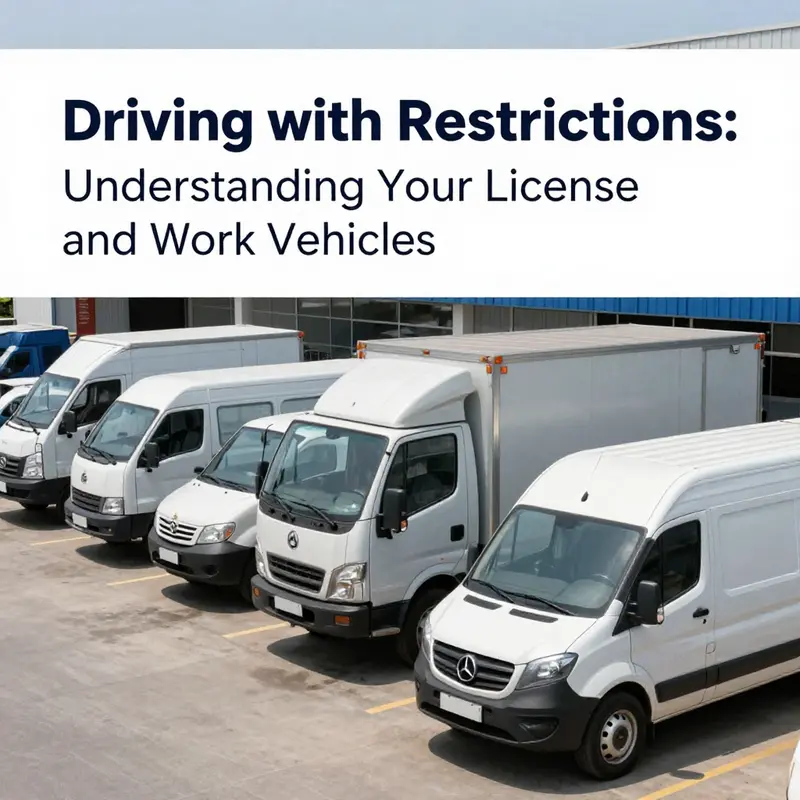
A restricted license does not silence the road. It speaks in terms of conditions, hours, routes, and contexts. For many drivers, the question of whether a work vehicle can be operated under a restricted license is less a simple yes-or-no verdict and more a careful inspection of the language that shapes their permission to drive. The chapter that follows threads together the logic behind restricted licenses, the kinds of work vehicles that may or may not be covered, and the practical steps a driver and employer must take to stay on the safe and legal side of the law. It is a chapter about the tension between necessity and safety, between what is legally possible and what safety requires, and about how different jurisdictions translate that tension into concrete driving rules that govern everyday tasks on the road. To illuminate this, a recent regulatory framework from China offers a concrete case study: a temporary motor vehicle driving permit issued to foreign nationals. It provides a lens through which to view the more familiar question in many other countries: what does a restricted license permit you to do when your job depends on moving a vehicle? And how do you navigate the distinctions between non-commercial, personal use, and commercial driving when a license comes with a caution label rather than a clean bill of unrestricted access?
The nature of a restricted license is best understood not as a barrier but as a map. It marks the paths you may travel and those you must avoid. In many jurisdictions, restrictions arise for protective reasons—medical conditions that affect vision or seizure control, or stricter consequences that follow impaired driving. Not every restriction is the same, and its impact can shift depending on the vehicle you drive and the purpose for which you drive it. A medical restriction, for instance, can be determinative: if the condition is such that driving is unsafe, the license may prohibit you from operating any vehicle at all. In other cases, a restriction may allow you to drive a vehicle but only under certain conditions—perhaps only during daylight hours, or only for non-commercial purposes, or only in specific geographic areas. The critical point is that the restriction binds the driver to a precise set of terms that cannot be overridden by a mere demand from a supervisor or a need on a job site.
The differentiation between non-commercial and commercial driving is often the hinge on which many work-related questions turn. A non-commercial vehicle is not automatically a green light for everyone who holds a license with some form of limitation. The line is drawn by the purpose of the drive and the vehicle’s classification. Light, personal-use vehicles—such as a small van used to shuttle tools within a local work site or to transport a few colleagues to a meeting—may fall within a broad interpretation of “allowed” under several restricted-license scenarios. In contrast, commercial vehicles—trucks that carry goods, buses that transport passengers, or heavy vans used for routine delivery—generally sit outside the permissible scope of a restricted license, especially when the restriction explicitly targets commercial operation or when a higher level credential, such as a Commercial Driver’s License (CDL), is ordinarily required. The distinction matters for risk management. Employers who rely on a restricted-license employee to operate a work vehicle must balance operational needs with the duty to comply with the law and to ensure safety for the driver and others on the road. It is not merely a compliance issue; it is a question of liability and insurance, training, and the reputational cost of missteps.
A practical way to parse these questions is to begin with the restriction itself and the vehicle in question. If the restriction is tied to a medical condition, the driver may be outright prohibited from driving any vehicle, regardless of whether the vehicle is used for work purposes. The general logic is straightforward: if the condition could render the driver unable to control the vehicle or respond quickly to hazards, then permitting driving would increase the risk of an accident. In such cases, the safest and most responsible course is to refrain from driving any vehicle until medical considerations are fully addressed and the licensing authority provides updated guidance. On the other hand, a restriction born of a past incident—say, a DUI or other offense—may allow limited driving, potentially with devices such as an ignition interlock or other monitoring measures, and often under specific circumstances like commuting to work or driving during set hours. Even then, the burden lies with both the driver and the employer to ensure the vehicle operated is compliant with the device requirements and the permitted use case.
The Chinese example of a temporary motor vehicle driving permit—designed for short-term, non-resident visitors who hold foreign licenses—helps illustrate a form of licensing that is inherently time-bound and purpose-bound. It is not intended for long-term employment or professional driving and it explicitly restricts the user from engaging in commercial driving. The permit class determines what you may drive: C1 and C2, which cover passenger cars and small vans up to nine seats, allow use of rental vehicles; D, E, and F categories—encompassing motorcycles and lighter trucks—permit use only for vehicles owned by the applicant, particularly when temporarily imported. The key rule here is clear: you drive either a rental car for C1/C2 or your own temporarily imported vehicle for D/E/F, and you must ensure the vehicle is properly registered and insured for temporary importation. The permit’s validity period ranges from up to three months for typical short visits to as long as a year for some longer stays, such as work visas or study permits. Importantly, the system prohibits driving for hire or using the permit to operate a commercial vehicle, and it forbids converting the temporary status into a full Chinese driver’s license without navigating a formal conversion process. It is a compact demonstration of how official rules constrict driving to controlled, non-commercial use, and how even a seemingly straightforward act—driving a vehicle—becomes a regulated activity determined by the specific class of permit, the vehicle’s subject to weight and classification, and the precise purpose of travel.
The lesson from such a framework translates across borders. When a person holds a restricted license in any country, the practical question becomes: what is the vehicle’s class, what is the operator’s purpose, and what else is the law requiring you to satisfy? A restricted license may permit you to operate certain non-commercial vehicles under strict conditions, but it almost always bars the operation of heavy or commercial vehicles or requires additional endorsements, training, or device-based monitoring. The practical reality is that employers often formalize these distinctions within policies that codify who may drive a company vehicle, under what conditions, and with what documentation. Even if the law would technically permit limited driving, safety and liability concerns can override specific permissions granted by a license. This is why many safety-sensitive roles insist on an unrestricted license or a clean record, not merely to comply with the letter of the law but to align with risk management strategies that protect employees, the company, and the public.
In everyday terms, consider a driver who holds a restricted license that limits driving to daylight hours, and perhaps to a non-commercial vehicle with a low gross vehicle weight rating (GVWR). If the job involves driving a small delivery van within a city, and the vehicle falls under the permitted class, there may be a path to lawful operation. But this hinges on a precise alignment of the vehicle’s GVWR, the driving purpose, and the license’s stated restrictions. If the same job shifts to a larger, heavier van or a small truck used for transporting tools and equipment on a commercial basis, the restricted license becomes less likely to cover the activity. The same logic applies in other jurisdictions. A state with stricter traffic laws or more stringent occupational licensing requirements may interpret restrictions differently from a neighboring state. That divergence is not merely academic; it creates real-world consequences for workers who commute across state lines or move between projects that require different vehicle classes.
For readers who face this complexity firsthand, the recommended approach is layered and deliberate. First, identify the exact wording of your restriction. This means reviewing the license designation and any accompanying notes or medical statements that accompany the license. Second, assess the vehicle you intend to drive for work: its class, its weight, the purpose (delivery, passenger transport, on-site service, etc.), and whether it is a vehicle owned by the employer or a rental vehicle for the job. Third, consult the licensing authority or department of motor vehicles in your jurisdiction. Provide them with the vehicle’s make, model, GVWR, and the intended use case so they can interpret whether the restricted license permits operation under those precise conditions. This step is not only prudent but essential in avoiding penalties, which can include fines, license suspension, or liability in the event of an accident.
A crucial dimension in this inquiry is the role of the employer. In many workplaces, the safety profile of a driver is scrutinized as carefully as the legal permission to drive. Employers may require a clean driving record or an unrestricted license for safety-sensitive roles, particularly those involving passengers, daily customer interactions, or the transport of goods that could pose a risk if mishandled. Even when the law would allow a restricted-license driver to operate a vehicle under limited conditions, an employer may nonetheless insist on an unrestricted license to meet insurance requirements and to reduce risk exposure. The employer’s stance often reflects a combination of regulatory compliance, risk management, and industry norms. The practical implication is that workers must not assume permissibility by license alone. They must seek explicit confirmation from both legal and human resources or safety departments before operating a work vehicle on restricted terms.
In practice, navigation through these questions benefits from a disciplined method. Start with the restriction’s source—whether it comes from medical, behavioral, or regulatory grounds. Then align this with the vehicle category. If you find a match, you still need to verify the permit’s scope, including its validity period and any prohibitions on commercial activities. It is also wise to document the interaction with the licensing authority: keep records of the guidance you receive, the forms submitted, and the dates of any approvals or amendments. Such documentation can be invaluable if a regulatory review or an insurance claim arises later. Moreover, it is prudent to consider the broader implications of these rules for cross-border or multi-site work scenarios. A company with sites in different jurisdictions may need to harmonize policies so that drivers are not caught between conflicting local rules. In such settings, it becomes essential to have a centralized compliance framework that carefully maps each license category to the specific vehicle types and job tasks that are permissible in each location.
To further illuminate the practical path forward, one can look to official guidance about temporary or restricted-use driving permits. The Chinese framework, for instance, makes explicit the non-commercial intent of the permit and the prohibition on hiring drivers for hire or operating commercial vehicles. This clarity helps to prevent ambiguity about what constitutes legitimate use. It also underscores the importance of ensuring that the vehicle used under any restricted authorization is properly registered and insured for the purposes allowed by the permit. While readers in other countries will not be subject to the same exact rules, the underlying logic—clarity of purpose, strict alignment with vehicle class, and acknowledgment of non-commercial intent—operates across jurisdictions. The best practice remains the same: verify with the official licensing authority, present a precise description of the vehicle and its planned use, and secure written confirmation that your intended operation is lawful under your license’s restrictions.
Beyond the technicalities, there is also a human element to these questions. The driver’s judgment, the employer’s safety culture, and the public’s safety in daily traffic all hinge on the precise interpretation of a license’s language. When a restriction is interpreted too narrowly, a driver may be deprived of a legitimate work vehicle option that would not meaningfully endanger others if correctly controlled. When interpreted too broadly, the same restrictions may invite risk that could have been avoided with closer compliance. The best outcome occurs when drivers, employers, and licensing authorities engage in a transparent dialogue about what is permissible, what is not, and what steps can be taken to expand safe mobility leg by leg—whether through training, additional endorsements, or vehicle-specific allowances.
In closing this chapter’s exploration of work vehicles under restricted licenses, it is essential to keep two guiding principles in view. First, the license is a legal instrument designed to protect road safety; it is not a practical avoidance tool for a job’s needs. Second, when the job requires moving a vehicle that falls outside the scope of the restriction, do not improvise. Instead, seek an authoritative clarification, adjust the job plan, or obtain any necessary endorsements, licenses, or inspections that will align the license with the work. The path to lawful operation is not a shortcut but a careful, documented, and collaborative process that respects both safety and necessity. The case study from China reinforces the point: temporary, non-commercial driving privileges are possible for short stays, with explicit constraints on vehicle type and usage. Across borders, the overarching pattern remains consistent. A restricted license can accompany work-related driving in some limited forms, but only when the exact intersection of vehicle class, use-case, and legal permission is deliberately matched. For readers seeking one concrete reminder of where to begin, consult your local DMV or licensing authority with the vehicle’s specifics in hand, including make, model, GVWR, intended use, and whether the vehicle is rental or employer-owned. And to recognize how state-specific interpretations may vary, consider the guidance found in state-level analyses of how restrictions impact driver licensing: state-rules-impact-on-driver-licensing.
For those who want to explore the formal regulatory path in another major framework, official guidance is available from the national authorities that regulate road use and licensing. In the Chinese context, the Ministry of Public Security offers explicit regulations governing temporary driving permits for foreign nationals. The detailed provisions cover eligibility, vehicle categories, permit validity, and the prohibition on commercial driving under temporary status. When read alongside the practicalities discussed above, the Chinese model provides a structured template for how many jurisdictions approach the question of work-related driving under restrictions. It emphasizes that the core purpose of the permit is to enable limited, non-commercial road access for travelers and short-term workers, rather than to create a pathway to professional driving for those whose licenses carry restrictions. For readers who want to consult these formal standards, the official source is the Ministry of Public Security’s regulatory page on temporary motor vehicle driving permits, which lays out the rules in precise terms and serves as an essential reference for anyone evaluating work-vehicle driving under restricted licenses. Internal diligence should always be paired with external guidance to ensure you’re acting in accordance with the current law and policy in your location.
Ultimately, the question of whether you can drive a work vehicle with a restricted license is not answered by a single rule but by a careful synthesis of the license’s language, the vehicle’s class, the context of use, and the official guidance from licensing authorities. When in doubt, pause, verify, and document. Remember that the aim of restrictions is safety first and access second, and that the best path forward is a disciplined, legally informed approach that respects both the needs of work and the obligations of the road. The road is long, and the license is a map—clear, precise, and used with care, it can guide you to productive work while keeping you and everyone else safe on the journey.
Navigating the Fine Print: How State Rules Shape Driving a Work Vehicle on a Restricted License
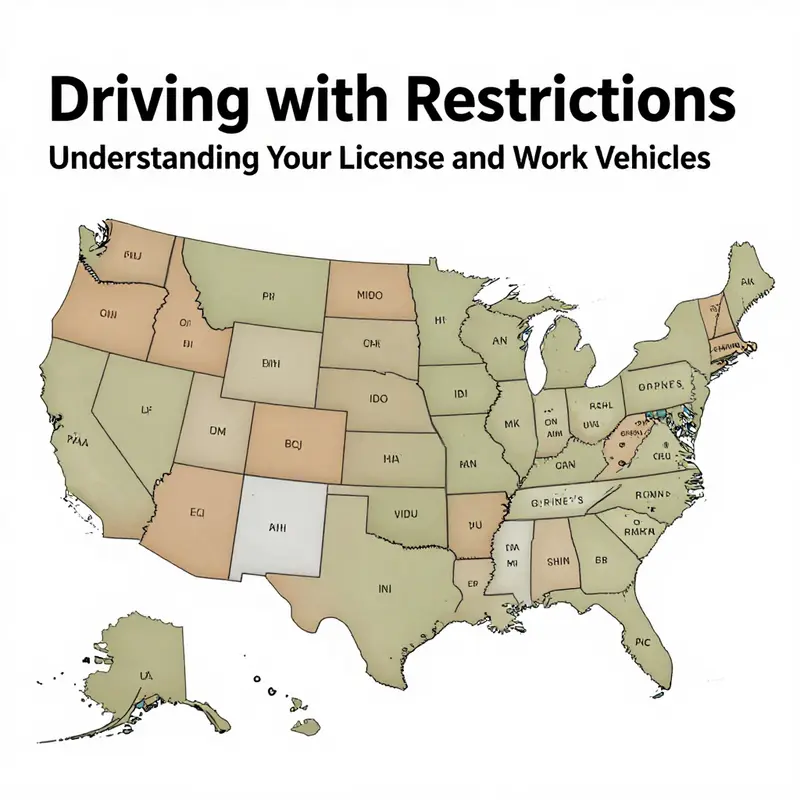
In workplaces across the country, the prompt to drive a work vehicle with a restricted license is a common moment of reckoning. The expectation may be straightforward: you need to get from site A to site B, deliver a package, or move equipment for a task. The reality, however, sits in the fine print of your license. A restricted license is not a single predefined status; it is a tailored set of permissions and prohibitions designed around your past driving history, medical conditions, or legal obligations. Because each state maintains its own licensing framework, the exact permission to operate a work vehicle can vary dramatically from one jurisdiction to another. The result is a practical tension between what your paper allows and what your job requires. This chapter does not pretend to resolve every scenario with a single answer. Instead, it offers a lens to read the restriction, a framework to consult the right authorities, and a careful approach to keep you, your employer, and the public safe while you navigate the road ahead.
The backbone of the question is the distinction between the type of restriction and the type of vehicle you intend to drive. Some restrictions arise from medical conditions that could impair your ability to operate a vehicle safely. In those cases, the law may restrict you from driving entirely, or it may require constant compliance with medical conditions such as vision standards, seizure control, or medication management. In other medical scenarios, there may be partial permission, but only under strict limits. For example, a restriction may specify that driving is allowed only during certain hours or for certain purposes. In other cases, restrictions are tied to DUI or DWI violations and may require ignition interlock devices and limited use to essential travel, such as commuting to work. The common thread is that restrictions are not mere formalities; they define what you may not do, and often what you must do, to stay in compliance.
Alongside medical or offense-based restrictions, there is the practical boundary between a work vehicle that is non commercial and one that does fall under commercial driving rules. A non commercial vehicle might be a personal pickup truck, a van used for light deliveries, or a small utility vehicle that supports daily operations. In many states, these vehicles can fall within the scope of a restricted license if the restriction does not explicitly bar non commercial work use. The contrast becomes sharper when the vehicle crosses into commercial territory, especially vehicles that require a Commercial Driver’s License or are used in a business setting that treats the operation as part of commerce. In those circumstances, restrictions often explicitly prohibit operating commercial vehicles, even if the vehicle is not enormous. Consequences escalate quickly if you inadvertently drive a vehicle that your license terms do not permit. The line is not a mere paperwork concern; it is a safety and liability boundary that a driver and employer must heed closely.
State laws add another layer of complexity. The United States does not have a single national standard governing restricted licenses for work vehicles. Instead, each state crafts its own rules, and those rules can differ in material ways. Some states are more permissive about allowing restricted license holders to operate certain work vehicles, while others take a stricter stance and effectively prohibit driving in employment contexts unless a separate permit is issued. Even when a state does permit work-related driving, the exact conditions can be stringent: specific times, routes, or uses; vehicle classifications; or requirements such as a monitoring device. A practical approach is to treat the state DMV as the authoritative source for your own situation and to obtain written guidance that reflects your vehicle and its use. The need to verify with the local licensing authority is not an afterthought; it is the essential step to avoid penalties or future license complications.
To illuminate how this plays out in the real world, consider how California handles restricted driving permits. The state has a formal pathway for restricted driving that acknowledges the needs of individuals who may still need to drive for work while meeting safety and public interest concerns. The policy recognizes that the allowance to drive for work-related travel exists, but it is bounded by explicit conditions. These conditions can include restrictions on when you may drive, the requirement to keep certain records, and the need to maintain vehicle safety features or monitoring where appropriate. While the exact terms can shift with court orders or updates to the permit, the core idea remains clear: a restricted license may permit work travel under controlled circumstances, yet it does not grant carte blanche to operate any vehicle at any time. If your work involves a vehicle with special requirements, such as a heavy GVWR or a vehicle used in a high safety risk context, you must confirm whether those elements are covered by the permit. The California route demonstrates a broader principle: the pathway to work-related driving under a restriction exists, but it is activated only when you comply with the terms that accompany the permit and the vehicle’s particular use case.
In Texas, the framework similarly recognizes the tension between needing to work and the need to comply with state limits. A restricted license can, under court-ordered conditions, allow driving to and from work if you meet the requirements, including operating a vehicle equipped with a certified ignition interlock device and observing all other conditions imposed by the order. The logic is straightforward but exacting: driving remains tied to compliance, and the interlock device serves as a verifiable mechanism to ensure you do not operate the vehicle under prohibited conditions. This model underscores an important point for workers and managers alike: a company may rely on documentation that shows the driver has a legally permitted pathway to drive, but the constraints attached to that pathway are non negotiable. Employers must understand that a valid license with restrictions does not automatically translate to blanket permission to operate any work vehicle; the permission is anchored to the precise terms of the restriction and the vehicle’s compliance with safety and legal standards.
Florida’s approach provides another example of the nuanced balance between authorization and obligation. There, the right to drive a work vehicle hinges on the restriction explicitly permitting it, and the driver must ensure that the vehicle is properly registered and insured. The implication is that vehicle status matters. If the permit includes a clause about non commercial use or requires the vehicle to meet certain safety or reporting standards, those clauses become the baseline for all work tasks involving driving. Moreover, keeping a zero blood alcohol concentration and adhering to other court-ordered conditions remain foundational. The Florida model shows that the legal viability of driving a work vehicle under a restriction often rests on the combination of a permit that clearly says work driving is allowed and the practical steps of vehicle compliance and personal conduct that align with the permit’s spirit.
New York introduces a slightly different flavor with its conditional license framework. There, driving for employment purposes may be possible, but it comes with added requirements that can include attending a traffic safety course or installing a monitoring device. The emphasis in these cases is on accountability. The employer may want to confirm that the driver has completed specific training or that a system is in place to verify ongoing compliance. The overarching principle remains the same: job-related driving is not automatically granted under a restricted license. It is conditional on meeting the state-imposed obligations that accompany the permit, and on the driver continuing to demonstrate responsible use of the vehicle on the road.
Across these state examples, one constant stands out: before a driver takes the wheel for work, there is a need for careful validation. The primary questions are not merely about what vehicle you plan to drive, but about what the restriction allows, what it forbids, and under what circumstances. A restricted license can permit work travel, but it rarely does so without designating specific constraints. The consequences of ignoring those constraints can be severe. Violating a restriction risks license suspension, fines, or even criminal charges, depending on the jurisdiction and the nature of the breach. The potential liabilities extend beyond the driver to the employer, who may bear responsibility for permitting or enabling a restricted driver to operate a vehicle in a way that contravenes the permit. These are not theoretical concerns. They are enforceable rules that help keep roads safer and that define the duties of drivers and managers alike when the line between work necessity and regulatory compliance can feel thin.
When thinking through your own situation, the first step should always be to check with the local Department of Motor Vehicles or its equivalent. Bring the exact terms of your restriction, details about the vehicle you would operate, and the intended work use. If the vehicle has a GVWR that pushes it into a more regulated category, or if the work involves routes that would complicate compliance with time or location limits, write those details down for the DMV official you speak with. It is often helpful to have documentation from a supervisor or HR department that outlines the job requirements and acknowledges the need for driving as part of the role. A legal professional with experience in traffic and licensing law can offer additional clarity before you place yourself behind the wheel on a restricted permit. In some cases, the DMV may require the driver to demonstrate continued compliance through periodic renewals, updated medical evaluations, or the installation of monitoring devices. In other cases, the permit might be straightforward and only require routine compliance such as logging hours or submitting proof of insurance. The common thread in every scenario is that the process is designed to align the drivers ability to perform their duties with the safety expectations of the broader community.
To help anchor your decision in concrete information, consider the practical steps you can take now. Begin by confirming the exact terms attached to your restriction. Identify the vehicle you would drive for work and verify its classification and safety features. If your job relies on a fleet or a single vehicle, obtain the vehicle’s registration and insurance status, and check whether the GVWR sits within the permissible range for your license under the current restriction. Prepare a concise summary that includes your job duties, the specific driving tasks, and any routes, hours, or conditions listed in your permit. Share this summary with both your employer and the licensing authority when you seek guidance. The more precise your information, the more accurate the guidance you will receive.
In many workplaces, a robust policy will require the employer to confirm that the driver is legally authorized to operate the vehicle in the context of the restricted license. This is not only a matter of compliance but also of safety. An employer that requires a clean driving record or an unrestricted license for safety sensitive roles is not making an arbitrary standard; they are managing risk and ensuring that the organization can fulfill regulatory obligations and protect staff and customers. Even if the law permits a particular driver to operate a work vehicle under a restricted license, the employer may decide that the work requires additional credentials or a standard license for safety reasons. In that case, the employee may need to adjust duties or wait for a different permit to be issued. The intersection of law, policy, and practice means that the question of can I drive a work vehicle with a restricted license is rarely answered in a vacuum. It is answered through communication among the driver, the employer, and the licensing authority, with safety and accountability as the shared goal.
If this chapter has a single takeaway, it is this: do not assume that a restricted license automatically grants permission to operate every vehicle in every work scenario. Instead, treat the license as a living document that defines what you may and may not do. When in doubt, pause before you turn the key. Consult your state DMV website or contact a legal professional who understands the precise language of your restriction and the vehicle you intend to drive. Provide the DMV with the vehicle details, your work use case, and any relevant driving conditions, and ask for a written determination. Your employer can be an ally in this process, helping to align job expectations with legal requirements and safety standards, but the final authority rests with the licensing official who issued your permit.
One practical waypoint in this journey is to explore state resources that interpret license restrictions for work-related driving. For a broader view of how state rules can shape licensing decisions and to see how different states frame these questions, you can examine resources such as state rule summaries that address how licensing interacts with employment needs. This approach helps you understand not only the letter of the law but the spirit behind it, which is public safety and responsible driving. As you prepare to drive for work with a restricted license, keep in mind that the most reliable guidance comes from official sources, clear documentation, and an open dialogue with your employer and licensing authority. The road to compliance may require extra steps, but the result is a safer path for you and everyone on the road.
Internal link to state guidance: state rules impacting driver licensing
External resource for authoritative guidance on California restricted driving: https://www.dmv.ca.gov/portal/dl/
Final thoughts
Understanding the complexities surrounding a restricted license, especially when it comes to driving work vehicles, involves recognizing the types of limitations in place, the kind of vehicles affected, and the state laws governing these scenarios. By exploring these elements, drivers empower themselves to navigate their responsibilities more effectively. Always remember to consult your local Department of Motor Vehicles for the most accurate and personalized information regarding your specific situation. Input from employers can also provide valuable insights into whether you can operate a work vehicle under your current license restriction.