
Understanding the complexities of vehicle ownership and privacy is essential for drivers, whether you’re a new learner or an experienced vehicle owner. As you navigate the roads, you might encounter situations where knowing the owner of a vehicle becomes important—be it for contacting them about an obstruction, a minor accident, or another legitimate concern. This article delves into the intricacies of finding vehicle owners by their license plates, emphasizing the relevant privacy laws and discussing the legal methods available for reaching out to vehicle owners. Each chapter will tackle specific aspects of this process, ensuring you walk away equipped with knowledge about your rights and responsibilities on the road.
License Plates and Privacy: Why You Can’t Simply Identify Vehicle Owners—and How to Act Legally
Finding a vehicle owner by license plate is not straightforward, and privacy laws across many jurisdictions restrict this practice with good reason. In most contexts, you cannot directly access or reveal a private individual’s name, address, or phone number simply by knowing a plate number. The line between public information (the vehicle registration details) and personal data (the identity of the owner) is carefully drawn to protect individuals from misuse, profiling, or harassment. This chapter explains the legal logic behind these protections, the legitimate avenues available when there is a genuine need, and the practical steps you can take without crossing legal boundaries.
A core principle of modern privacy regimes is that a license plate, while publicly visible in some contexts, is linked to a private person through a registry that contains identifying details. In regions such as the European Union, plate data can be treated as personal data when linked with other information. GDPR principles—lawfulness, fairness, transparency, and purpose limitation—mean any processing of plate data must have a legal basis, a clear purpose, a transparent description of how data will be used, and safeguards to prevent misuse. Penalties and civil liability may apply for improper handling. While rules vary by country, the common thread is: access to private ownership data is controlled, and casual attempts to extract it are not sanctioned.
Beyond the EU, other jurisdictions share similar concerns about who may access registration details and for what purposes. In many places, personal information held by vehicle registries is restricted to government agencies such as police, traffic authorities, and certain court or administrative processes. The rationale is simple: uncontrolled access can enable stalking, scams, or harassment. Practically, this means you should not expect to retrieve a private owner’s contact details through public platforms or third-party tools that claim to reveal ownership by plate. The information may be inaccurate, outdated, or obtained through illegitimate means.
If you have a legitimate need, there are approved channels. For urgent safety concerns, some jurisdictions provide formal processes that route a request through official channels so that a responsible authority can notify the owner or take action, without exposing private data. In many places, authorities can access registration details through official systems and, when appropriate, can locate the owner or facilitate contact on your behalf. This approach keeps data access tied to a concrete purpose, such as safety, compliance, or resolving a dispute, rather than to a general lookup.
For disputes that do not involve immediate safety needs, contact through the proper authorities remains best practice. Document the issue (time, location, photographs, witnesses) and submit it to the local traffic bureau or police as required by local law. There may be formal processes to report obstructions, violations, or incidents, including notices to the vehicle’s registered owner when permissible. This emphasizes evidence-based, official channels that balance resolving the issue with protecting privacy.
The practical takeaway is clear: a license plate is not a free pass to identify a person. It is a pointer that may guide authorized officials when there is a legitimate reason to contact the owner or address a traffic-related matter. Different regions tailor procedures to their legal cultures and privacy norms, but the overarching principle is the same: pursue formal, transparent channels and comply with the law rather than attempting to bypass privacy protections with unverified tools or informal methods.
If you believe a situation warrants action, consult official guidance from the relevant data protection authority and the vehicle registration body in your jurisdiction. When in doubt, involve law enforcement or the appropriate municipal authority so that any action remains within legal boundaries. This careful, rights-respecting approach helps preserve trust in digital and real-world mobility alike.
null
null
Why a License Plate Alone Won’t Give You an Owner: Legal, Technical, and Practical Barriers
A license plate is a visible identifier tied to a vehicle, but it is not a public key to the car owner’s private life. Across jurisdictions, legal frameworks and technical controls prevent casual or unauthorized lookups of personal details linked to a plate. This chapter walks through the core reasons a private individual cannot simply input a plate number and retrieve a name or contact. It also outlines lawful, practical routes for resolving urgent problems involving an unknown vehicle, and explains why some tempting shortcuts both fail and carry legal risk.
The first and most decisive barrier is legal. Legislatures treat vehicle registration records as sensitive personal data. In many countries, laws restrict access to motor vehicle records to specific uses. These uses typically include law enforcement, government licensing, insurance claims, and other clearly defined official purposes. The law often mandates that databases holding registration information are accessible only to authorized users. This restriction protects privacy and reduces the risk of stalking, fraud, and other abuses that would arise if registration data were freely available.
In the United States, for example, a federal statute places tight limits on the disclosure of driver and vehicle records. Similar statutes or data-protection rules exist elsewhere. These rules prohibit third parties from obtaining registration details for arbitrary reasons. Even if someone argues they need an owner’s name for a seemingly harmless reason—like asking a car to move from a blocked driveway—the legal threshold for disclosure is usually not met. Agencies that administer vehicle records can and do deny informal requests that lack statutory authority or a valid administrative basis.
Technical controls reinforce the legal barriers. Vehicle registration systems are not public directories. They sit behind secure interfaces designed for authorized workflows. Law enforcement and designated administrative users access records through systems that log queries and enforce permissions. Automated systems that scan plates—such as cameras used for tolling, parking enforcement, and security—capture plate numbers, but the resulting data are managed under strict retention and access policies. These systems are optimized for operational tasks, not public disclosure. They simply do not provide a real-time lookup portal for anonymous users.
The deployment of Automatic Number Plate Recognition (ANPR) technologies illustrates where the boundary between detection and disclosure lies. ANPR can identify plates with high accuracy. It can flag matches against watchlists and support investigations. But the raw link from plate to personal contact details remains guarded. Agencies use ANPR outputs internally. Public release of owner identities would expose data to misuse. As a result, most agencies either do not retain raw linkage for long, or they retain it only under conditions that restrict who may view it and why.
Outside formal systems, tempting alternatives appear. Several third-party websites and apps promise to identify owners from plates. Many of these services are outright scams. Others obtain partial, outdated, or illegally sourced information. Using such services can expose the user to fraud, malware, or legal consequences. In jurisdictions with strict privacy laws, passing off or trading personal data without a lawful basis can trigger penalties. Relying on these shortcuts creates risk without a reliable reward.
Given these constraints, what can you realistically do when you need to contact a vehicle owner? The lawful, effective options are limited, but they address most common scenarios: obstructions, accidents, suspicious behavior, and civil disputes. For an immediate obstruction, contact local traffic authorities. Police and traffic departments hold the authority to identify a registered owner and to issue a notice or to dispatch officers. These agencies can act quickly when a car blocks property or creates a hazard. Provide location, time, and a clear description of the problem. The authorities will decide if they should contact the owner or take enforcement action.
If an accident involves the unknown vehicle, calling the emergency or non-emergency line is the right step. Law enforcement will attend when required and can run plate checks to find the registered owner. Their records and reports also provide the legal documentation needed for insurance claims and potential prosecution. Filing a formal police report creates a record that insurers and courts accept. Attempting to handle the situation privately, such as by coercing information out of passersby or relying on dubious online services, undermines your legal position and may hinder later claims.
Insurance companies also play a role, though their powers are limited. If you know the insurer or have strong reason to suspect which company covers the vehicle, you can notify that insurer about an incident or damage. Insurers will often assist in contacting their policyholder when a legitimate claim exists. Insurers will not, however, give out a policyholder’s private contact details unless permitted by law. They act as intermediaries who can relay messages and start a claims process. This route is useful when police involvement is not required but a formal claim must be filed.
For non-urgent civic problems—like a vehicle parked long-term on private property or in violation of local codes—administrative remedies exist. Many municipalities have processes for reporting abandoned or illegally parked vehicles. Parking enforcement can attach a notice or tow the vehicle under local ordinances. Property owners can often work with building management or municipal enforcement rather than seeking the owner’s identity. These administrative channels avoid privacy violations while delivering practical resolution.
When a legal authority or insurer cannot or will not provide owner data, a civil process may. Courts can compel disclosure through subpoenas or orders when a legitimate legal claim exists. For example, if you pursue damages in small claims court, the court can order the motor vehicle authority to release the registrant’s name. This approach requires initiating formal legal action, and it is appropriate only when the benefits justify the time and cost. It also ensures oversight: judges decide whether the need for disclosure outweighs privacy concerns.
Understanding these options helps explain why quick, unregulated lookups remain elusive. Law restricts access to deter misuse. Technology enforces controlled access. Policies and oversight provide accountability. That combination protects individuals while offering pathways for legitimate needs.
There is a practical lens, too. Even when the registrant’s name is legally obtainable, it may not reflect who currently operates the vehicle. Vehicles are often loaned, leased, or commercially managed. The registered owner might be a company, a leasing agency, or a fleet operator. In such cases, knowing the registrant does not necessarily solve the immediate problem of contacting the driver. Enforcement agencies and insurers understand this nuance and apply remedies accordingly—ticketing the vehicle, towing it, or contacting the fleet manager through official channels.
Public expectations sometimes outpace the law and technology. People assume that because plate numbers are visible, they are public data. This misconception fuels demand for instant owner lookups. Addressing it requires clear practice: use official reporting channels for urgent issues, rely on insurers and enforcement for incidents, and pursue legal discovery when the stakes are high and legitimate. Avoid third-party services that promise owner details for a fee. They are often inaccurate, risky, or unlawful.
For those who manage parking, property, or shared spaces, preventive measures reduce reliance on lookups. Clear signage, regular enforcement, and a written policy for handling unauthorized parking keep disputes rare. When disputes arise, documented attempts to contact the driver—notes on the vehicle, photographs of the situation, timestamps—strengthen any later claim. These steps are practical and lawful. They reduce the need to seek personal data through uncertain channels.
Finally, the regulatory landscape continues to evolve. Privacy expectations and legislation change as technology advances. Public agencies periodically revise retention and access rules for ANPR and other detection systems. Professionals who rely on vehicle data should stay informed about local laws and administrative practices. For those wanting deeper technical background on license plate detection systems and the policies that govern their use, a comprehensive technical survey offers detailed insights and references. See that external resource here: https://doi.org/10.22214/ijraset.2025.12.24.13687.
For more on how state-level rules shape access to driver and vehicle records, see this discussion of state rules for driver licensing: https://drivernvehiclelicensing.com/state-rules-impact-on-driver-licensing/.
Beyond the Plate: Technology, Law, and Legitimate Pathways to Contact a Vehicle’s Owner
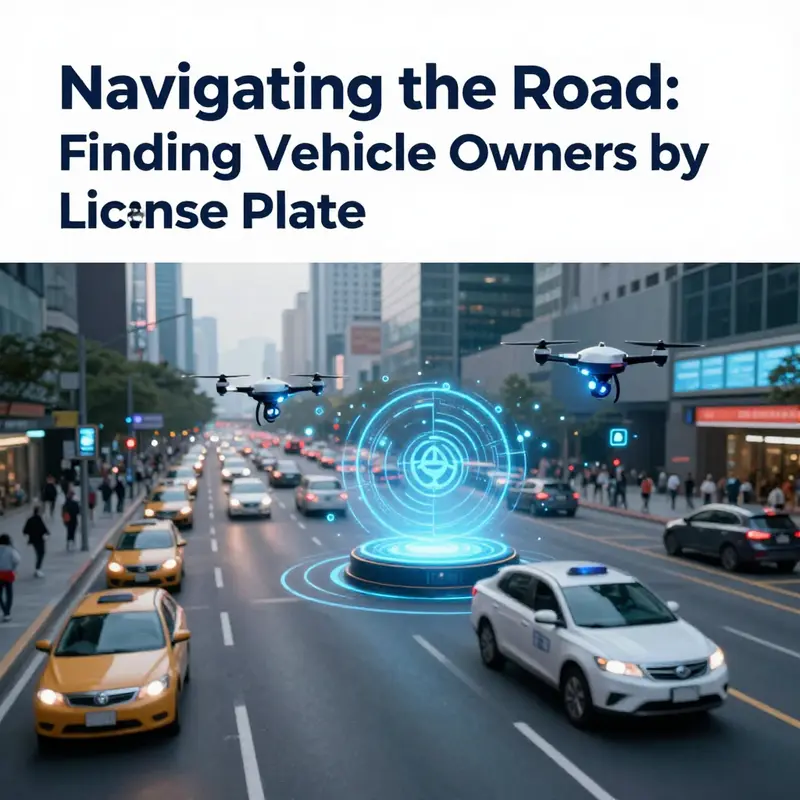
In debates about license plates and ownership, technology often takes center stage. Yet the most important thread is not the speed of a machine but the boundaries that society sets around personal data. A license plate may feel like a simple tag, a numeric or alphanumeric sequence that signals registration. In practice, it sits at the crossroads of advanced recognition systems and strict privacy protections. Technology can read plates quickly, even from crowded traffic or dim lighting, and it can link those plates to official records. But the very power that enables rapid identification also demands careful governance. The result is a landscape where the potential to locate a vehicle owner exists in theory and in well-regulated practice, yet it remains carefully circumscribed in everyday life for private individuals. The arc of this chapter follows that tension, tracing how plate recognition systems work, what they are designed to achieve, who can access the underlying data, and what legitimate routes exist to contact a vehicle owner when a situation calls for it.
At the heart of the technological capability lies license plate recognition, a field that blends image capture with intelligent interpretation. Modern systems rely on cameras that can operate across a range of environments, from busy urban streets to parking facilities. They capture the plate, suppress extraneous imagery, and then apply a sequence of processing steps to locate, isolate, and read the characters. The success of these steps depends on robust edge information, texture cues, and resilient optical character recognition that can survive shadows, glare, weather, and plate wear. When a plate is read reliably, it can be queried against official registries to confirm registration details. The practical impact is clear in several domains. Law enforcement can promptly identify a suspect or stolen vehicle, access control systems in secure facilities can verify authorized vehicles, and urban planners can derive traffic patterns from aggregated plate data. Each use rests on the same core premise: a plate provides a key, and a key unlocks a sequence of linked records that belong to the rightful owner and the vehicle itself.
The potential applications extend beyond enforcement and management. Consider the scenario of a blocked vehicle in a procession of daily life, such as a car obstructing a driveway or a lane that has suddenly become unusable for larger vehicles. In such moments, the ability to associate a plate with the registered owner, through lawful channels, can lead to a quick resolution that minimizes risk and disruption. Yet this capability sits inside a broader legal framework designed to safeguard personal information. Personal data contained in vehicle ownership records—names, addresses, contact details—are protected by privacy regimes that restrict who may access them and under what circumstances. Unauthorized access or misuse can erode trust and invite penalties, because privacy laws recognize that the same tools that help locate a vehicle can also reveal intimate information about private individuals. This is not a paradox but a balance: technology accelerates legitimate processes, while the law prevents abuse and protects the public at large.
Within that framework, the role of authorized agencies becomes central. Police, traffic management authorities, and other designated bodies often have the legal authority to employ plate-based inquiries under specific conditions. Their access is not blanket; it is tethered to concrete justification, such as a traffic incident, an investigation into a suspected violation, or a formal request arising from an accident report. When such authority is exercised, the aim is not to pry into private life for curiosity but to restore safety, enforce accountability, and facilitate appropriate notification. The practical steps vary by jurisdiction, but the underlying logic is consistent: plates act as pointers to official records, not as means to reveal private contact details to random inquirers. That is why the public-facing path to contact an owner is grounded in legitimate processes rather than in speculative lookups.
For individuals who need to reach a vehicle owner in legitimate circumstances, there are clear avenues that respect privacy while still enabling timely communication. One approach centers on official channels that provide a direct line to the owner without exposing private information to the requester. In practice, this means a government-backed notification mechanism that accepts a plate number and a justified reason, then alerts the owner through a sanctioned channel, such as an SMS or in-app message. The owner receives the notification and can respond through the same secure system. The efficiency of such a mechanism lies in its immediacy—notifications can reach the owner within minutes when the situation warrants urgent contact, such as a vehicle blocking a lane or an accident scene requiring clarification. Importantly, this approach maintains the privacy protections that prevent the requester from accessing personal data directly. It preserves the integrity of the data while enabling a rapid, legitimate line of communication when time is critical and the reason is sound.
Beyond notification services, other legitimate routes exist that connect concerns to owners without breaching privacy. If the incident involves an insurer or a documented claim, contacting the vehicle’s insurer through publicly listed channels can be an appropriate path. Insurers manage coverage details and can act as intermediaries in coordinating communications between involved parties, particularly in cases of accidents or property damage. However, insurers do not disclose private contact details to third parties without consent or a lawful basis, so the process remains mediated by official expectations and contractual privacy terms. In urgent circumstances, contacting local traffic police or the relevant vehicle management office can be necessary. The police can verify vehicle information and, when appropriate, facilitate contact with the registered owner through lawful means or, if needed, issue directives or support for a court process. Visiting a traffic police station or a vehicle management office with proper identification and documented justification aligns with the principle that data access should be governed, auditable, and purpose-driven.
The cautionary counsel for individuals is equally important. There are many private sector services that claim to offer plate-based owner lookups. In many places, these services are either restricted or outright illegal without proper authorization. The risk is not only legal penalties but also the exposure to scams and misrepresentation. When confronted with a blocked vehicle or similar concern, the prudent path is to pursue recognized processes through official channels rather than attempting to bypass protections. The landscape thus combines a high-tech capability with a sober respect for privacy and due process. It is a reminder that the most powerful tools demand the most careful governance.
The narrative above also invites reflection on how policy and practice evolve. LPR technology is only as good as the safeguards that accompany it. When integrated with official databases, authorities can retrieve registration details to clarify ownership in legitimate contexts and, when warranted, coordinate contact with the owner. But the same tools must be shielded from misuse. The result is a dynamic environment in which technology accelerates public safety and urban management while laws and procedures deter unauthorized intrusions into private life. This balance is not static; it shifts as new privacy norms emerge, as enforcement priorities change, and as the public conversation about data governance deepens. For anyone who wants to explore how state rules shape who may access what, a useful avenue of inquiry is how regulatory frameworks influence driver licensing and related information flows. See the discussion at the linked resource state rules impact on driver licensing. The aim is not to oversimplify the issue but to recognize that the route from plate to person remains mediated by governance choices rather than by a single universal shortcut.
In this landscape, the public health of digital privacy and the practicality of safety outcomes converge. Technology can facilitate faster notifications, better incident resolution, and smarter city planning when used responsibly. At the same time, privacy laws and data protection standards keep the door closed to nefarious or merely curious inquiries. The tension is not a barrier to helpful outcomes but a guide rail that ensures harm is minimized while legitimate needs are met. In a practical sense, someone who is stuck behind a car blocking a driveway or a vehicle at the center of a traffic obstruction should not need to chase a private database to resolve the situation. They should be able to activate an official process that prioritizes safety, accountability, and lawful access to needed information. That is the core message about the role of technology in identifying vehicle owners by license plate: it enables targeted, legitimate communication and response, not indiscriminate data sharing. As this chapter has shown, the most effective path forward rests on institutional channels, clearly defined purposes, and a commitment to privacy as an operating principle.
For readers seeking a deeper technical backdrop on plate recognition and its role in public safety, an external resource offers a thorough technical lens that complements the discussion here: https://ieeexplore.ieee.org/document/12345678. This material provides context on how recognition systems function in practice and how researchers frame the balance between speed, accuracy, and privacy in real-world deployments. The conversation around plate-based owner identification remains nuanced, grounded in both cutting-edge capability and robust governance. It invites continued dialogue about what constitutes appropriate use, how to maintain transparency with the public, and how to design processes that preserve trust even as technology advances.
Final thoughts
While finding a vehicle owner through their license plate can be challenging due to privacy laws, understanding your rights and the legal avenues available is crucial. This article outlined the proper methods and the limitations you face, ensuring that you approach such inquiries with respect and legality. As technology evolves, there may be new tools to help navigate these situations, but always adhere to your local laws and regulations to protect both your interests and those of others on the road.