
Operating a commercial vehicle is a significant responsibility that comes with specific licensing requirements. Understanding these requirements is crucial for new drivers, existing drivers, vehicle owners, and auto dealerships alike. This guide will illuminate the essential aspects of commercial vehicle licensing, starting with an overview of licensing requirements, progressing to the different types of commercial licenses, addressing the legal implications of lacking the required credentials, and finally exploring how licensing regulations can differ from one region to another. Each chapter is designed to provide a comprehensive understanding of what is necessary to ensure compliance and safety on the road.
From C1 to Road Transport Certificates: Mapping China’s Commercial Vehicle Licensing Pathway
When a business depends on the steady, reliable movement of people or goods, the question of licensing moves from abstract legality to practical safety. You might start by asking whether a license is required at all, but in the realm of commercial driving the real inquiry is which license fits which vehicle, and what rules govern the road to that credential. This chapter follows the thread from the most common passenger-vehicle licenses through the specialized categories that control who may drive large fleets, freight haulers, and passenger services. It also pulls back the veil on the road transport certificate that sits alongside the普通驾驶证 (ordinary driver’s license) for professional operations. The aim is not merely to list categories but to illuminate how each tier shapes responsibility, training, and the day-to-day reality of moving people and cargo with a vehicle that weighs, seats, or lengthens the scale of risk on urban streets and highways alike. In this way, the licensing landscape becomes a map—one that shows not just who can drive, but who can drive safely and legally in a commercial setting.
In China, the licensing structure for driving is clearly tiered by vehicle type and the purpose of operation. The C1 license allows drivers to handle smaller passenger vehicles, typically up to nine seats including the driver, with a practical ceiling of roughly six meters in length and a weight under 4,500 kilograms, provided the operation is non-commercial. The C2 license mirrors the C1’s seat limit but restricts operation to automatic-transmission vehicles, a distinction that can matter in the realism of town-and-country routes where crew and dispatch expect predictable vehicle behavior. For larger passenger operations, the B1 and B2 licenses come into play: B1 covering medium-sized passenger vehicles with ten to nineteen seats, and B2 for larger passenger fleets exceeding nineteen seats. Each category signals a different set of operational responsibilities, training needs, and testing emphasis, as these vehicles challenge a driver’s ability to manage passengers, turning radiuses, stopping distances, and the subtle choreography of a multi-seat ride.
Yet the licensing framework does not end with just the right category. For professional drivers who operate commercially—whether it’s moving goods across provinces or shuttling commuters within a city—there is a separate, essential credential: the Road Transport Qualification Certificate. This certificate, issued to those who work in road transport industries, is not merely a formality; it is a legal requirement that stands alongside the standard driver’s license. It signifies that the individual has met the specific, occupation-focused standards for professional transport, including familiarity with regulations, safety protocols, and the operational discipline demanded by commercial fleets. The separation between the ordinary license and the professional qualification underscores a fundamental public-safety principle: the skills and responsibilities of routine driving do not automatically translate into the demands of commercial transport, where the stakes—time, cargo safety, passenger comfort, and road-sharing behavior—are higher and more complex.
To understand the pathway to these licenses, it helps to consider the age framework that governs who can seek a CDL-like credential for different vehicle categories. The regulations establish a tiered age ladder that aligns with the complexity and risk profile of the vehicle to be operated. For the largest passenger vehicles, including city buses and heavy-duty coaches, applicants must be at least 22 years old and may continue to operate within a recognized training and licensing window up to the upper limit of 63. Medium-sized buses, large trucks, and tractors sit in a closely adjacent bracket, with a minimum age of 20 and the same upper ceiling of 63. Light-duty towing vehicles, by contrast, begin at 20 and extend up to 70. For ordinary two-wheeled or three-wheeled motorcycles, the range expands further, from 18 to 70. Finally, the broad category of small cars and automatic-transmission vehicles—and special vehicles for disabled persons’ use—require a minimum age of 18. These age ranges are not arbitrary; they reflect an intent to ensure that drivers bringing high-capacity vehicles into service have both the maturity and the stamina to handle long hours, complex maneuvers, and the unpredictable dynamics of road traffic under demanding operating conditions.
But age is only part of the equation. The physical fitness standards laid out by the Ministry of Public Security are meant to guarantee that a driver’s body can withstand the rigors of commercial operation and respond safely to emergencies. Height requirements vary by vehicle size, with large buses, heavy-duty towing vehicles, city buses, large trucks, and trolleybuses asking for a minimum height of 155 centimeters. Medium-sized buses demand at least 150 centimeters. Vision requirements are equally precise: for large buses and the most demanding categories, a visual acuity of 5.0 in both eyes is required; most other categories set the threshold at 4.9. The rules are not as simple as “better is better.” For instance, monocular vision may still qualify if the better eye achieves 5.0 acuity and the field of view exceeds 150 degrees horizontally. Color vision is non-negotiable in terms of red-green discrimination, a critical safeguard for recognizing signals and signs on the road. The hearing standard specifies that both ears should be capable of detecting sound direction from a tuning fork at a distance of 50 centimeters, a measure designed to ensure a driver can perceive critical auditory cues in noisy urban environments.
The standards extend to upper and lower limb function. Both thumbs must be intact, and each hand must have at least three fully functional fingers, with specific, carefully defined exceptions for certain configurations in the left hand. The lower limbs must be fully functional, with minimal disparities in leg length—any difference up to five centimeters being permissible. These criteria are not intended to be exclusionary for every individual; they are framed to maximize functional safety and, where needed, to accommodate legitimate medical or physical conditions while preserving overall capability. Taken together, age and fitness requirements in China create a disciplined entry gate for commercial driving—one that screens for a baseline of capability before a driver even begins training, and then tests progressively through education, testing, and practical evaluation.
The chapter of licensing for foreigners who hold non-Chinese driver’s licenses adds another layer of consideration. The overarching principle is straightforward: foreign license holders must meet the same baseline standards when seeking a commercial license in China. They are subject to the same minimum ages, vision and hearing criteria, and limb-function requirements that apply to Chinese applicants. The intent is not to create barriers for international professionals but to ensure uniform safety standards across all who operate commercial vehicles on public roads. In practice, this means that an applicant with a foreign license would undergo the same regulatory steps to obtain the C1, C2, B1, or B2 categories, and would also pursue the Road Transport Qualification Certificate if the commercial operation falls under professional driving. The process may involve translation or validation steps for the applicant’s existing documentation, but the essential gatekeeping remains the same: a clear signal that the driver can meet the physical and cognitive demands of a demanding, safety-critical occupation.
The Road Transport Qualification Certificate deserves particular attention, because it embodies the policy choice to separate general licensing from occupational credentialing. This separation recognizes that commercial transport introduces additional layers of risk management, compliance, and ongoing professional development. The certificate ensures that drivers are not only capable of handling a vehicle from a mechanical standpoint but also conversant with traffic regulations, routine safety practices, and the operational discipline needed to coordinate with dispatchers, loaders, and maintenance teams. The legal framework links these competencies directly to penalties and enforcement. Failing to hold the correct license or the required certificate can invite fines, administrative penalties, or more serious consequences, especially when hazardous materials or oversized cargo are part of the operation. The safety calculus, in other words, makes compliance essential rather than optional.
For professionals navigating this landscape, the licensing journey is as much about preparation as it is about paperwork. The path generally includes formal training, a medical examination, a vision test, a knowledge examination, and a practical driving test that assesses control of the vehicle, adherence to safety protocols, and the ability to respond to common traffic situations. Training programs are tailored to the vehicle category—C1 and C2 programs focus on passenger vehicle operation, while B1 and B2 programs emphasize handling larger vehicles, better braking margins, and the management of passengers and cargo under urban conditions. The training also covers the unique operational routines of commercial transport, such as route planning, load distribution, and regulatory compliance in different jurisdictions. This integrated approach ensures that when a driver first sits behind the wheel of a large passenger bus or a heavy freight tractor-trailer, the response is governed by a well-practiced set of procedures rather than ad hoc improvisation.
Even with a clear pathway, the licensing regime is not static. Local agencies may implement adjustments to fine-tune standards based on safety data, changing traffic patterns, or evolving regulatory priorities. The essential point remains: the license you hold is a credential tied to a specific vehicle category and to a specific set of operating responsibilities. It is not merely a label but a formal permission to engage in regulated activity that carries direct implications for public safety, employer compliance, and personal accountability. This is why the process emphasizes not only the acquisition of a credential but also ongoing adherence to medical, legal, and safety requirements—well beyond the moment of issuance.
In discussions of licensing rules and how they translate into practice, it helps to consider examples from the broader conversation about driver qualifications and the sometimes opaque interface between national standards and local implementation. For a broader look at how state rules shape licensing practice, see the discussion on state rules impact on driver licensing. This kind of dialogue underscores a central reality: while the core standards are anchored in national policy, the lived experience of commercial drivers is shaped by the day-to-day realities of dispatch windows, road conditions, maintenance cycles, and the human factors that come with long hours on the road. Such realities reinforce why the licensing framework places such a strong emphasis on safety and competency, from the first step of application to the ongoing compliance that accompanies professional driving.
For readers seeking authoritative, up-to-date information on these standards and the exact requirements that apply to different vehicle categories, the official sources remain indispensable. The Ministry of Public Security’s Traffic Management Bureau maintains the baseline regulations and publishes updates to licensing standards, medical criteria, and the Road Transport Qualification Certificate requirements. The official portal provides the most current articulation of age bands, vision and hearing thresholds, and the specific documentation needed for applicants. When in doubt, consult the primary regulatory authority to confirm the precise criteria that apply to your situation and location. You can access the official resource at the public site of the Chinese government’s traffic management authority: https://www.mps.gov.cn.
In sum, the question of whether you need a license to drive a commercial vehicle in China is answered by a layered framework. The right vehicle category—C1, C2, B1, or B2—aligns with the size and passenger-carrying capacity of the vehicle. The Road Transport Qualification Certificate adds a separate, occupational credential that recognizes the specialized demands of professional transport. Age and physical fitness criteria act as gatekeepers that preserve safety across all operators, while foreign license holders are guided through the same fundamental standards with appropriate integrations for documentation and validation. The result is a coherent system designed to ensure that commercial drivers are not only legally empowered to operate their vehicles but also prepared to do so with the highest possible regard for safety, efficiency, and public trust. The licensing pathway is thus less a single hurdle and more a continuous commitment to professional standards that protects drivers, passengers, and the broader community on every mile of road.
Internal link reference: For a broader discussion on how state rules influence licensing practice, see state rules impact on driver licensing.
External resource: For official standards and the most current regulatory framework, consult the Chinese Ministry of Public Security’s Traffic Management Bureau at https://www.mps.gov.cn.
null
null
Beyond the Wheel: The Legal Perils of Driving a Commercial Vehicle Without the Right License
Holding a commercial vehicle in one’s hands is not merely a test of skill or endurance; it is a pledge to operate within a tightly drawn legal framework designed to protect the public. When that pledge is broken—when a person drives a commercial vehicle without the appropriate license—the line between routine transportation and an offense against public safety blurs quickly. The consequences are not limited to a single jurisdiction or a single incident. They ripple through legal systems, insurance records, and the professional lives of drivers and the companies that employ them. In many places, licensing serves as more than a credential; it is a gatekeeper that connects a person’s fitness, training, and vehicle category to the specific duties that a road network expects them to perform. This broader view helps explain why licensing regimes are careful, sometimes exacting, and why authorities pursue violations with a seriousness that reflects the potential for harm when large, heavy, or passenger-carrying vehicles are misused.
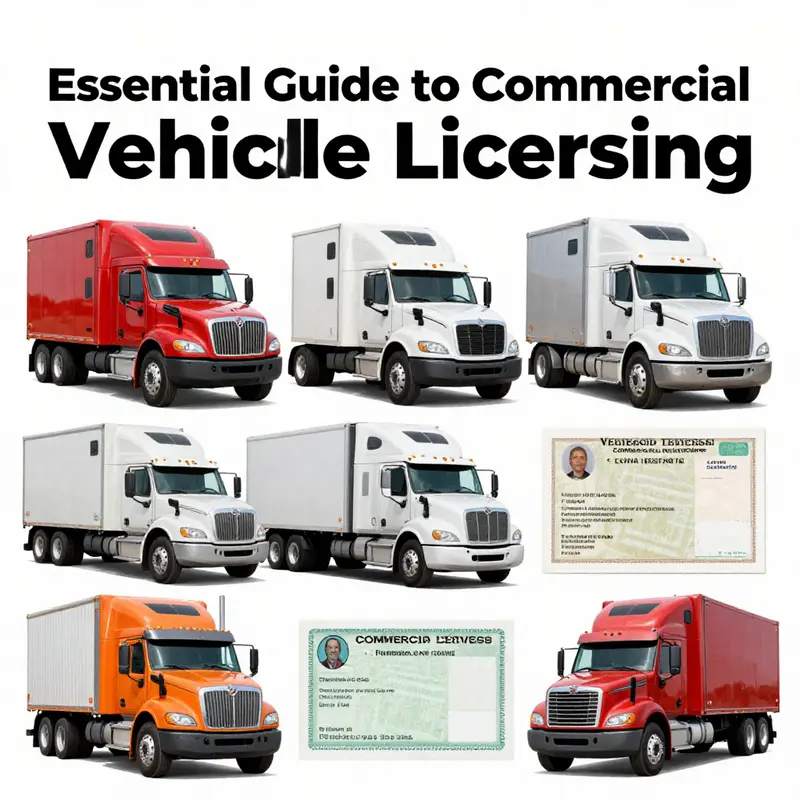
A useful way to understand the gravity of driving a commercial vehicle without the right license is to examine how licensing is structured in domains where the size, weight, and purpose of the vehicle create distinct obligations. In a country like China, for example, the licensing system is layered to reflect the different kinds of vehicles a driver may operate. The C1 and C2 licenses authorize the operation of smaller, typically non-commercial passenger vehicles, with C2 limiting drivers to automatic transmissions. The B1 and B2 licenses scale up to medium and large passenger vehicles, with B2 covering larger fleets and more extensive passenger capacities. Yet these categories are not mere labels; they define the precise type of vehicle a driver may legally command and the conditions under which they may do so. Crucially, when a vehicle is used for commercial purposes—whether to move goods or passengers for compensation—the driver’s licensing becomes intertwined with additional qualifications that certify the individual’s readiness for professional operations.
Alongside the standard driver’s license, many regulatory regimes require a separate credential that attests to the driver’s competence in commercial transportation. In the Chinese context, this is the Road Transport Qualification Certificate. This certificate is not a luxury add-on; it is a mandated credential for those who operate professionally on the road. It signals that the operator meets the professional standards expected by regulators and the public. Without both the appropriate vehicle-class license and this separate qualification, a driver’s ability to legally transport people or goods is compromised, and the legal penalties can be severe. The structure of these requirements reflects two core realities: first, the inherent risk of larger vehicles with higher loads, and second, the social demand for reliable, trained operators behind the wheel of vehicles that carry people, freight, or a combination of both.
In stark contrast to this formal architecture of licensing, the actual enforcement of these rules reveals a consistent emphasis on deterrence and public safety. In jurisdictions such as Hong Kong, the law makes clear that operating a commercial vehicle requires meeting precise licensing criteria. A driver must be at least 21 years old and must hold a full private car or light goods vehicle license for a period that demonstrates real-world handling of the vehicle class in question. In recent regulatory adjustments, the probationary period and the one-year holding requirement have been adjusted, but the underlying premise remains intact: licensing is not a mere formality. If a driver falls short of these criteria, or if they operate without any license altogether, the act constitutes a criminal offense under the Road Traffic Ordinance. The penalties are calibrated to reflect both the seriousness of the offense and the vehicle’s potential for harm, with the prospect of heavy fines, imprisonment, and disqualification from driving. The safety logic here is straightforward: heavier vehicles paired with inadequate training and authorization pose higher risks, and the law responds accordingly.
On the mainland side of the border, the legal framework is similarly concrete, though the language and mechanisms differ. Article 19 of the People’s Republic of China Road Traffic Safety Law states that driving a motor vehicle without a valid driver’s license is illegal. The law captures several missteps beyond simply lacking a license: possessing a license that does not match the vehicle class, using a forged or expired license, or being medically unfit or underage to drive. The penalties, while varied by offense and jurisdiction, typically include detention and fines. These provisions reinforce a fundamental principle: licensing is not a decorative credential but a demonstrable assurance of capability, fitness, and accountability. Even learners who are in the process of acquiring driving skills encounter stringent rules. In many cases, they must operate within the bounds of a formal learner’s permit and accompany a qualified instructor. Straying from these guidelines can itself be deemed driving without a license, underscoring the seriousness with which regulators treat the act of learning to drive a commercial vehicle as a pathway to public road use.
This legal architecture—class-based licenses, separate professional qualifications, and strict enforcement—serves broader purposes beyond punitive responses to violations. It underpins road safety strategies by ensuring that anyone behind the wheel of a large or passenger-carrying vehicle has undergone the appropriate training, understands the rules of the road relevant to that vehicle, and is subject to ongoing oversight. The public safety calculus is not only about the driver’s technical ability. It also encompasses the vehicle’s operational profile, such as its mass, braking dynamics, and the consequences of driver error in crowded urban environments or along long-haul routes. Heavier vehicles require longer stopping distances, more precise maneuvering, and stricter adherence to fatigue management and load securement. Jettisoning the license requirements in these contexts would erode the systemic checks that regulators rely on to minimize the probability and severity of collisions and near-misses.
The implications for individuals and organizations are multifaceted. For the driver, the cost of noncompliance is not just a legal sanction; it can mean the loss of income, the derailment of a career, and the stigma of a criminal record in professional circles. For employers, the stakes are even higher. Any deployment of drivers without proper licensing exposes the company to regulatory fines, civil liability, and increased insurance premiums. When a vehicle loaded with passengers or freight is involved in an incident, the absence of appropriate credentials can transform a tragedy into a protracted legal conflict, complicating investigations and liability determinations. In such cases, regulators may scrutinize company policies on hiring, training, and vehicle maintenance with renewed rigor, while courts assess the extent to which a lack of licensing contributed to the harm. The broader consequences extend to public trust: communities expect that those who operate commercial transport are vetted, certified, and monitored to uphold standards that protect everyone who shares the road.
A crucial element in understanding these consequences is recognizing that licensing is not a static badge but a dynamic system. Vehicle classifications, regulatory amendments, and the evolution of safety standards all affect what counts as a valid license for a given operation. For instance, the distinction between a license that authorizes non-commercial operation and one that allows paid service can determine the legality of a particular job, the hours a driver may work, and the types of routes that can be served. In this sense, licensing is part of a broader governance framework that aligns professional transportation with public policy goals—reducing risk, promoting accountability, and ensuring that the transportation network functions efficiently and safely. When a driver violates licensing rules, the ripple effects touch not only the immediate parties involved but also regulatory credibility and the public’s confidence in the system.
The conversation around licensing also intersects with transparency and public communication. Regulators, in recent years, have emphasized clear, accessible information about the requirements for different vehicle classes and the steps necessary to obtain and maintain credentials. In Hong Kong, for instance, the Transport Department’s guidance and official resources provide essential details on eligibility, tests, and ongoing compliance, reinforcing the message that licensing is an actionable, ongoing responsibility rather than a one-time hurdle. This emphasis on clarity helps deter potential violations by removing ambiguity about what is required and by outlining the consequences in concrete terms. For professionals who drive as a livelihood, such transparency is not merely helpful; it is a business prerequisite that enables compliant operations, reduces the risk of unexpected penalties, and supports safer, more predictable service delivery.
As readers consider the practical implications, it is useful to reflect on the broader regulatory landscape that shapes licensing across borders. The core lesson remains consistent: commercial vehicle operations are subject to rigorous licensing regimes because the stakes are high. The mismatch between a driver’s license and the vehicle’s category, or the use of a vehicle for commercial purposes without the corresponding professional qualifications, cannot be brushed aside as a minor infraction. It is a misalignment that regulators treat with gravity, because the cumulative risk to public safety is unacceptable when a single misstep can place dozens, or hundreds, of lives at risk. This awareness should inform not only individual drivers but also fleet managers, instructors, and policy advocates who seek to improve how licensing systems prepare drivers for the complex realities of modern road transport.
For readers who want to ground these observations in official guidance, turn to the formal regulations and regulatory bodies that oversee licensing in the relevant jurisdiction. The specific statutes, compliance thresholds, and penalties are published and updated by government agencies. In the Hong Kong context, the Transport Department remains a key reference point for current requirements and procedures. The underlying message, however, is universal: only those who hold the correct license for the vehicle and the intended use should be on the road in a professional capacity. This principle is not merely about compliance; it is about upholding a shared standard for safety and accountability on a public and interconnected road network. If you want to explore how state rules shape driver licensing more broadly, a concise discussion of the evolving landscape can be found at state rules impact on driver licensing.
In the end, licensing serves as a gatekeeper—one that helps ensure that commercial drivers are fit, trained, and prepared to manage the responsibilities that come with transporting people and goods. The consequences of driving without the right credentials are not abstract; they are concrete, immediate, and potentially life-altering. The chapters that follow will continue to explore how licensing interacts with other dimensions of commercial driving, including inspection regimes, safety standards, and career pathways for professional drivers. By grounding policy discussions in concrete cases from different jurisdictions, readers gain a clearer sense of why the right license is not a bureaucratic hurdle but a fundamental element of safe, reliable road transport.
External resource: https://www.td.gov.hk
Regional Road Maps: How Licensing Differences Decide When You Need a Commercial Driver’s License
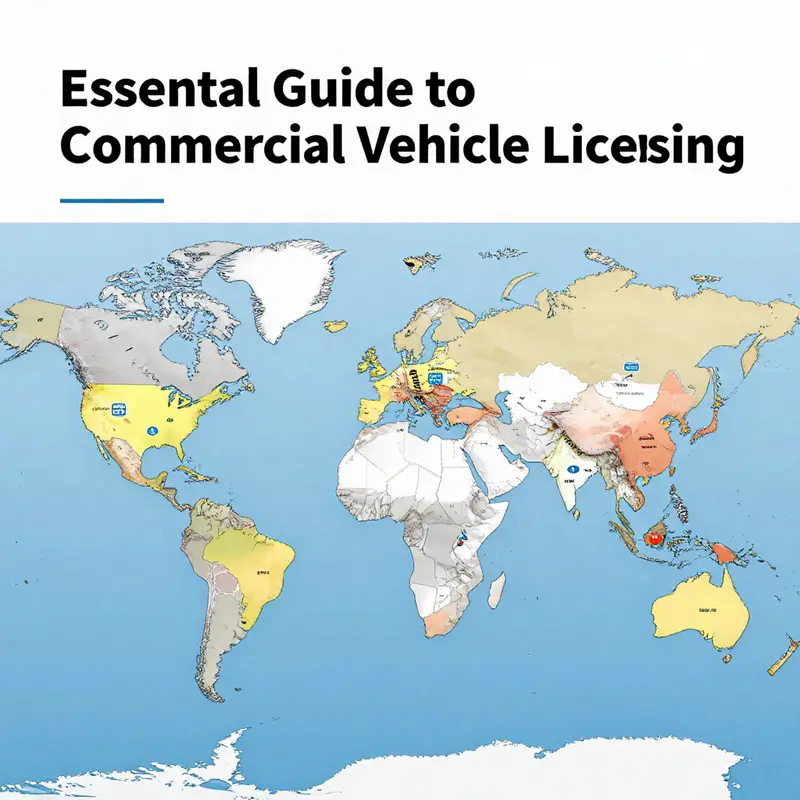
Across the world, the moment you become a professional driver is not defined by one universal rule. It is shaped by a mosaic of regional regulations that determine whether a driver must hold a specific commercial license, and what that license must cover. The question at the heart of this chapter—do you need a license to drive a commercial vehicle—unfolds differently depending on where you operate, the type of vehicle you intend to command, and the purpose behind the journey. The landscape is not simply a matter of a single document; it is a system of classifications, certifications, and compliance duties that together govern what it means to steer a truck, a bus, a delivery van, or any vehicle designed to move goods or people for a living. To understand this landscape, it helps to move beyond the broad exhortation that a commercial driver’s license is always required. Instead, one must map the nuanced terrain of licensing across regions, whose borders are defined not only by geography but by transport policy, public safety priorities, and economic needs.
Begin with the core idea that licensing is a gatekeeper for safety, training, and accountability. In many jurisdictions, the gate is open to those who demonstrate the capacity to handle larger, heavier, or more complex vehicles, while the specific doorway depends on local definitions of what constitutes a commercial operation. In the United States, for instance, the Federal Motor Carrier Safety Administration (FMCSA) sets a federal baseline for commercial driver licensing, but states retain substantial discretion to tailor requirements. This means a driver who is fully qualified in one state may face additional or different conditions if they move to another state, or if they intend to operate across state lines. The federal backbone ensures consistency in fundamental standards—such as medical fitness, knowledge testing, and the broad categories of vehicles that trigger a CDL—but the surrounding rules are highly state-specific. Endorsements for hazardous materials, passenger transport, or specialized vehicle configurations, for example, can be required differently from one state to the next. And even within a single state, hours-of-service rules, rest break requirements, and fleet safety programs can diverge from one decade to the next as policymakers respond to perceived risks on the road, shifting technology, and evolving industry practices.
If one looks closer at regulatory architecture, it becomes clear why the regional approach matters so much for planning and operations. Compliance is not a static checklist; it is a dynamic framework that affects every step of a carrier’s lifecycle—from recruitment and training to scheduling, inspection, and accident response. The regional nature of licensing creates opportunities for some operators to tailor their workforce strategy around local rules, while presenting pitfalls for others who expand into new markets without updating their compliance profiles. A company that runs a fleet across multiple states must harmonize its driver qualification files, medical certificates, and licensing credentials so that a single driver’s status is valid on every route they drive. This harmonization challenges teams to maintain parallel systems for endorsements, vehicle classifications, and inspection requirements, all while staying alert to periodic changes in law that can retroactively affect what a driver may and may not do on the road.
The contrast with other regions is instructive. In the European Union, licensing has pursued greater harmonization under directives like the EU Driving Licence Directive. The intent is to recognize licenses across member states and to streamline cross-border operations for freight and passenger services. Yet even within the EU, different national authorities retain control over medical fitness assessments, language proficiency, and some local traffic regulations. The result is a more predictable framework for cross-border operations than in places where licensing remains highly fragmented, but it still requires careful coordination and ongoing monitoring of national variances. In emerging markets, the picture is often more complex: regulatory frameworks can be uneven, enforcement variable, and definitions of what constitutes a “commercial vehicle” or a “professional driver” may differ markedly from one jurisdiction to another. These gaps increase risk for operators who assume that licensing is universally portable or uniformly enforced. They also increase the cost of compliance, as fleets invest in legal guidance, training programs, and administrative systems designed to accommodate multiple regulatory logics rather than a single, global standard.
The practical consequences of these regional differences touch every aspect of day-to-day operations. For carriers that move freight across a broad network, the possibility of route planning being constrained by endorsements can force re-routing or additional rest periods to align with local rules. A driver with a HazMat endorsement may be fully qualified on one state’s roads but encounter a more stringent or differently structured requirement on another, creating a need for cross-state credential verification and documentation control. For passenger transport, the divergence between jurisdictions can influence whether a vehicle is classified as a large passenger vehicle or a mid-size coach, which in turn determines the size of the crew, the training program required, and the safety inspection regime. Even the timing of required inspections—annual, semi-annual, or event-driven—can differ, affecting maintenance planning, downtime, and overall fleet utilization.
From a risk-management perspective, these regional distinctions are not mere paperwork. They shape liability, insurance terms, and the penalties carriers face when found non-compliant. Fines, vehicle impoundment, or suspension of operating licenses can cascade into service disruptions and revenue losses. The penalties escalate when hazardous materials are involved or when vehicles exceed size or weight limits, reflecting the heightened risk profile of those operations. In practice, this means a company cannot simply assume that possessing a standard CDL and a few renewals will cover all its activities. The regional architecture demands ongoing vigilance: a compliance program must routinely audit endorsements, verify medical certificates, monitor hours-of-service data, and track regulatory changes that affect driver qualifications. The consequence of neglect is not only legal exposure but the erosion of safety culture, which in this field is inseparable from regulatory compliance.
To navigate this labyrinth effectively, operators increasingly rely on a combination of specialized expertise and technology. Legal consultants with regional knowledge help interpret the precise requirements of each jurisdiction, while compliance software and fleet management platforms enable real-time credential tracking, ongoing training scheduling, and automatic alerts when regulatory thresholds shift. The emphasis on regional differences also invites a more thoughtful approach to recruitment and training. Employers seek drivers who can adapt to multiple regulatory environments, or who can be specialized for a particular corridor, thereby reducing the complexity of multi-jurisdiction operations while maintaining safety and efficiency. In this context, the licensing question—do you need a license to drive a commercial vehicle? becomes less about a single form and more about a carefully designed ecosystem that ensures every driver, every route, and every shipment complies with the right rules at the right time.
A useful perspective emerges when we look at examples from China, which illustrates how licensing can be segmented by vehicle type and purpose. The C1, C2, B1, and B2 classifications reflect how seat capacity, transmission type, and vehicle category translate into distinct licensing requirements. The C1 and C2 licenses, for instance, cover passenger vehicles with a certain range of seats and allow non-commercial operation, with C2 restricted to automatic transmissions. The B1 and B2 licenses expand to larger passenger vehicles. When commercial use enters the picture, additional credentials—such as a Road Transport Qualification Certificate—become essential for professional drivers engaged in freight or passenger transport. This layered approach shows how licensing systems can combine vehicle-specific classifications with separate professional qualifications to govern safety-critical operations. Although China’s framework is not identical to those in the United States or the EU, it highlights a core principle that regional licensing is rarely a single-dimension gate. It often involves a constellation of licenses, endorsements, and certificates that together define what a driver may do on the road and under what conditions.
The broader message for practitioners is clear: licensing is not a one-size-fits-all gate but a regional, multi-layered policy instrument. For those planning cross-border or cross-regional operations, a proactive, holistic compliance mindset is essential. This means engaging early with regulatory authorities, mapping the entire licensing landscape for every jurisdiction of operation, and investing in training that aligns with the most stringent requirements among the regions involved. It also means anticipating shifts in policy, such as the adoption of more stringent medical standards, stricter hours-of-service rules, or newer environmental criteria for vehicle operations. In practice, this translates to robust record-keeping, dynamic route planning, and the capacity to adjust quickly when a jurisdiction tightens its rules or introduces a new endorsement category.
From an informational standpoint, the most reliable path to clarity is to consult official sources and stay connected with regulatory developments. For those working in the United States, the FMCSA site provides essential baseline information and updates that shape state-level implementations. In Europe, the directives offer a framework for understanding cross-border recognition while acknowledging the continued role of national authorities in medical and language requirements. For practitioners who operate in or with emerging markets, the emphasis rests on building relationships with local legal experts and leveraging compliance software that can adapt to fast-changing regulatory landscapes. The strategic takeaway is straightforward: to determine whether a driver needs a license for a specific commercial operation, you must examine the local, regional, and national rules that govern vehicle type, operation type, and the intended business purpose.
As regulators and industry participants continue to refine licensing regimes to address safety, efficiency, and environmental concerns, the road map will inevitably evolve. But the underlying principle remains stable: licensing matters, and regional differences profoundly influence when and what kind of license is required. The best practice for fleets is to treat licensing as a moving target—one that benefits from continual alignment with local norms, proactive training, and systems that translate regulatory complexity into practical, day-to-day compliance. For readers seeking a gateway into this landscape, consider exploring the nuanced ways state rules can impact driver licensing, and how those regional nuances translate into the broader question of who may drive a commercial vehicle and under what conditions. state rules impact on driver licensing This approach helps ensure that the answer to the central question—do you need a license to drive a commercial vehicle? remains grounded in an accurate, location-specific reality, rather than a generic entitlement that may not apply on the road you will travel.
External reference: https://www.fmcsa.dot.gov
Final thoughts
Understanding the need for a commercial vehicle license is pivotal for anyone involved in driving commercially. This guide has outlined the fundamental licensing requirements, types of licenses available, potential legal consequences of driving without a proper license, and highlighted the regional variations in regulations. With this knowledge, individuals can better navigate the landscape of commercial driving and adhere to relevant laws, ensuring road safety and compliance. Always ensure that you check local regulations to stay informed and responsible.