
Navigating the vehicle registration landscape can be complex, especially for new drivers, seasoned vehicle owners, and auto dealerships. A pivotal question arises: Do you need a license to register a vehicle? This article unpacks the intricacies surrounding vehicle registration and the necessity of a driver’s license across different cases. Each chapter will explore essential elements of the registration process, detailed requirements, special cases, and online versus in-person options. Lastly, it will touch upon international considerations for those unfamiliar with local regulations. Whether you’re a learner, an existing driver, an enthusiastic vehicle owner, or a dealership professional, understanding these aspects will provide clarity on the registration process.
The License Gatekeeper: How a Driver’s License Shapes Vehicle Registration Across States
Do you need a driver’s license to register a vehicle? The answer is layered and state-specific, not a single nationwide decree. There is no federal mandate that says a driver’s license is required to register a vehicle. Instead, each state’s motor vehicle agency crafts its own rules, guided by a simple, common aim: to link a vehicle to identifiable ownership and to the person who is most likely to operate it, while keeping the public record accurate and up to date. In practice, this means the driver’s license frequently enters the registration process, not as a separate “vehicle license” but as a trusted credential that helps confirm identity, prevent fraud, and assign responsibility should something go wrong. The interplay between license status and registration is a practical outcome of how states balance convenience with safety and accountability, and because the rules differ by jurisdiction, the exact requirements can feel bewildering to someone who moves between states or buys a vehicle across state lines.
The differences among states can be seen in the way California and New York approach registration. In these states, proof of a valid driver’s license is commonly required when you register a vehicle, particularly if you are listed as the primary owner or operator. The logic is explicit: the person who will operate the vehicle should be linked to the official record. The DMV in such states treats the license not only as a form of identity but as evidence of driving eligibility. Importantly, even in states with this expectation, there can be circumstances where a license is not the sole gatekeeper. For example, households with shared vehicles or cases where ownership documents are strong enough to verify ownership and insurance can still progress through the process, though the license often remains a critical piece of the verification puzzle. The practical takeaway is that the presence or absence of a license is not simply a yes-or-no question; it’s a question of how the state’s system weighs different pieces of documentation and how it manages the lion’s share of the risk associated with driving on public roads.
In contrast, Florida and Texas illustrate a more flexible approach. These states may permit vehicle registration without a current driver’s license under certain conditions—provided the applicant can show ownership (title or bill of sale), proof of insurance, and compliance with residency and presence requirements. The policy recognizes a broader reality: people move, buy cars in other states, or own a vehicle without immediately obtaining a local driver’s license. This flexibility helps avoid blocking legitimate transactions, but it also means you cannot assume a license is always the minimum entry criterion. It’s a reminder that a registry’s primary job is accurate ownership and compliance with safety and insurance standards, not policing the license status of every person who appears at the counter.
Regardless of whether a license is strictly required to begin the registration, the typical document suite remains consistent. Proof of ownership, usually a title or a bill of sale, is central. Insurance proof is another non-negotiable in most jurisdictions, tying the vehicle to a required level of financial responsibility. For many areas, a vehicle inspection or emissions test remains part of the equation, especially in states prioritizing environmental and safety standards. Fees accompany the process—registration fees, title fees, taxes, and sometimes local charges—reflecting the costs of maintaining the public vehicle registry and enforcing compliance. The exact amounts and conditions vary, but the structure is recognizable: ownership is proven, the vehicle’s status is recorded, and the vehicle is permitted to operate only if it meets the state’s standards and is properly insured.
A further layer of nuance concerns residency and the status of non-residents. Some states permit non-residents to register vehicles, at least temporarily, but often require a valid home address, a local impulse to prove presence, or even an eventual transition to a local driver’s license. For people who plan to stay only briefly, or who drive only occasionally in a state where they are registered, the rules can be perplexing—but they exist to ensure that the public registry reflects real-world use and real financial accountability. When moving between states, or when buying a vehicle while living elsewhere, the decision about which jurisdiction governs registration hinges on where the vehicle will primarily be kept and operated, not merely where the owner resides on paper.
First-time registrations for new vehicles bring additional considerations. A Manufacturer’s Certificate of Origin (MCO) or import certificate can be required if the vehicle has not yet been titled in the state. This is particularly relevant for vehicles imported from abroad or for those that arrive without a traditional title. In these scenarios, the registration process often involves extra verification steps, and dealers or importers may act as intermediaries to ensure the necessary documents are in place before the DMV issues plates and registers the vehicle. Even when a dealer consolidates much of the paperwork, the final decision rests with the state, and a visit to a DMV office may be necessary to verify VIN details or to complete on-site inspections.
The question also turns on who is listed on the registration and who is expected to operate the vehicle. Many households share cars, and ownership may not align perfectly with daily usage. Some states require the owner to appear in person to sign the registration, or to provide a written authorization for another person to operate the vehicle. This practice underscores a fundamental point: registration is about recording accountability, while driving eligibility is about the right to operate. The license often sits at the center of both concepts because it represents the combination of identity, driving status, and public accountability. This is not a contradiction but a deliberate design: the state wants to be able to link the individual who will be in control of the vehicle with a verifiable credential and with proof of the ability to abide by driving laws.
Online and in-person options coexist in this landscape, sometimes in tension. Many states now offer online registration portals where you can upload documents, verify ownership, and pay fees electronically. Yet some steps will still require you to appear in person, particularly when an inspection is mandated or when the documents require live verification. This hybrid approach reflects the contemporary balance between convenience and rigor: online systems can streamline routine tasks, but certain checks are most reliably performed in person, where a staff member can physically verify documents and confirm that the vehicle meets current standards. The result is a process that looks different from state to state but behaves in a familiar arc: confirm ownership, confirm operator status or the ability to operate, verify insurance, verify safety or environmental compliance, and finalize the public record with the correct ownership and operator details.
The big takeaway for anyone navigating this territory is practical: there is no universal rule that a license is always needed to register a vehicle, but a license is the most common and reliable signal used by many states to verify identity and driving eligibility. This is why the license shows up so frequently in registration workflows, and why losing or letting a license lapse can complicate even otherwise straightforward registrations. If you are moving, purchasing, or re-titling a vehicle, start with your state’s official DMV guidance rather than relying on anecdotes. The DMV’s own pages will spell out exactly what documents are required, what forms you must complete, and whether a license is required for your particular situation.
For readers who want to see the broader landscape, state rules and driver licensing provide a framework that demonstrates how the same core principle—link ownership and operation to a verifiable credential—can be implemented in diverse ways. This perspective helps demystify a sometimes opaque set of requirements and emphasizes the practical consequences of your decisions about where to register and under which premises you register a vehicle. You can explore this broader context through the linked discussion on state rules and driver licensing. state rules and driver licensing.
As a practical caution, remember that registration is separate from the right to drive. Even if your state permits registering a vehicle without a current license, you should not assume you may legally operate the vehicle without one. The license remains your most reliable baseline for proof of eligibility to drive and to be identified in the event of an accident or traffic violation. If you want to verify the exact requirements for your own state, rely on the official guidance and check frequently updated DMV pages, since policies can change with new safety standards or funding decisions. For official guidance, see the California DMV: https://www.dmv.ca.gov
License as Gatekeeper: Do You Need a Driver’s License to Register a Vehicle?
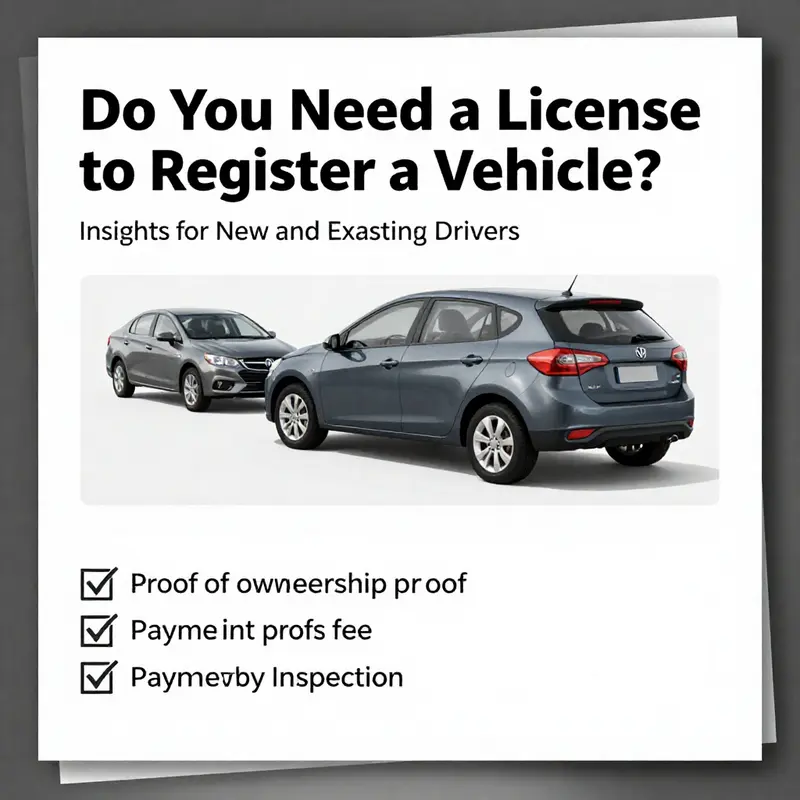
When people set out to register a vehicle, the focus often lands on the license plate, the fees, and the forms. Yet the underlying question is more fundamental: what counts as the official authorization to connect a vehicle to a person and a place on public roadways? In most jurisdictions, the answer hinges on a driver’s license, not a separate vehicle license in the sense of a permit to operate. The license acts as a gatekeeper, a trusted credential that links an individual to the right to drive and, by extension, to register a vehicle in their name. This connection makes sense once you remember that registration exists to ensure accountability, safety, and accurate records, all of which flow from the ability to operate a vehicle legally and responsibly. The practical upshot is straightforward: you will typically need to show a valid driver’s license as part of the registration process, even though the exact steps can vary by country, state, or territory.
In jurisdictions with long-established motor vehicle regimes, the driver’s license serves multiple purposes during registration. It stands as proof of identity, confirms the applicant’s age and legal status to operate a motor vehicle, and functions as a cue for insurers, inspectors, and licensing authorities that the person behind the paperwork is a real, authorized operator. This nexus between license and registration is why many motor vehicle departments require a current, valid license before they will issue or renew a vehicle’s registration. It isn’t simply a bureaucratic preference; it’s a safeguard that helps prevent fraud, ensures continuity of coverage, and ties the vehicle to a person who is known to meet minimum safety and competency standards.
Beyond the license itself, there is a set of core documents and steps that consistently appear in the vehicle registration process. Most systems require proof of ownership, typically the title or a bill of sale, to establish who owns the vehicle or who has the right to register it. Insurance is another non-negotiable element in many jurisdictions, because registration is closely tied to the vehicle’s liability coverage. Insurers provide the connective tissue between ownership, operation, and the legal obligation to compensate in the event of an accident. A valid insurance policy statement often must accompany the registration application, ensuring that the vehicle is prepared for road use from the moment the plates are issued.
Alongside ownership and insurance, inspections play a crucial role in maintaining public safety and environmental standards. Depending on where you live, vehicles may need to pass safety checks, emissions tests, or both, as a condition for license plate issuance or renewal. The inspections go beyond aesthetics; they help ensure that brakes, lights, steering, and emission controls meet minimum standards. Timeliness matters here, because failed inspections or overdue checks can stall or suspend the registration process. In some places, you can schedule these examinations online or at designated inspection centers, while other regions require in-person visits at specific government offices. Either way, the goal is to confirm that the vehicle is safe to operate and compliant with local environmental rules before it becomes street-legal.
The financial side of registration is equally consistent across jurisdictions, though the exact fee structure varies. Registration fees typically cover administrative costs, and many places add taxes, title fees, and other charges. These costs are not merely a formality; they reflect both the value of the vehicle and the ongoing responsibility of keeping the vehicle registered and trackable within the public record. When combined, the required documents—proof of ownership, proof of insurance, inspection certificates where applicable, and the driver’s license—form a reliable framework that reduces risk for road users and for the state or province that governs the roads.
The picture becomes more nuanced when you introduce the realities of travel, residency, and cross-border movement. Non-resident or out-of-state registrations exist in many systems, and these scenarios test the flexibility of the process. Some jurisdictions permit out-of-state residents to register a vehicle locally, but they still demand a valid license from the home state or country, along with proof of ownership and insurance that complies with local requirements. The landscape shifts further for first-time registrations, where a new vehicle may require additional documentation such as a Manufacturer’s Certificate of Origin (MCO) or an import certificate if the vehicle is brought from abroad. The common thread is that the presence of a valid driver’s license frequently remains a non-negotiable element, even as other steps adapt to the specifics of ownership, origin, or residency.
In recent years, online services have transformed how people navigate the registration maze. Many regions now offer digital portals where applicants can submit documents, verify identity, check insurance status, and pay fees without stepping into a government office. Still, certain steps—such as in-person inspections or document verification—may require a visit to a DMV or equivalent office. The blend of online convenience with occasional touchpoints in person reflects an ongoing effort to streamline the process while preserving safeguards against fraud and misrepresentation. For those juggling work, family life, or a tight schedule, the option to manage much of the process online can significantly reduce friction, yet it does not erase the reality that a valid license remains the anchor credential around which registration revolves.
These general patterns acquire particular texture when we zoom in on specific places, such as Hong Kong, where the regulatory culture emphasizes careful documentary compliance and the linkage between ownership records and road-legal status. In Hong Kong, the journey to lawful registration begins with a verification of ownership documents. The vehicle title, the bill of sale, and, for new vehicles, the Manufacturer’s Statement of Origin (MSO) form the foundation. Importantly, when a vehicle is brought into Hong Kong from abroad, an endorsement from relevant government departments is required to show that environmental protection standards, safety examinations, and other regulatory checks have been satisfied before the first registration can proceed. This reflects a broader philosophy: registration is not merely about stamping a plate; it is about ensuring that every vehicle on the road aligns with local expectations for safety and environmental responsibility from the moment it enters the system.
Insurance in Hong Kong is more than a formality. It is a binding prerequisite for registration, one that confirms the vehicle has coverage consistent with the minimum liability requirements. The practical effect is that you cannot register the vehicle unless you can demonstrate active coverage that remains valid as you operate on public roads. Next comes the vehicle inspection regime. Regular safety and emissions examinations are mandatory to maintain a valid license to operate, and these inspections function as a recurring checkpoint to keep the fleet compliant and roadworthy. Scheduling inspections early is prudent; delays in inspection can ripple into the overall registration timeline, especially if the vehicle’s licence is nearing expiry or if the applicant is preparing to drive away with new plates.
Another distinctive element in the Hong Kong workflow is the Certificate of Clearance. Prospective buyers are advised to obtain this certificate before finalizing a purchase. The certificate acts as a safeguard against unresolved penalties or potential suspension of the licence tied to the vehicle. Yet the certificate has a strict validity window—72 hours from issue—meaning timing is essential. In a dynamic market, buyers need to coordinate inspection, verification, insurance, and payment so that the certificate remains viable through the critical window. The Transport Department also provides online services that mirror these needs: an Online Enquiry Platform to confirm the validity and expiry of a vehicle licence and an Online Checking System for hire car permits, which helps the public determine whether a private car has the necessary authorization to carry passengers for hire or reward. These tools exemplify how digital instruments can simplify compliance while preserving the integrity of the licensing framework.
For those navigating this landscape, the guidance and resources section of the official Transport Department website remains the most reliable compass. Logical sequencing—gathering ownership documents, confirming insurance, scheduling inspections, calculating fees, and submitting applications—typically yields the smoothest path to a timely registration. Embedded in this process is a core truth: indeed, you do not need a vehicle-wide license in the abstract, but you almost always need a valid driver’s license as part of the registry’s identity and eligibility checks. The practical upshot is that readers should treat the driver’s license as the gateway credential to the entire registration journey, even as other documents and steps fill in the details.
For readers curious about how these dynamics play out in different jurisdictions while staying anchored to the central question, a useful path is to consider state-specific rules and how they shape the driver-licensing landscape. See the discussion on how state rules impact driver licensing for nuanced examples and evolving procedures that can affect both registration timelines and eligibility status. state rules impact on driver licensing
As you plan your next vehicle registration, it helps to think of the process as a system designed to confirm who is authorized to operate, who owns the vehicle, and whether the vehicle is ready to join traffic in a safe and responsible manner. The license is the personal credential that unlocks the system, while ownership documents, insurance, and inspections unlock the vehicle’s place within the public record. The steps are not arbitrary hurdles; they are carefully calibrated to protect drivers, pedestrians, and the broader community from risk and to ensure that every vehicle on the road can be identified, insured, and maintained within the standards trusted by the jurisdiction.
Ultimately, the question of whether you need a license to register a vehicle is best answered with a simple synthesis: you almost certainly need a valid driver’s license as part of the registration process, even as you gather ownership proof, insurance, inspections, and payments. The exact requirements will depend on where you live and whether you are registering a vehicle in person or online. In places with robust, paper-based regimes, expect the process to be more document-heavy and time-consuming; in places that have digital platforms, you may complete many steps remotely while still presenting your license as a central proof of identity and eligibility. Either way, the license functions as the key that unlocks the registry, while the other documents and procedures ensure that the vehicle can be used safely and legally on public roads.
Readers should consult their local licensing authority for the most current rules, fees, and timelines. While the overarching principle remains consistent, the exact sequence and requirements can shift with policy changes, environmental commitments, and technological upgrades. For those seeking official, place-specific guidance, the Transport Department’s vehicle licensing page offers a definitive resource: it lays out the steps, the documents, and the conditions for different scenarios—from new imports to renewals to suspensions. This chapter has aimed to illuminate the through-line that ties license, ownership, insurance, and inspection into a coherent, enforceable system, so you can approach registration with clarity rather than guesswork.
External resource: Transport Department – Vehicle Licence, Registration & Examination: https://www.td.gov.hk/en/vehicle_registration/index.html
When Ownership Isn’t the Whole Story: Navigating Special Cases in Vehicle Registration Without a Driver’s License
People often assume vehicle registration is a simple card that follows the car wherever it goes. In reality, registration is a record of ownership and identity, but it sits within a broader web of rules about who may drive. The chapter you’re reading digs into the special cases that can blur the line between ownership and operation. It asks a practical question: does registering a vehicle require a license, and what happens when the driver’s license and the registration don’t line up neatly because of family arrangements, residency status, or cross-border circumstances? The core idea is that registration and licensing, though connected, serve different purposes in the law. Registration is a public record of who owns the vehicle and, in many places, who has insured it. Licensing, by contrast, is a statement about who is legally permitted to drive the vehicle. This distinction matters because people frequently assume that whoever owns the vehicle also has the license to drive it, or that the act of registering under one person’s name grants automatic privilege to drive. The truth is far more nuanced, and the nuances become especially important in special cases.
Take the UK as a concrete reference point. The regulatory framework there emphasizes a key principle: driving a vehicle on a public road requires a valid driving licence for the vehicle’s category. It does not matter who appears on the vehicle’s registration document. The driver must hold a licence that matches the vehicle class—cars, motorcycles, heavy goods vehicles, or other categories. This rule anchors safety and accountability in a way that ownership alone cannot. The DVLA’s guidance makes this clear: if you do not have a valid driving licence for the type of vehicle you are driving, you are breaking the law, even if the vehicle is properly registered and insured. The focus is squarely on the driver’s qualifications, not just the registration details. For a person who owns a car but permits another individual to drive it, the owner can bear liability if they knowingly allow an unqualified driver to operate the vehicle. The bottom line is simple in principle, but the practical implications can be complex in real life—especially within households where both partners share a vehicle or when a vehicle is registered in one name but used by another.
This leads to the heart of the special cases: ownership and operation do not always travel the same path. A household vehicle registered under one spouse’s name can still be driven by the other spouse if that driver holds the appropriate licence. The DVLA’s guidance underscores this separation—“the person who drives the vehicle must have a valid licence for that vehicle.” The registration name does not automatically grant driving entitlement. In practice, this means that the primary concern for law enforcement and the courts is whether the person behind the wheel holds the correct licence and appropriate insurance, rather than whether the registration document matches the driver’s name. If a husband has a valid car licence, and the car is the husband’s to drive, the law treats him as legally permitted to drive the car even if the registration is in his wife’s name, provided the car’s classification and the driver’s licence align. Conversely, if a driver lacks the right licence for the vehicle class, both the driver and the person who allowed the unlicenced operation face potential penalties. The law views licensing as a gatekeeper for road safety; registration records cannot substitute for it.
In households and personal relationships this distinction can feel counterintuitive. People sometimes assume that because a vehicle is registered to one person, the other person who uses the vehicle would also be subject to the same legal protections, or that the registration acts as blanket approval for operation. The reality, however, is that the responsibility to ensure lawful operation rests with the driver who is behind the wheel. The DVLA’s stance and the Section 1 provisions of the Road Traffic Act establish that unlawful driving carries consequences regardless of ownership or registration status. This means fines, penalties, points on a licence, or even disqualification can follow unlicensed driving, independent of insurance coverage or registration correctness. The unlicensed scenario remains a criminal offense in many jurisdictions, underscoring the necessity of proper licensing before use. The legal framework does not provide a loophole for a registered owner who assumes permissive driving rights for someone else. Instead it places the onus on the driver to possess the appropriate licence for that category of vehicle at the time of driving, and on the vehicle’s owner to be mindful of who they permit to operate the vehicle. This is especially relevant in cases where a vehicle is a family asset used by multiple adults.
Another layer of complexity arises with non-residents or cross-border dynamics. In many jurisdictions, a person who resides outside the jurisdiction and seeks to operate a vehicle there must navigate whether their home license is recognized locally, whether an international driving permit can bridge the gap, or whether they must obtain local licensing before driving. The UK experience gives a clear route: driving without a license is illegal, and even if your home country has valid licenses, you may still need to satisfy local requirements to drive legally in another country. Non-residents contemplating vehicle use in a new country should take care to verify how long they can drive with their current license, what vehicle categories are covered, and whether temporary registration or import rules affect their ability to operate. The same logic applies to other countries with flexible cross-border licensing arrangements. The overarching message is straightforward: even when a vehicle is registered in a particular name, the right to drive it is contingent on holding a valid license appropriate to the vehicle type. The consequences of neglecting this rule can be severe, and they do not disappear simply because you are connected to the vehicle by ownership or familial ties.
The practical takeaway for readers is not to treat registration as a shield that protects you from licensing requirements. Registration confirms who owns and may insure the vehicle, but the right to operate rests with the driver’s licence, proof of insurance, and relevant vehicle checks. Special cases—such as family vehicles, or situations where a vehicle is registered in one name but used by another—do not dissolve these fundamental rules. If a driver’s license is in a different name or category than the vehicle requires, the driver remains in violation if they operate the vehicle. In this light, the registration document functions as a public record that supports accountability, while licensing is the regulatory gatekeeper that ensures road safety. The DVLA references and statutory provisions emphasize this two-tier system, designed to keep the roads safer while accommodating legitimate personal arrangements within families, shared households, and even cross-border life.
For those navigating these questions in real life, the guidance is practical as well as legal. Start with confirmation that a valid licence for the vehicle category is in place before you set any plan for operation. If you share a vehicle with a partner or a family member, discuss who will be the licensed operator and ensure insurance coverage aligns with that arrangement. If the vehicle is registered in one name while operated by another, remember that authorities will verify the driver’s licence and insurance when checks occur. The timing of inspections or vehicle checks can vary by jurisdiction, and some regions require periodic emissions tests or safety inspections as part of the registration renewal process. In such cases, the driver’s licence and the vehicle’s registration status must both be in compliance at renewal. When considering non-residents or travelers who intend to drive temporarily, investigate whether an international driving permit, local licence verification, or local registration requirements apply. In short, registration and licensing are distinct but interdependent facets of the broader framework that governs vehicle use. This distinction helps ensure safety and accountability while allowing for legitimate personal arrangements within families and across borders.
As you reflect on these special circumstances, you may wish to consult authoritative sources beyond local regulations. The UK government and DVLA guidance reinforce the central idea: your license is the qualifier, not your registration. Driving a vehicle without a valid licence constitutes a criminal offense with potential penalties that include fines, points, and disqualification, and this holds even if the vehicle is properly registered and insured. The safety ethic behind these rules is clear: a valid driver’s license is a baseline requirement for operating a vehicle on public roads. For readers seeking deeper understanding, the official guidance offers detailed explanations about licensing categories, the seriousness of offences, and the consequences of driving without a licence. While the precise procedures may vary by country or state, the underlying principle remains consistent across many jurisdictions: ownership does not grant driving rights, and proper licensing remains essential for lawful operation.
In closing, the notion that registration can substitute for licensing is a practical misconception that can land people in trouble. Special cases illuminate the importance of distinguishing ownership from operation and recognizing that the responsible steps involve ensuring licensure, verification of insurance, and adherence to any local inspection requirements. The pathway to compliant vehicle use, then, is straightforward in theory but sometimes nuanced in practice. Confirm you hold a valid licence for the vehicle category, confirm that the appropriate owner and/or operator is insured, and be mindful of local rules about cross-border or multi-user ownership. This approach preserves safety, reduces legal risk, and keeps the journey smooth whether you are a resident, a non-resident, or a family navigating shared vehicles.
Internal link: For nuanced considerations that touch on how local rules can shape licensing beyond just the UK framework, see State rules impact on driver licensing. State rules impact on driver licensing
External reference: For official guidance on driving licenses and related offenses, consult the UK government resources on driving licences and offences. External resource: https://www.gov.uk/driving-licence
From Online Clicks to Counter Visits: Navigating Online and In-Person Vehicle Registration
Registration is often framed as a bureaucratic hurdle, yet it is better understood as a service that blends identity verification, legal eligibility, and ongoing compliance with a vehicle’s lifecycle. The shift toward online options does not erase the need for human oversight; instead, it complements it by handling routine tasks quickly while reserving in-person time for complexities that online systems cannot resolve. In this chapter, we explore how online and in-person pathways co-exist, how jurisdictions wire them into a coherent system, and what this means for drivers, owners, and policy alike. The core idea remains simple: to register a vehicle is to anchor it to an authorized operator, and that linkage is safeguarded by a chain of requirements designed to ensure safety, accountability, and proper ownership. Across many places, a valid driver’s license acts as the most common touchstone. It is not merely a credential to operate a motor vehicle; it serves as a key piece of identification that demonstrates legal eligibility to drive and, by extension, to register a vehicle in the name of the right person. This practical truth underpins the broader registration framework: proof of ownership, proof of insurance, and, in many regions, a vehicle inspection or emissions check. The sequence can vary, but the logic endures. You demonstrate who you are, prove you own the vehicle or have the right to register it, show that it is insured, and confirm it meets safety or environmental standards before the plates or registration documents are issued. The online era has given these steps a new rhythm. In the Hong Kong Special Administrative Region, for example, the Transport Department has built a comprehensive online suite to keep the process efficient while preserving the safeguards that in-person interactions provide. Vehicle licence renewal is now a routine online task, available around the clock on the official government portal. This arrangement significantly reduces time spent traveling to a licensing office and waiting in lines, enabling busy owners to renew their licenses from home or a nearby office with a stable internet connection. Yet the system does not abandon the in-person option; instead, it strategically uses online convenience to streamline the experience, while reserving in-person visits for cases that require direct verification or human judgment. If you need more than renewal—perhaps you want to upgrade or personalize your vehicle’s registration mark—the Hong Kong framework supports online inquiries and applications for a chosen personalised vehicle registration mark (PVRM), including the ability to check availability, submit an application, and even make a deposit payment entirely from home. The same digital pathway applies to traditional registration marks as well, with the option to reserve an available mark for auction through the government portal. In parallel, the department offers an online pathway to request a Certificate of Particulars of Motor Vehicles, a document that can be essential for various administrative purposes and due diligence checks. The breadth of online services is impressive, but it is not a one-size-fits-all runaround. The very completeness of online coverage depends on the vehicle’s status and the user’s circumstances. The online system knows when a vehicle’s case is straightforward—say, a standard renewal or a simple transfer of ownership—and can process these tasks quickly, often in a few minutes. When a case involves more nuance—such as a vehicle that’s older and might be subject to a particular inspection regime, or a vehicle imported from abroad with an irregular title status—the system often flags the need for an in-person visit. In such cases, a trip to a Transport Department office or a designated car testing center remains the necessary route to resolution. This dual pathway—online for routine matters, in-person for the exceptions—helps maintain a balance between efficiency and accountability. The Hong Kong example also shows how online services extend to vehicle safety and compliance through scheduling. Private cars and light goods vehicles, with a gross vehicle weight up to 1.9 tonnes, can schedule their annual vehicle examination online at designated car testing centers. That scheduling capability underscores a broader principle: the online channel is not merely a convenience; it is a structured method to ensure timely compliance with safety and environmental standards. It also reflects a strategic design choice: keep the majority of administrative tasks digital, while preserving a seamless in-person channel for tasks that demand direct verification, hands-on inspection, or nuanced decision-making. One consequence of this approach is the transformation of public service culture. Digital interfaces have to be intuitive, secure, and resilient because they become the first line of contact for most users. They must handle identity verification with rigor, protect sensitive data, and provide clear, user-friendly guidance on the required documents and steps. At the same time, the in-person route must offer a reliable safety net. If a document cannot be verified digitally, if a vehicle’s status is ambiguous, or if a system error arises, a physical visit becomes not a fallback but a necessary extension of service. This interplay between online and in-person modalities has several practical implications. For residents, it means reduced travel time, lower potential for clerical errors, and quicker turnover for straightforward cases. For government agencies, it means creating an integrated ecosystem where data flows securely between online interfaces and in-person workflows, and where staff can focus on tasks that demand judgment and specialist expertise. It also signals a broader shift in how citizens perceive government services. Rather than viewing registration as a cumbersome hurdle, people increasingly see it as a spectrum of options designed to fit different needs and schedules. Yet as with any digitized system, there are caveats. Access to online services depends on reliable internet connectivity and digital literacy. In jurisdictions with lower broadband penetration or in populations with limited familiarity with online processes, in-person options remain indispensable. Language, accessibility, and disability considerations also shape how well online systems serve diverse communities. That is why the best registration frameworks present a fluid experience, where the default is online for speed and convenience, but the door to in-person support is always open. The Hong Kong model demonstrates this philosophy in practice. It emphasizes that the majority of common needs—licence renewals, document requests, and mark applications—can be completed online with speed and security. It also acknowledges that some cases require in-person handling to safeguard integrity and ensure that a vehicle’s status on record is current and accurate. For policy and practitioners, these online-versus-in-person dynamics raise important questions about data integrity, system interoperability, and the allocation of resources. If online channels grow, does staffing adapt to handle more complex inquiries? How do agencies ensure that digital identity verification remains robust in the face of evolving security threats? How can systems be designed to minimize unnecessary in-person visits while still providing clear, accessible pathways for those who need them? Answers to these questions hinge on thoughtful design, ongoing maintenance, and periodic evaluation of service outcomes. In practice, a well-structured registration environment aligns documentation requirements with local regulations, and it communicates these expectations clearly to the public. For instance, the need to prove ownership with a title or bill of sale remains a universal anchor for legitimacy. The requirement for proof of insurance is a common feature in many jurisdictions, reflecting a fundamental link between registration and the broader safety net that protects road users. In the online domain, these proofs are typically uploaded as digital copies or verified through trusted systems, while in-person steps might involve presenting originals or obtaining notarized copies. The sequence and specifics can vary, but the underlying purpose remains stable: to attach the vehicle to a responsible, legally recognized operator and to ensure that the vehicle meets safety and environmental standards before it can circulate. As you contemplate your own path—online, in-person, or a combination—consider the practical rhythm of your life, the status of your vehicle, and the local rules that govern ownership and operation. If you are simply renewing an expiring licence and your information is up to date, the digital route offers a fast and dependable solution. If your situation involves a new vehicle, an imported model, or a registration mark that requires auction or special handling, you may find that an in-person consultation provides clarity and helps you avoid delays. To connect these ideas with real-world practice, think of online registration as the front door to a well-ordered system. It invites you in with speed and convenience. The back door—opened by a courteous staff member at a licensing office or testing center—ensures that complexity is resolved with human attention and expertise. This design philosophy makes online and in-person options not competing pathways but complementary routes that, together, deliver reliable and accountable vehicle registration. For readers seeking a broader sense of how regulatory requirements can vary by jurisdiction, a look at US state vehicle inspection requirements offers useful context about the diversity of standards that exist across borders. US state vehicle inspection requirements provides a snapshot of how inspections intersect with registration in different states, highlighting how some places link ongoing compliance to periodic checks, while others place greater emphasis on certainty at the point of registration. In the end, the central message remains consistent: registration operates best when online efficiency and in-person assurance work in tandem. The modern vehicle owner benefits from both the speed of digital processing and the confidence that comes from direct, human verification when needed. The Hong Kong example, with its 24/7 online licence renewal, online appointment bookings, online mark applications, and online vehicle examination scheduling, serves as a practical illustration of how a well-integrated system can reduce friction without compromising integrity. It is not a singular model to imitate in every jurisdiction, but a clear blueprint for how to structure a comprehensive, user-centered registration ecosystem. The goal is not to replace one mode with the other but to harness their respective strengths. When this balance is achieved, registration becomes less a test of patience and more a demonstration of how government services can adapt to the needs of a modern, mobile population while preserving the safeguards that keep roads safe and records accurate. External resource: Official Transport Department — Vehicle Registration and Examination. https://www.gov.hk/en/residents/services/transport/vehicle/vehicleregistrationexamination.htm
Cross-Border Residency Realities: Navigating Vehicle Registration When You Don’t Hold a Local License
When you move across borders with the intention to stay, the line between driving legally and owning a car becomes a choreography of documents, deadlines, and mutual recognition. The core idea remains simple: in most places you must register a vehicle in the country where you actually reside, even if you can still drive on a foreign license for a period. The nuances, however, depend on residency status, the duration of your stay, and the specific rules of the host country. In the European Union, this balance often centers on whether you are a temporary visitor, a student, an employee, or a new permanent resident, and it shapes when and how you must shift from international to local regulatory footing. Understanding this landscape helps prevent last‑minute scrambles at a local office and reduces the risk of penalties that come from misaligned registration timelines or mismatched proof of ownership and insurance.
Residency status is the compass that guides your registration path. For temporary stays—work assignments, study terms, or short‑term residence—the prevailing approach in many EU countries is permissive at first. You can usually drive with your foreign license for a defined window, commonly up to 12 months, while your residency is being established. This period is not a license to ignore the host country’s registration duties; rather, it buys time to arrange the necessary documentation and to determine whether you will convert your status into local, longer‑term arrangement. The practical takeaway is clear: even when a foreign license suffices to operate a vehicle temporarily, you should begin preparing for registration well before any deadline expires. The moment your intention solidifies into permanent residence, the game changes. Registration becomes a near‑certain obligation, and in many cases you will be expected to obtain a local driver’s license or at least begin the process toward one as part of meeting vehicle registration requirements.
The registration process itself tends to mirror the familiar backbone of proof‑of‑ownership, proof‑of‑insurance, and compliance with technical standards. You will typically need to present the vehicle’s title or certificate of ownership and, in some cases, a bill of sale or import documents if you’re bringing the vehicle from abroad. Even when your licensed status is still under a foreign license, the host country will expect you to demonstrate that the vehicle is insured locally or meets the country’s minimum insurance requirements. In many jurisdictions, proof of insurance is not merely a courtesy but a legal prerequisite for registration, and you may be asked to show a policy that meets local coverage standards. This is not merely a formality. Insurance verification is part of the regulatory fabric designed to ensure that vehicles on the road are backed by financial responsibility and that, in the event of an accident, the system can respond with a credible source of compensation.
Alongside ownership and insurance, inspections often seal the path to registration. Some countries require a safety inspection, a vehicle emissions test, or both. The frequency and scope of these checks vary widely. In practice, this means you may find yourself scheduling an inspection soon after arrival, or ensuring that your vehicle complies with local emission thresholds before the registration can be processed. Such checks reflect a broader policy aim: to harmonize the road‑worthiness of vehicles operating within a shared space while allowing for local environmental and safety priorities to shape administrative requirements. The effect on the applicant is straightforward: anticipate a potential technical hurdle and align your vehicle’s condition with the host country’s standards before you reach the registration desk.
Deadlines and timelines are another critical thread in this tapestry. You will encounter a spectrum of expectations, from strict 30‑day registration pockets to more lenient Windows that stretch toward the end of a temporary stay. In some places, failure to register within the prescribed period can trigger penalties or complicate later compliance, especially if your residency status has shifted from temporary to permanent. The practical implication is that timing matters as much as the documents themselves. Plan to secure the necessary paperwork upfront, schedule inspections, and set a calendar reminder for the deadline that applies to your situation. If you are unsure about which window applies to you, the most reliable approach is to contact the host country’s transport or motor vehicle authority early in the process, well before any formal registration attempt.
Beyond the mechanics of documents and deadlines lies a layer of standards and compliance that can catch even the most careful mover off guard. Local standards on emissions and vehicle safety may be more stringent than those of your home country, and they can influence whether a vehicle is eligible for registration at all. A car that passes muster back home might require modest adjustments to meet local exhaust limits, lighting configurations, or safety equipment. The practical upshot is that you should treat the vehicle’s conformity not as a separate hurdle but as an integral part of the registration journey. If you anticipate a need to retrofit or modify parts to comply with local norms, begin coordinating with a reputable workshop or the transport authority as soon as your move is confirmed. This proactive approach helps avoid delays at the moment of registration when time is of the essence.
Interacting with authorities in a foreign country can feel daunting, but official guidance is usually clear and accessible. The heart of reliable guidance often lies in official portals and legislation rather than anecdotal advice. For anyone planning cross‑border vehicle registration, the suggested path is to consult the destination country’s transport or motor vehicle authority website. These portals unify procedures, forms, and contact points, and they are updated to reflect changes in policy or new compliance requirements. In practice, this means relying on official sources for the most accurate timelines, the exact documentation you need, and any country‑specific quirks—such as whether a local driving test can be exchanged for a foreign license, or if a temporary import procedure applies to your situation. The official guidance also helps you distinguish between genuinely local requirements and transitional provisions designed for short‑term residents.
For those navigating these waters, a practical, researcherly minded approach can reduce stress and keep all parties aligned. If you are in a country with a pronounced cross‑border footprint, you may find yourself speaking with multiple offices—registrar, tax authority, and the vehicle regulator—each holding a piece of the compliance puzzle. In many cases, you will find a cohesive answer by starting with the national, or regional, transport authority and then following the cross‑references to insurance, emissions, and ownership proofs. An important reminder sits here: even when your license remains foreign for the time being, the act of registration is a statement of local recognition and responsibility. You are declaring yourself as a resident who accepts the rules of the place you now occupy, and the vehicle must meet those rules, not only in spirit but in the exact letter of the law.
Amid these practicalities, it remains essential to recognize that the path is not uniform across borders. Some destinations in the EU and beyond may grant temporary registration or recognition for foreign licenses with minimal friction, while others require more formal steps toward a local license or a more substantial alignment of documentation. The variability is precisely why a careful, case‑by‑case review matters. It is not enough to assume that a foreign license will shield you from local procedures. The objective is to ensure that you can lawfully operate and provide proof of compliance for the vehicle you drive, which is why the registration process is inseparably linked to your residency, your vehicle’s characteristics, and the host country’s regulatory aims.
In this context, the broader narrative returns to the principle that registration is the bridge between ownership and operation within a given jurisdiction. Even when your status permits driving with a foreign license for a defined period, you are still expected to inhabit the country’s regulatory framework for vehicle ownership. The door may open with an international permit or a foreign license as a temporary arrangement, but the door to full, enduring compliance is the local registration and, often, the local driving credential. This is not merely bureaucratic rigmarole; it is a structured, transparent framework intended to guarantee road safety, environmental stewardship, and clear accountability for the vehicle on the road.
To support readers navigating this terrain, it is helpful to keep in mind a few actionable anchors. First, determine your residency status and the duration of your stay as early as possible, since these two factors dictate the registration timeline and the likely need for a local license. Second, assemble ownership, insurance, and, where applicable, import documents at the outset, so you are not scrambling amid deadlines. Third, verify whether your host country requires a safety inspection, an emissions test, or both, and schedule these checks proactively. Fourth, consult official resources—the transport authority website will usually be the most reliable source of truth for forms, processing times, and exceptions. Lastly, remember that the local rules you encounter are designed to align with broader regulatory aims, and compliance is a signal of respect for the country where you live and drive. For those seeking further, country‑level, cross‑border context, the European Commission’s Vehicles portal offers a consolidated reference that covers temporary and long‑term residents and provides direction tailored to the EU landscape. See the official portal for comprehensive, up‑to‑date information on cross‑border vehicle registration: https://ec.europa.eu/growth/transport/vehicles_en.
When you consider your immediate questions—Where do I register? What documents must I prepare? Do I need a local license now?—the underlying thread is consistency. Consistency between your residency status, your vehicle’s compliance, and the host country’s administrative steps is what keeps you in lawful operation and helps you avoid costly missteps. The journey from foreign license to local registration is less a single gate and more a corridor of checks, each dependent on the last. Understanding this flow, rather than reacting to each requirement in isolation, transforms a potentially overwhelming process into a series of manageable, predictable steps. The result is a smoother transition into local life and a vehicle that remains an asset rather than a regulatory liability. With careful planning, you can honor the letter of the law while keeping your mobility intact, no matter where your travels take you.
Within this framework, a practical tip for readers who recognize the value of clarity is to bookmark the official country‑level guidance and to note the key contact points for licensing, registration, and inspections. Ask questions early, document every submission, and keep copies of all correspondences. In a environment where policies evolve, staying informed is the most reliable form of preparation. As you chart your next move, let the cross‑border registration journey become a well‑understood part of your relocation plan, not an afterthought. And if you need to connect the dots between licensing and registration, remember that a local rule can often be navigated more efficiently when you see how it sits within the larger system—the system that ensures every registered vehicle is accounted for, insured, and roadworthy in the place you now call home.
Final thoughts
Understanding the requirements and nuances of needing a driver’s license to register a vehicle is essential for anyone engaging in the vehicle registration process, from new drivers to seasoned enthusiasts. With varied regulations across states and countries, being informed empowers you to navigate the landscape more effectively. Whether you encounter straightforward requirements or special cases, knowing what documents and licenses are necessary will aid in achieving a seamless registration experience.