
Titling a vehicle is a crucial step for proving ownership, yet many people wonder whether a valid driver’s license is a prerequisite for completing this process. This question affects a wide audience, including new drivers, existing drivers without licenses, auto dealerships, and vehicle owners. As vehicle ownership regulations can vary significantly by state, it’s essential to understand these nuances. In the following chapters, we will explore the process of titling a vehicle without a license, delve into the specific state regulations governing this issue, and examine the legal implications that may arise in various scenarios. This comprehensive guide aims to clarify the essential steps and considerations that accompany this important aspect of vehicle ownership.
Ownership Without a License: Navigating the Vehicle Titling Path When a Driver’s License Isn’t In Hand
In many parts of the United States, the act of proving who owns a vehicle and the act of proving who can legally operate it are two distinct steps that live on separate tracks. The road to ownership begins with the title, a document that establishes legal ownership of the asset. The road to operation, by contrast, often follows a different route, one that typically intersects with the requirement of a valid driver’s license. Yet the separation between ownership and operation does not mean a lack of responsibility or a lack of legality. A person can hold the title to a vehicle without ever presenting a driver’s license to the authorities, and in many states this is entirely permissible so long as the essential paperwork is in order, the vehicle is properly insured, and the state’s rules are satisfied. Understanding how to navigate this terrain means embracing a careful, patient approach to paperwork, a clear sense of the state-by-state variations, and a readiness to cross-check rules directly with the local department that handles titles and registrations. The journey begins with a practical understanding of the core documents and ends with a nuanced awareness of how gifting, gifting with liens, auctions, and private-party transfers may alter the sequence of steps required to establish legitimate ownership. It is a narrative of documentation, verification, and compliance that reveals why title-only transactions exist in the first place and how they can be completed without the need for a driver’s license in hand at the point of transfer.
Ownership begins with proof of purchase and a chain of documentation that shows how the car came to be in the current owner’s hands. The original signed title is the primary document, ideally clean of any lingering liens or encumbrances. If a lien exists—say, the car was financed—the title may bear a lien that must be released before ownership can be cleanly transferred. In such scenarios, the new owner’s responsibilities include securing a lien release from the lender and ensuring that the lender’s interest is satisfied before or at the point of transfer. The lien release, a one-page document or a stamp on the title itself, is the bridge that converts a secured asset into an unencumbered property eligible for transfer. Without this release, the title might be considered unmarketable, and the transfer could stall, even if the buyer physically takes possession of the car.
But the title is only the starting document. For vehicles that carry a younger profile—typically less than ten years old—an odometer disclosure statement becomes part of the mandatory paperwork. The odometer statement acts as a safeguard, documenting the vehicle’s mileage and informing the buyer and the state about the accuracy of the odometer reading. This requirement tightens the circle of responsibility around the transfer, ensuring that the new owner cannot be misled about how far the vehicle has traveled. The odometer disclosure is not a license to bypass other steps; rather, it complements the broader set of requirements that govern ownership, transfer, and eventual registration. It is one piece of a larger mosaic that includes a bill of sale, proof of insurance, and a completed title and registration application, each tile reinforcing the others with a specific function in the chain of ownership.
A bill of sale, while not always mandatory, plays a crucial role in private-party transactions and transfers that occur outside of a dealership. The bill of sale anchors the transaction in a clear record that states what was sold, for how much, and when the transfer occurred. When present, it can be a persuasive piece of evidence for the state’s motor vehicle agency that the transfer was legitimate and that the new owner has a rightful claim to the vehicle. Yet the absence of a bill of sale does not automatically render a transfer invalid, provided the state can otherwise verify the purchase through alternate documents and the other elements of the title transfer are satisfied. The key is to align every document with the state’s expectations so that the ownership narrative remains coherent and credible in the eyes of the DMV and any potential future buyers.
Proof of insurance becomes a practical necessity when the vehicle is to be operated on public roads, or when the title is being transferred with intent to register. The precise requirements for proof of insurance vary by state, but the underlying principle remains consistent: the vehicle must be insured in order to be legally driven, and the proof must reflect the current owner’s status. In practice, this means presenting an insurance card or an equivalent document in the name of the person who will be listed as the owner on the title and the registrant on the auto policy. Even if you do not hold a driver’s license, you can be listed as the insured owner of the vehicle, provided you meet state requirements for vehicle ownership and can demonstrate a valid address, identity, and a legitimate transfer of ownership through the title and related documents. The presence of insurance is not merely a bureaucratic formality; it is a public commitment to the vehicle’s financial responsibility in the event of an accident or damage, protecting other road users and the vehicle’s owner alike.
The application form, often labeled something like an Application for Title and Registration, is the formal cradle for the transfer process. This document collects essential information: the vehicle’s VIN, make, model, year, odometer reading, current and new owners’ names and addresses, and details about any liens. The form correlates with the title to create a complete record that the DMV can reference, audit, and store. Completing this form accurately minimizes delays and avoids the need for corrections later in the process. It is not unusual for applicants to be asked to provide additional supporting documents at this stage—from VIN verifications to proof of identity and residency. The goal is to ensure that the state’s records reflect a true, verifiable chain of ownership that cannot be readily disputed by a subsequent party or a recoverable lender.
An important element that sometimes surfaces in the process is a VIN inspection. There are occasions where the vehicle either lacks a title altogether or is being transferred in a manner that triggers closer scrutiny. A VIN inspection, which verifies the vehicle’s identity and matches it to documents on file, becomes a practical safeguard in these circumstances. The inspection helps to prevent title fraud and ensures that the person claiming ownership can substantiate their claim with observable, verifiable characteristics of the vehicle itself. The need for a VIN inspection varies from state to state and may depend on the specific nature of the transfer—such as a gift, a transfer from another state, or a transfer of a vehicle that has had its title history questionably or incomplete. This step, while potentially time-consuming, preserves the integrity of the titling system and fosters trust among private sellers, buyers, and the state agencies that oversee vehicle ownership.
State-specific regulations further shape the path to titling without a license. States differ in subtle, critical ways that affect how ownership is established, and those differences often reflect the state’s broader approach to public safety, taxation, and vehicle compliance. For example, in a state like Indiana, gifting a vehicle involves confirming that the car is titled solely in the giver’s name and that there are no outstanding liens before the transfer can proceed. The logic is straightforward: if a title has a lien or is tied to another owner’s claim, transferring it to someone who does not hold a driver’s license could create a legal tangle or a future dispute about the rightful ownership or the vehicle’s encumbrances. The same logic applies to other jurisdictions that require similar checks before effectuating a clean title transfer. In practice, this means that a person without a license can still receive a vehicle through a gift or private sale, but the process must validate title history, ensure lien status is clear, and confirm the new owner’s identity and address through acceptable forms of identification that the state recognizes for purposes of title transfer.
This is where the role of the DMV becomes central. A reader might wonder whether a driver’s license is ever necessary for titling, and the answer hinges on the precise phrasing of state law. In many places, the DMV will require some form of identification as part of the title transfer, but not strictly a driver’s license. A state-issued non-driver identification card often suffices as acceptable ID to complete the transfer. The practical upshot is that even without a license, a person can proceed with titling if they can meet the state’s documentation standards, provide proof of ownership, and satisfy any verification steps that the state imposes. Nonetheless, the exact set of requirements can shift with changes in regulation, so the prudent course is always to consult the local DMV or its official website for the latest guidance. The DMV’s guidance pages typically outline document lists, form numbers, fee schedules, emission testing requirements if applicable, and any state-specific steps that apply to gifts, private-party transfers, or out-of-state moves. Reading these pages carefully minimizes missteps and helps avoid delays that can arise from missing or misfiled documents.
Preparation is not a once-and-done task but a disciplined habit. The process rewards those who anticipate what might be needed and who verify the specifics before showing up at a DMV counter or submitting an online form. In practice, this means assembling the original title, the odometer disclosure if required, the bill of sale, proof of insurance, and the completed title application well in advance. It also means confirming that any liens have been released or satisfied and ensuring that the vehicle’s VIN matches the documents being submitted. If the vehicle is being transferred from a private seller, it never hurts to request a VIN verification from the seller and to confirm that the seller’s name perfectly aligns with the title and any accompanying documentation. When gifting is involved, take extra care to verify that both the giver and the recipient understand the title status, the lien status, and the timing of legal transfer so that there are no surprises during the actual handoff.
The cross-state dimension adds another layer of nuance. If the transfer involves moving a vehicle across state lines, you’ll encounter additional rules about emissions, safety inspections, and different fee structures. Some states require that a new registrant demonstrate compliance with emissions standards or safety checks before a title can be issued or a registration activated. In such scenarios, your plan must include time to fulfill these obligations, possibly in advance of or in parallel with the titling steps. The inter-state dimension also invites an awareness of the differences in VIN verification rules, disclosure requirements, and the accepted forms of proof of identity across jurisdictions. Because every state has its own documentation ecosystem, the wise applicant maintains direct contact with both the DMV in the state where the transfer occurs and, if necessary, the DMV of the destination state when the vehicle will be registered there. The aim is to anticipate conflicts that could stall the transfer and to build a corridor of communication that keeps the case moving forward.
To bring these threads together in a concrete, workable plan, consider a typical scenario: a private purchase from a seller in your state, where you do not hold a driver’s license but you do have a state-issued identification card. The seller provides the original title, a signed bill of sale, and, if applicable, a lien release. The buyer provides proof of insurance, a completed application for title and registration, and any required VIN verification. If the seller’s name and the buyer’s name line up consistently with the VIN, and if the odometer reading on vehicles under ten years old is disclosed, the transfer can proceed. If there is no existing title, a VIN inspection or a similar verification step may be required to establish ownership. If the transfer involves gifting, the gift process must ensure that the title is free of liens and that only the recipient’s name appears on the title after the transfer. In all these steps, the DMV is the arbiter, and the key to success is open, preemptive communication: letthe department know the specifics of the transaction, bring every document to the appointment, and be prepared to address any gaps in the paperwork with the appropriate forms or letters.
One subtle but important point is the timing and sequencing of documents. In some cases, the insurance requirement can only be finalized after the title transfer has begun, while in others, the insurance confirmation must accompany the title application as part of the submission. The sequencing can feel tedious, but it is not arbitrary. It reflects the delicate balance between ownership, liability, and the state’s interest in ensuring that the vehicle will be operated in a safe, accounted-for manner. The goal is for the new owner to secure a valid title and to establish the right to register the vehicle and drive it legally, even if they do not possess a driver’s license at the time of the transfer. In this sense, titling becomes a bridge to future operation, and the DMV becomes a facilitator who ensures the bridge is built on solid ground.
The broader takeaway is that a driver’s license, while commonly associated with vehicle ownership and operation, is not a universal currency for title transfer. The essential currency is valid ownership evidence and compliant documentation. As long as you can present a coherent chain of ownership, demonstrate your status as the person who will be recorded on the title, and meet the state’s requirements for identification, proof of insurance, and any necessary inspections, you can move from ownership to the practical next steps of registration and operation. The process can involve careful navigation of state-specific regulations, particularly for cases that involve gifts, auctions, or transfers without a typical sales transaction. Being loan-free in terms of liens, having a clean title history, and ensuring that all IDs and documents are consistent across the board are the backbone of a smooth titling experience.
For readers who want a quick compass, a practical recommendation is to start with the most authoritative source—the state’s DMV page dedicated to titles and registrations. There you will find the exact list of documents required for your particular situation, including whether a DMV formal identity document suffices in lieu of a driver’s license, whether an odometer disclosure is mandatory, and what forms you must complete. If you are unsure at any step, a direct call or visit to the DMV can save days of back-and-forth correspondence. The DMV’s guidance is especially important for those who are moving between states or who are dealing with a gift transfer where the car must be titled solely in the giver’s name before it can be transferred to the recipient, ensuring there are no liens or hidden encumbrances in the chain of title. The importance of confirming state-specific requirements cannot be overstated because the same terms can be interpreted differently from one state to another, and a rule that seems universal may in practice be a requirement with nuanced qualifiers that change the way you prepare your documents.
In sum, the titling path for someone without a driver’s license is a careful choreography of documents, verification steps, and state-specific quirks. It is not a bypass of the law but a different route to the same destination: legal ownership and the ability to register and operate a vehicle within the framework of state rules and public safety. The transparency of the process—clear proof of ownership, verified identity through an acceptable form of ID, documented insurance, and properly executed forms—works to protect all parties involved. The buyer gains secure ownership and a path to registration, the seller is assured of receiving proper consideration and a legitimate transfer, and the state maintains a verifiable record that supports enforcement, taxation, and compliance with emission or safety standards where applicable. The final image is one of clarity and accountability: a title that tells the truth about ownership, a vehicle that is properly insured, and a record that reflects the lawful transfer of property, regardless of whether the new owner holds a license at the moment of transfer.
As the landscape continues to evolve, the best practice remains to engage directly with the state’s DMV, review the official documentation requirements, and verify any state-specific nuances that may influence the transfer timeline or the document set. This approach reduces delays, prevents missteps, and aligns you with a process that respects both the letter of the law and the practical realities of buying, gifting, or transferring ownership of a vehicle without a driver’s license in hand. For readers seeking deeper context on related regulatory themes and to explore how different jurisdictions interpret the intersection of vehicle licensing and ownership, the following external resource offers a grounded overview of the broader framework governing title transfers and license requirements across the United States: https://www.dmv.org/vehicle-registration/register-car-without-license.php. In addition, there is value in examining state-level variations through targeted discussions of vehicle inspection and licensing rules to anticipate any practical implications for your specific situation. A deeper dive into these topics can illuminate how local practices shape the steps you must take to secure a title without a license while remaining compliant with all applicable laws. For more reading on how inspection requirements vary by state, you can explore the resource linked indoors at this channel: US states vehicle inspection requirements.
In the end, the core message is practical, not theoretical: with the right documents, a clear understanding of ownership, and a proactive stance toward state-specific rules, you can establish a vehicle title even without a driver’s license. The title, once secured, unlocks the door to registration and use, anchored by insurance, clarity of ownership, and a transparent record that can withstand scrutiny. The process demands attention, patience, and a willingness to navigate official channels with precision, but the outcome—ownership secured on paper and the possibility of lawful operation in the future—justifies the careful preparation that precedes it. The road to title ownership without a license, after all, is not a detour around the law but a deliberate, compliant route to a legitimate, transferable property right that stands up to the scrutiny of lenders, sellers, and the agencies charged with safeguarding public roadways.
Ownership Without a Driver’s License: Navigating Vehicle Titling Across States
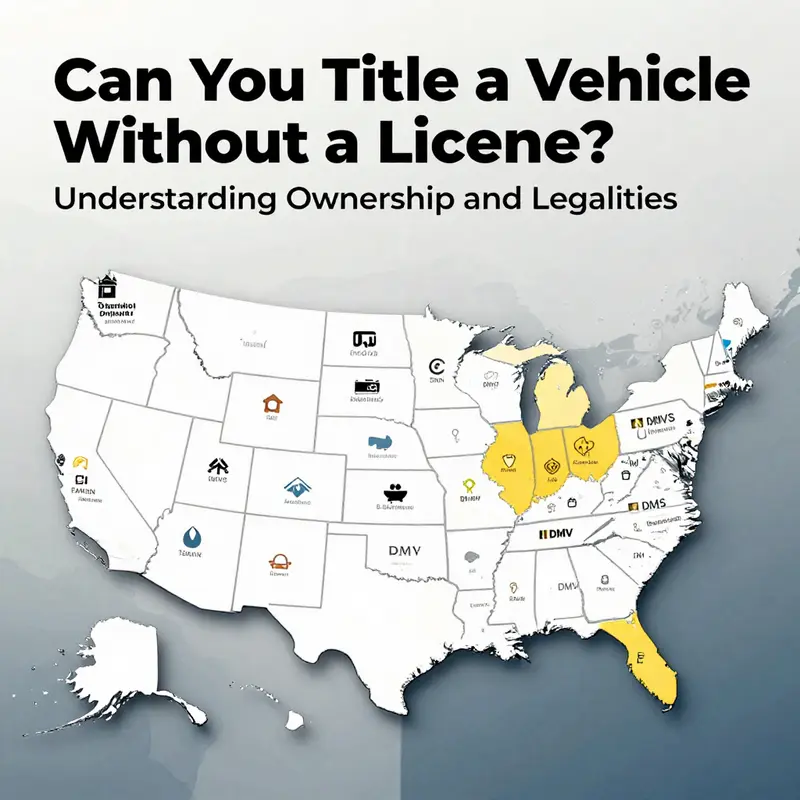
Ownership and operation sit on different tracks in the world of vehicle law. The title is about who owns the vehicle; the license is about who is legally allowed to operate it on public roads. Those two functions, though connected in everyday life, are governed by distinct rules in many states. The practical upshot is that you can often obtain a vehicle title without holding a valid driver’s license, but there are caveats. The journey from purchase to possession to lawful ownership is a procedural one, built on state-specific forms, proofs of identity, proof of ownership, and, in many cases, proof of insurance and payment of fees. The breadth of this landscape is surprising. In some places, the title may be transferable to someone who cannot legally drive yet can demonstrate legitimate ownership, while in others, licensure can be a gatekeeper to both title and registration. The core concept rests on a simple premise: a title is a document that proves ownership. A license allows operation. The two functions do not always require the same credentials, but they do require compliance with a state’s separate, sometimes overlapping, regulations. Reading the regulations with care, recognizing where ownership and operation diverge, is essential for anyone stepping into the process without a license.
To understand how titling can unfold in practice, consider the typical routes a vehicle title follows when there is no licensed driver in the equation. A private-party purchase, an inheritance, a gift, or even a vehicle acquired at an auction can all lead to a title transfer that does not hinge on the applicant’s ability to drive. Each route has its own documentation trail: bills of sale, transfer certificates, death certificates or court documents for estates, letters of appointment for executors, and perhaps notarized statements that explain the unusual situation. The paperwork exists to establish ownership unequivocally and to ensure that the person named on the title has a legitimate claim to the vehicle. The existence of these paths can be a practical relief for family members, estates, or non-driving individuals who still need to manage a titled asset. Yet, given the variance from state to state, the same path can look quite different depending on where you apply for the title.
In the broadest terms, many states recognize that ownership and the ability to operate are two distinct matters. The approach to titling without a license typically hinges on ownership documentation and identity verification, rather than on a driver’s license status. States that welcome title transfers from non-licensed individuals often require alternative forms of identification. A state-issued ID card, a passport, or a Social Security number may be accepted in lieu of a driver’s license. Some jurisdictions also require a notarized statement explaining the reason for the title transfer—especially in situations involving inheritance, gifts, or transfers through an estate. The presence of such a notarized element is not universal, but it appears with enough frequency to be a significant consideration for applicants who do not hold a driver’s license.
The discussion often narrows to a handful of practical questions. Can a person who cannot legally operate a vehicle still own it? Can they be named on the title, and can their ownership be recognized by the state’s title office? And what about insurance, which some states insist upon before any title or registration action can proceed? The answer, historically nuanced, tends to be yes in many places, with critical caveats. You may indeed title the vehicle without a license, but you must meet all other statutory requirements, and you must not assume that titling alone will render you exempt from the duties that come with ownership. In most cases, the state will require you to insure the vehicle in order to complete any registration action tied to the title. Even if the title itself does not demand licensure, the practical reality is that the vehicle cannot legally operate on public roads without meeting the state’s licensing and insurance requirements. Ownership and possession are one set of responsibilities; operation is another, with its own set of permissions and restrictions.
California presents a useful illustration because it sits at the crossroads of many titling questions. The state allows titling without a driver’s license in appropriate circumstances, provided the applicant can demonstrate ownership and cover the usual fees. Yet the California Department of Motor Vehicles may also insist that the applicant demonstrate permission to operate the vehicle legally on public roads. In plain terms, California recognizes that ownership can be transferred even if the transferee does not hold a license, but it does not remove the obligation to comply with the broader regulatory framework governing vehicle use. The distinction is subtle but important: the title may be issued to someone who does not have a license, but the vehicle cannot be operated in public traffic until the owner satisfies the licensure and use requirements that apply in California. This layered approach—ownership first, operation later—reflects a policy aim to separate the right of ownership from the right to drive, while ensuring that the operation of a vehicle remains subject to road safety and regulatory controls.
Florida and Texas offer a slightly more permissive posture toward titling without a license. In many cases, these states permit title transfers to non-licensed individuals, but not without a cost. The process often entails additional documentation or verification steps designed to confirm legitimate ownership and to verify that the parties involved in the transfer have a meaningful connection to the vehicle. The additional steps commonly center on confirming identity, establishing ownership, and ensuring that the vehicle can be properly tracked within the state’s titling framework. In both states, the core premise remains the same: you can title a vehicle without a license if you can prove ownership and meet the administrative requirements, but there may be extra hoops to jump through. The practical effect is that the title can become the instrument of ownership even when the operator’s license status creates a separate barrier to driving, testing, or registering the vehicle for road use.
Beyond the core documents that establish ownership, many states accept alternative means of identification when a driver’s license is not available. A state-issued ID card, a passport, and a Social Security number are common denominators across jurisdictions. In some cases, other proofs of identity or legal status may be demanded, especially when the vehicle transfer is part of a collateralized arrangement, an inheritance, or a gift. The use of alternative identification helps ensure that the person listed on the title has a verifiable and lawful stake in the vehicle, which reduces the risk of fraud or misappropriation. In addition, some states may require a notarized statement to validate the nature of the transfer. For example, if the vehicle is being inherited or transferred as part of an estate, the transfer documents may need to include the death certificate or court documentation that confirms the appointment of an executor or administrator. Such steps ensure that the transfer is legitimate and that the signer has the authority to act on behalf of a decedent or trust.
Even when the title can be issued without a license, legal restrictions concerning operating the vehicle remain. The fundamental distinction between ownership and operation means that titling does not wipe away the obligation to comply with licensing requirements for actually driving. A person who is titled to the vehicle but does not hold a license will typically be restricted from operating the vehicle on public roads until they obtain the necessary license. In jurisdictions where insurance is a prerequisite for title transfer or for registration, the absence of coverage can block progression even if the title has been issued. This separation of duties is not an accident; it reflects safety K concerns and the need to keep the pathway to road use tightly regulated while still allowing for ownership arrangements that do not hinge on licensure.
In practice, there are scenarios that illustrate the spectrum of possibilities. Consider someone who inherits a vehicle and does not hold a driver’s license at the time of the transfer. The transfer may proceed, with the executor or an administrator providing the necessary paperwork to prove inheritance and establish the chain of ownership. The vehicle, once titled, may sit unregistered or unoperated until the new owner obtains a license and secures insurance. The situation can become more complex if the vehicle remains registered to the decedent or if there are outstanding liens or financial interests tied to the vehicle. In another scenario, a private party may sell a vehicle to a non-licensed buyer. The title could be issued to the buyer, especially if the buyer provides a valid identification document and proof of ownership, along with payment of any applicable transfer fees. The buyer, however, would face practical constraints in using the vehicle until licensing and insurance are sorted out. These examples highlight why the line between titling and licensing matters, and why prospective title applicants should plan for both the immediate transfer of ownership and the longer journey toward lawful operation.
Special provisions exist in some states for people who face temporary barriers to obtaining a license. For instance, in New York, incarcerated individuals can still effectuate title transfers through a legally appointed representative, but the process requires strict adherence to procedural rules. In Illinois, a vehicle can be titled without a license if the applicant is acting as an executor of an estate or as a representative of a trust. These provisions underscore that states recognize the dignity of ownership while balancing safety and legal accountability. They also illustrate that the path to titling without licensure is not monolithic; it is shaped by the social, legal, and administrative fabric of each jurisdiction. When confronted with these complexities, the prudent approach is to engage directly with the state motor vehicle agency. The agency’s staff can clarify the exact forms, identifications, and notarizations required and can outline any state-specific quirks that can affect processing times and final outcomes.
One practical takeaway is the importance of preparation. Before you begin the process, assemble a clear and complete packet of documentation. This typically includes proof of identity, proof of ownership, and any supporting letters or legal documents that explain the transfer’s basis. If you are transferring ownership through an estate, you may need probate documents or letters of appointment. If it is a gift, you might need a gift deed or similar documentation. If you are purchasing from a private seller, a bill of sale and the vehicle’s current title or the certificate of title from the seller are vital. Insurance is often a prerequisite for any registration action, so arranging coverage in parallel with the title transfer can prevent delays when the time comes to register the vehicle for road use. The combination of careful documentation and a clear explanation for why licensure is not currently held helps the DMV or its equivalent in your state to move smoothly through the process.
In addition to the core steps, there are practical considerations that can affect the timeline and outcome. For example, some states will require the applicant to provide a statement of why a non-driver is seeking title in their name. This is more common in cases involving non-traditional ownership structures, such as trusts or estates, where the person seeking title is not the person who will eventually operate the vehicle. The notarization of such statements helps to deter fraud, a consideration that states take seriously given the potential for theft or misrepresentation when ownership documents do not align with actual control of the vehicle. The identification requirements, too, can be exacting. A non-driver may be asked to provide multiple forms of identification to reduce the risk of mistaken identity or theft of ownership. The DMV or other state agencies frequently provide checklists or online pre-approval tools that let applicants verify that they have the necessary documents before visiting a service center. This pre-approval can save time and reduce the frustration that often accompanies title transfers.
As you navigate these requirements, a key strategic move is to treat the title transfer as a two-step journey: first secure a valid, enforceable title that links you to the vehicle, and then ensure that you meet the licensure and insurance conditions needed to operate it legally. In some states the two steps can be completed in close sequence, with the title issued promptly after the submission of documentation and payment of fees. In others, contingent approvals or additional verifications may extend the timeline. The difference often reflects the workload of the local DMV office and the complexity of the case—an estate transfer, an inherited vehicle, or a gift can trigger more checks than a straightforward purchase. Even so, the fundamental logic remains stable: you can own the vehicle and hold the title without a license, but your ability to drive in public is governed by license status and insurance compliance, and that status is subject to separate requirements. This dual reality has practical consequences for buyers, heirs, and non-drivers who must coordinate timing, budgeting, and expectations.
For readers who want to dig deeper into how driver licensing interacts with other state rules, a closer look at the broader regulatory landscape is worthwhile. State rules impacting driver licensing often shape the rights and obligations that accompany vehicle ownership in nuanced ways. A helpful reference point is to explore how different states structure their titling processes when licensure is not present. See the discussion on state rules impacting driver licensing for broader context and nuance, which can illuminate why certain states add extra steps or require alternative identification during titling. state rules impacting driver licensing.
In short, titling a vehicle without a license is possible in several major jurisdictions, but it is never automatic. The process hinges on proving ownership through documents appropriate to the transfer path, whether it is a private sale, an inheritance, a gift, or a transfer from an estate. It often requires alternative identification, careful notarization, and a careful alignment with the state’s broader vehicle-use rules, including insurance and, ultimately, license status for operation. The result is a practical pathway to ownership that respects the state’s public safety and consumer protection goals. The path is not uniform, and that inconsistency is precisely why prospective title applicants benefit from direct, up-to-date information from their local DMV or motor vehicle agency. By approaching the process with a clear understanding of the distinctions between ownership and operation, applicants can anticipate the steps, gather the right documents, and align expectations with the realities of their state’s framework.
To aid readers who are planning a specific maneuver—say, inheriting a vehicle, purchasing from a private seller, or facilitating a title transfer through an estate—it’s worth grounding the discussion in a practical, if general, sequence. Begin with ownership documentation: the bill of sale, the current title (if available), and any documents that demonstrate your legal claim to the vehicle. Next, gather identity documents: a state ID, passport, or Social Security number; if your state requires it, obtain a notarized statement explaining the transfer’s basis. Then assemble proof of insurance and be prepared to pay transfer fees or taxes associated with titling the vehicle. If the transfer is part of an estate or trust arrangement, collect probate documents or letters of appointment. Finally, file the necessary forms with the DMV, complete the title application, and await the issuance of the title. In parallel, arrange for insurance if you intend to operate any vehicle on public roads, and check the state’s rules on what is required for registration and operation. This approach reduces repetition and minimizes the risk of delays caused by missing information or noncompliance.
In conclusion, the path to titling a vehicle without a license is a tested but nuanced process. It requires a precise alignment of ownership documentation, alternative forms of identification, and awareness of any state-specific quirks. It also demands attention to the larger context: even if you hold a title, you may not be permitted to operate the vehicle until you satisfy licensing and insurance requirements. The distinction between owning and driving matters, not only for individuals but also for families and estates that must manage vehicles as a financial and legal asset. The landscape is not uniformly difficult, but it is detail-rich. By understanding the general rules, recognizing the state-specific variations, and preparing thoroughly, applicants can navigate titling without licensure with greater confidence and fewer surprises. The guidance above is designed to help you anticipate what your state may require, but nothing replaces checking the current official guidance from your local DMV or equivalent agency. The state-by-state differences mean that a plan that works in one jurisdiction may require adaptation in another. Use the internal and external references as anchors for your next steps, and approach the process as a careful, documented transfer of ownership complemented by separate steps toward lawful operation when licensure and insurance are in place.
External reference for further detail: For authoritative state guidance on titling and related requirements, consult the California DMV vehicle title information page: https://www.dmv.ca.gov/portal/vehicle-title-and-registration-information/vehicle-title-information/
Internal reference for broader context: For a discussion of how state rules can influence driver licensing decisions and related practice, see the article on state rules impacting driver licensing. state rules impacting driver licensing.
Titling a Vehicle Without a Driver’s License: Navigating Ownership Across Diverse Scenarios and Legal Boundaries
Titling a vehicle without holding a driver’s license sits at the intersection of ownership, accountability, and public safety. It is not as straightforward as a single universal rule that says yes or no; instead, it unfolds as a tapestry of state-by-state regulations, insurance prerequisites, and practical considerations shaped by who is buying, who will drive, and where the transaction takes place. The chapter that follows aims to illuminate this landscape in a way that respects the complexity while offering a coherent through line so readers can see how one thread—ownership—unfolds through different scenarios, from private-party purchases to gifts, and from resident buyers to non-residents and even those who are undocumented. At the heart of titling without a license is ownership documentation: a title, a bill of sale, or similar instruments that prove who holds the right to the vehicle. The title is an official record of ownership, a document that must pass through the state’s vault of records to establish legitimacy and protect future transfer rights. The fact that a license might not be required for titling in some jurisdictions can confuse people who assume that ownership and operation go hand in hand. The law, in many places, separates the act of proving ownership from the act of proving the ability to operate a vehicle. This separation is purposeful. It recognizes that a person may acquire a vehicle for a variety of legitimate reasons without immediately taking to the road. A parent purchasing a car for a teenager, an entrepreneur acquiring a fleet for a small business, or a collector purchasing a classic vehicle all demonstrate the practical reality that ownership can precede, coexist with, or even be independent of day-to-day driving. The practical upshot is that titling can occur without a license in many states, but the full spectrum of legal responsibilities attached to that ownership remains, and those responsibilities often hinge on insurance, liability, and the specific means by which the vehicle will be used. The central thread that runs through these scenarios is documentation and the assurance that the vehicle’s title accurately reflects who owns it. State DMVs are not simply clerks stamping documents; they are guardians of a chain of title that must endure through resale, financing, and potential liability scenarios. In this sense, the title is both a shield and a signal: a shield against questions about who possesses the vehicle and a signal to lenders, buyers, insurers, and law enforcement about where responsibility begins. Within this framework, several core themes emerge. The first is that title and registration are often distinct processes. In many places, you can be listed as the owner on the title even if you do not or cannot drive the vehicle. The second recurring theme is insurance. The law typically insists that a vehicle on public roads be insured, and the insurer’s policy often interacts with who is listed as the named insured and who is authorized to drive. The third theme concerns the bounds of who can legally own or title a vehicle in specific situations, including minors, non-residents, and undocumented individuals. Taken together, these themes create a practical path for someone who seeks to title a vehicle without a driver’s license while also clarifying what else must be addressed to remain compliant and protected from liability. A practical way to approach the matter is to begin with the documentation necessary to show ownership. The title application, sometimes colloquially called a transfer of title or title deed, is your primary instrument. For a private-party purchase, the seller typically signs the back of the title, and you complete a title transfer packet that includes your information, the vehicle’s identification number (VIN), odometer disclosure if required, and a bill of sale that records the transaction price and date. The bill of sale is not just a formality; it anchors the purchase price for tax calculations and acts as an independent corroboration if the title records become contested. In some states, when the vehicle changes hands, the title must be assigned to the new owner and then submitted to the DMV together with an application for title and registration, proof of address, and sometimes proof of insurance. In other states, a separate title transfer form is used, sometimes in conjunction with a separate registration form. The key point is that ownership is documented, and the DMV has a standardized route to record that ownership. How this plays out in practice depends on whether the vehicle will be operated in the owner’s name or by a named driver on a separate policy. Insurance policy structures reflect the same duality that ownership and operation present. An owner who does not drive but who intends to own and potentially supervise others who will drive may need to obtain insurance coverage to satisfy state requirements, which often require a named insured to meet basic eligibility criteria, including having a valid driver’s license. The nuance matters because many insurers will not insure a vehicle unless a driver who is legally eligible to operate is listed as the primary or named insured. Some states allow the owner to be listed on the policy as the named insured even if the owner does not hold a license to drive, but the driver or drivers who will operate the vehicle under the policy must be licensed. The policy then governs who is covered to drive, and the DMV will look for evidence that the vehicle is insured, with coverage appropriate to the vehicle’s use. This intersection of title and insurance means that those who title a vehicle without a license must carefully navigate who is named on the policy and how the policy addresses liability when the vehicle is not being driven by the titled owner. The dynamic is often captured in practical limits and caveats. Some states require the named insured to possess a valid driver’s license as a condition of obtaining insurance coverage for a vehicle that is titled in the policyholder’s name. In other words, the policy documents themselves can create a constraint on ownership in practice: you may own the car for title purposes, but your ability to secure insurance might hinge on meeting licensing requirements. And even when the law permits titling without a license, there are consequences if the vehicle ends up being driven by someone who lacks proper license documentation. In many jurisdictions, driving without a license is illegal. The fact that you can title the vehicle without a license does not provide immunity from penalties for driving without one. The act of titling a vehicle without a license may also carry particular risk when ownership is held by a minor or by someone who is not a resident or who has a status that complicates registration. If a minor’s parent or guardian registers a vehicle in the minor’s name to hold ownership, the minor cannot legally operate the vehicle until they possess the appropriate license. This separation between ownership and operation underscores a responsible approach to vehicle management: the vehicle can be owned and the title transferred without immediate driving, but driving will require appropriate licensing and compliance with all related rules. In some states, the rules become even more complex when the vehicle is purchased by a non-resident or by someone who does not have lawful status. Residency and immigration status can influence the DMV’s willingness to issue a title or to register a vehicle. Some states require proof of residency or a state-issued ID that demonstrates lawful presence; others grant access to title and registration with certain forms of identification that may not be tied to conventional driving privileges. The effect is that the path to ownership—via title—can be accessible to a broader set of individuals than the path to operation, but it does not remove the overarching obligation to adhere to insurance, tax, and reporting requirements. For undocumented individuals or those with uncertain status, the reality of titling without a license can involve additional steps and potential limitations. Some states may permit titling with a foreign driver’s license or other government-issued identification, while others may require a more nuanced approach or an avenue to demonstrate eligibility for insurance and registration regardless of license status. The moral of these state-by-state variations is not simply a catalog of what is possible; it is a guide to what remains essential for lawful ownership and safe operation. The ownership itself is a separate act from the right to operate. This separation is crucial because it allows for legitimate ownership in circumstances where driving is not intended or where the driver’s license is not currently held, but it also creates a framework for accountability. If the owner plans to drive in the future, or if someone else will drive on their behalf, the owner must ensure that any future operation will comply with licensing, insurance, and registration requirements. The process of titling without a license is thus a negotiation between the desire for ownership and the obligation to meet the legal standards that govern use. Even when ownership can be established without a license, it is common to encounter additional documentation demands. A lien on the vehicle can complicate the title transfer. If a bank or financial institution provides financing, the lienholder typically holds an interest in the title until the loan is repaid. The title then may list the lienholder as the secured party, and any transfer of ownership often requires clearance of the lien or the consent of the lienholder. This adds a practical layer: you may be the owner of record, but the title reflects a financing reality that must be respected in any transfer, sale, or re-titling. The presence of a lien can also affect insurance. Lenders often require you to maintain a certain level of coverage, and the policy may list the lienholder as an additional insured or as a loss payee. In a situation where the owner does not drive, the lienholder’s role remains central to the vehicle’s financial integrity. The owner’s ability to title a vehicle without a license is, therefore, not an isolated rule but a piece of a broader ecosystem that includes the lien, the insurer, the state regulator, and the eventual buyer if the vehicle changes hands again. Given this ecosystem, one might wonder how best to approach a real-world scenario. Consider a scenario in which a teenager’s parent purchases a car for the teenager to use when they reach the driving age. The parent can likely title the vehicle in their name or in the teenager’s name, depending on state rules, with the understanding that the teenager cannot legally drive until they have a license. The parent may maintain insurance on the car, or an insurance policy may be issued that names the parent as the primary insured with the teenager listed as an additional driver or as a named insured. In this scenario, the titling process is completed, and the vehicle exists in a legal and traceable ownership record. But the future act of driving by the teen would require licensing progress and compliance checks, including tests and permit regulations that the state requires for new drivers. The legal system recognizes that there can be a legitimate gap between ownership and operation, and it provides mechanisms to handle this gap without undermining safety and accountability. The same logic applies to gifts, auctions, or corporate transfers. A car given as a gift can be titled in the recipient’s name without the recipient holding a driver’s license, provided that the state’s rules allow such an arrangement and that the necessary documentation—such as a deed of gift, a bill of sale, or a transfer certificate—is properly completed. An auction adds its own set of complexities. Vehicles sold at auction may be sold “as is,” but the title and the transfer still must conform to state requirements. If an auction is attended by someone who lacks a license but intends to title, the purchaser must meet the state’s proof-of-ownership requirements and may need to navigate additional steps, such as verifying a prior registration or addressing any outstanding liens. The broad lesson across these scenarios is not to conflate ownership with operation. Titling a vehicle without a license is often permissible, but it does not immunize the owner from the obligations that accompany vehicle ownership. The chain of responsibility remains intact, and the state’s DMV continues to enforce the rules that tie ownership, insurance, registration, and operation into a coherent framework. For readers who wish to explore this topic with a more state-specific lens, it is useful to consult the resource that outlines how state rules shape driver licensing and related ownership issues. This internal resource helps illuminate the guiding principles that underlie decisions about who can own a vehicle and how that ownership is documented without the immediate necessity of a driver’s license. The subtle but important point is that the law expects responsible use even when ownership is separated from driving. A vehicle can stand as a record of ownership and an asset on the balance sheet without any immediate plan to operate it. Yet the moment that ownership translates into use, the licensing and insurance obligations crystallize, and the state’s regulatory framework comes into play with its full force. As you move from scenario to scenario—the private sale, the gift, the auction, or the transfer for a minor—the prerequisites and potential hurdles shift, but the fundamental logic remains: establish clear, verifiable ownership; meet insurance and fiscal requirements; and ensure that any use of the vehicle complies with licensing and safe-driving standards. If you are contemplating a path that involves titling a vehicle without a license, you should view the process as a careful balancing act. Collect all necessary documents early: the title, the bill of sale, proof of address, any lien payoff statements, and any state-specific forms the DMV requires. Prepare to demonstrate proof of ownership beyond the bill of sale, when necessary, to forestall delays. Check whether the state requires an insurance policy that names someone with a license as the insured party, or whether the policy can accommodate a non-licensed owner. In many cases, you may need to designate a licensed driver who will be responsible for the day-to-day use, even if that driver is not the vehicle’s legal owner on the title. With that in mind, a disciplined approach to a titling transaction becomes a practical discipline: verify the acts of ownership before enrolling into the duties of operation. When dealing with a non-resident or an undocumented individual, the process may demand more careful documentation, including alternative forms of ID, proof of foreign residency, or a plan to address any state-specific residency requirements. This is not merely bureaucratic red tape; it is the safety net that helps ensure that vehicles circulating on public roads are properly identified and that ownership is transparent. The broader aim is to minimize disputes over ownership and to maintain a clear chain of title that future buyers can rely on. Each state has its own nuances, and practitioners often advise readers to consult the DMV’s official resources or speak with a qualified professional who understands the local rules. A helpful way to ground your understanding is to consider how the state’s approach to titling without a license might influence a future transfer of ownership or a future insurance decision. If the vehicle is later sold or transferred, the new owner will need to address the title transfer again, and this time the question of driver eligibility may arise in the context of registration and insurance, bringing the entire chain of responsibilities back into focus. The possibility of future licensing changes should also inform current decisions about how to title. For example, if you anticipate obtaining a license in the future, you may choose to structure the ownership and insured status in a way that will ease a transition into operation. The interplay between ownership, insurance, and operation is a dynamic that requires thoughtful planning. Finally, it is worth noting that the landscape is not static. Legislative changes, administrative reforms at the DMV, and evolving federal guidelines on identity verification and insurance can shift the requirements over time. Staying informed means checking in with official DMV resources and seeking guidance when scenarios become more complex—such as cross-border purchases, transfers involving multiple jurisdictions, or circumstances that implicate a minor, a non-resident, or someone with limited driving history. The experience of navigating titling without a license is that the question is rarely about whether ownership is possible; it is about how to ensure that ownership is recorded correctly while meeting insurance obligations and preparing for the realities of eventual driving, if and when that becomes permissible. This chapter has traced how different scenarios shape the practical steps, the risks, and the responsibilities involved. It is a reminder that ownership documentation is a foundation, but it sits atop a broader structure of legal requirements designed to protect the public, the buyer, and the lender, and to preserve the integrity of the vehicle records for years to come. For readers who want to explore authoritative state-by-state guidance that sheds light on the nuances of licensing rules and their impact on ownership and titling, the following reference offers a focused lens on how state rules shape driver licensing and related ownership questions. state rules affecting driver licensing. As you digest these considerations, you may also wish to consult an official resource such as the California DMV’s Vehicle Titling and Registration page, which provides definitive guidance on how to navigate title transfers, ownership documentation, and the regulatory expectations for insurance and registration when a vehicle is titled in a given state. External resource: https://www.dmv.ca.gov/portal/dmv/detail/vtr/title/vehicle_title.htm
Final thoughts
In conclusion, while titling a vehicle without a driver’s license is indeed possible in many states, understanding the specific regulations and legal implications is essential for successful ownership. Each chapter of this guide has illuminated essential factors and nuances that can affect your ability to title a vehicle. By ensuring compliance with local laws and ensuring you have all necessary documentation, you can navigate this process effectively. Whether you are a new driver, an existing driver without a license, or an auto dealer, being informed is crucial. Familiarizing yourself with the required procedures will help secure your vehicle’s title and ownership confidently.