
Why Motorcycle Fairings Crack in Transit: The Real Crush Points
A fairing cracks where load converges and the panel has nowhere to send it. That spot is the crush point. You can build the crate from the best double-wall board, line it with foam, strap it tight, and still open it to a spider-webbed panel—if the force inside piles up against one rigid edge. The box was never the problem. Where the force ends up is.
What a Crush Point Is
A crush point is any spot where arriving pressure has nowhere to go. Weight from a stack above, a drop below, vibration from every direction—all of it travels through the packaging until it reaches a place where the fairing can’t flex, slide, or spread the load. The energy has to leave somehow, and it leaves through the plastic as a crack. The same panel that takes a 20-mile highway ride without complaint breaks in a crate because it’s pinned against a hard contact point with no room to move.
A Geometry Problem, Not a Material Quality Problem
When a fairing shows up cracked, the first suspect is usually weak ABS, a bad batch, or cheap resin. Most of the time the material is fine. What failed is the packaging geometry—how the fairing’s shape sits against the supports around it, and which directions the force can come from. A thicker plastic rarely fixes a crush point. Changing the geometry does.
Who Loses Money When Panels Arrive Cracked
Motorcycle manufacturers. Cracked panels turn into returns, remakes, warranty claims, and freight paid twice—all before a single fairing reaches a customer.
Repair shops. One damaged panel stalls a repair, disappoints a customer, and triggers a reorder—often while the bike sits in a bay that should be earning.
Logistics companies. Damaged-goods claims, reshipment costs, and a battered reputation add up fast, and repeated compliance failures and rising insurance costs can push up the price of moving freight at all.
What This Article Covers
What follows maps the crush points where fairings actually fail, ranks packaging materials by how well each spreads load, and lays out prevention steps a manufacturer, repair shop, or logistics team can put to work on the dock tomorrow.
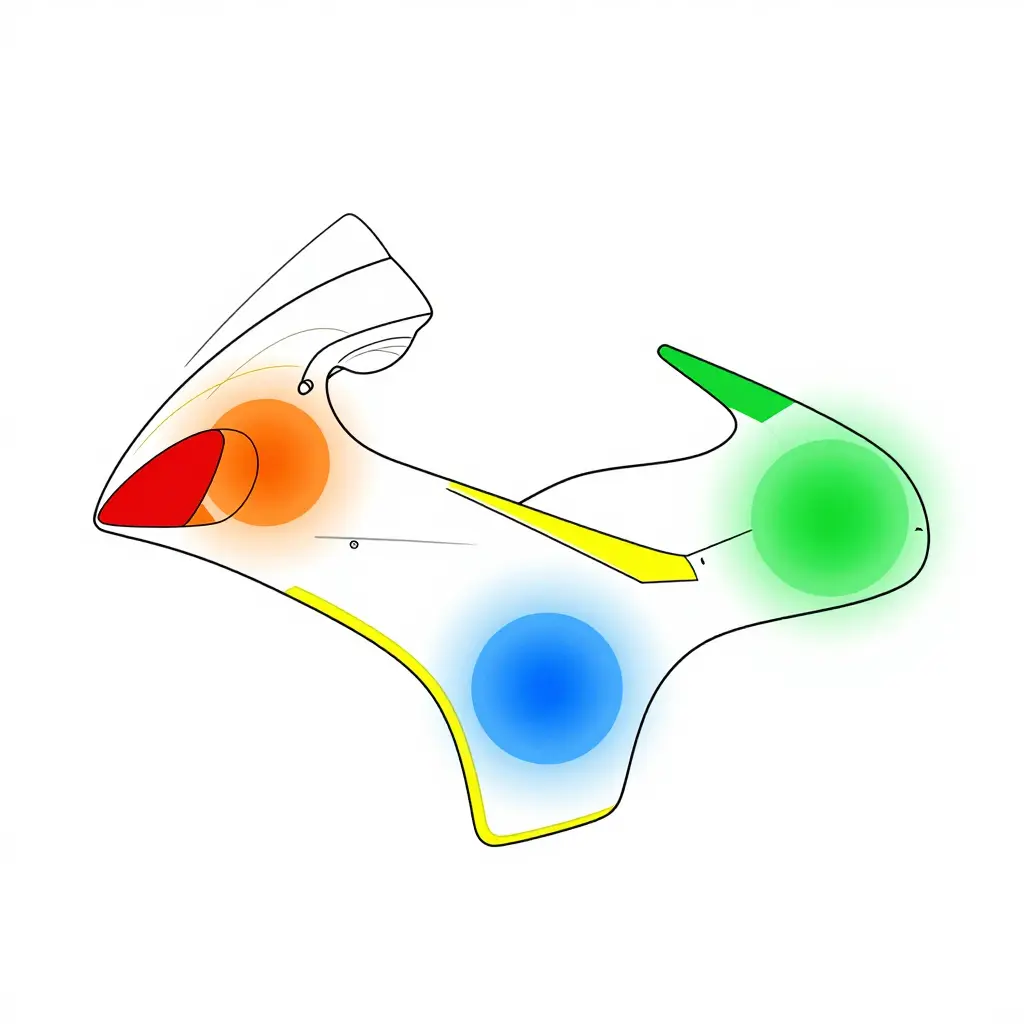
How to read the diagram
The illustration strips a generic side panel down to an outline. There are no labels by design—five shaded circles show where force tends to gather in transit. The warmer the color, the higher the stress:
- Red — the nose tip, the most forward and least supported part of the panel.
- Orange — the mirror mounting tab, thin enough to snap under a sideways load.
- Yellow — the lower cowl edge, which catches on pallet corners and straps.
- Blue — the fastener holes, where bolts pass impact straight into the plastic.
- Green — the upper fairing seam, a molded joint that flexes and can split.
Match each zone described here and in the sections that follow to its shaded circle. Once you know where the stress gathers, it’s far easier to design foam blocks, corner guards, and crate geometry that protect the panel where it actually breaks.
How Crush Points Form: Load Paths and Panel Weakness
A fairing shell rarely fails all over. It fails where force concentrates. In packaging, that concentration becomes the crush point, and the mechanism behind it is predictable.
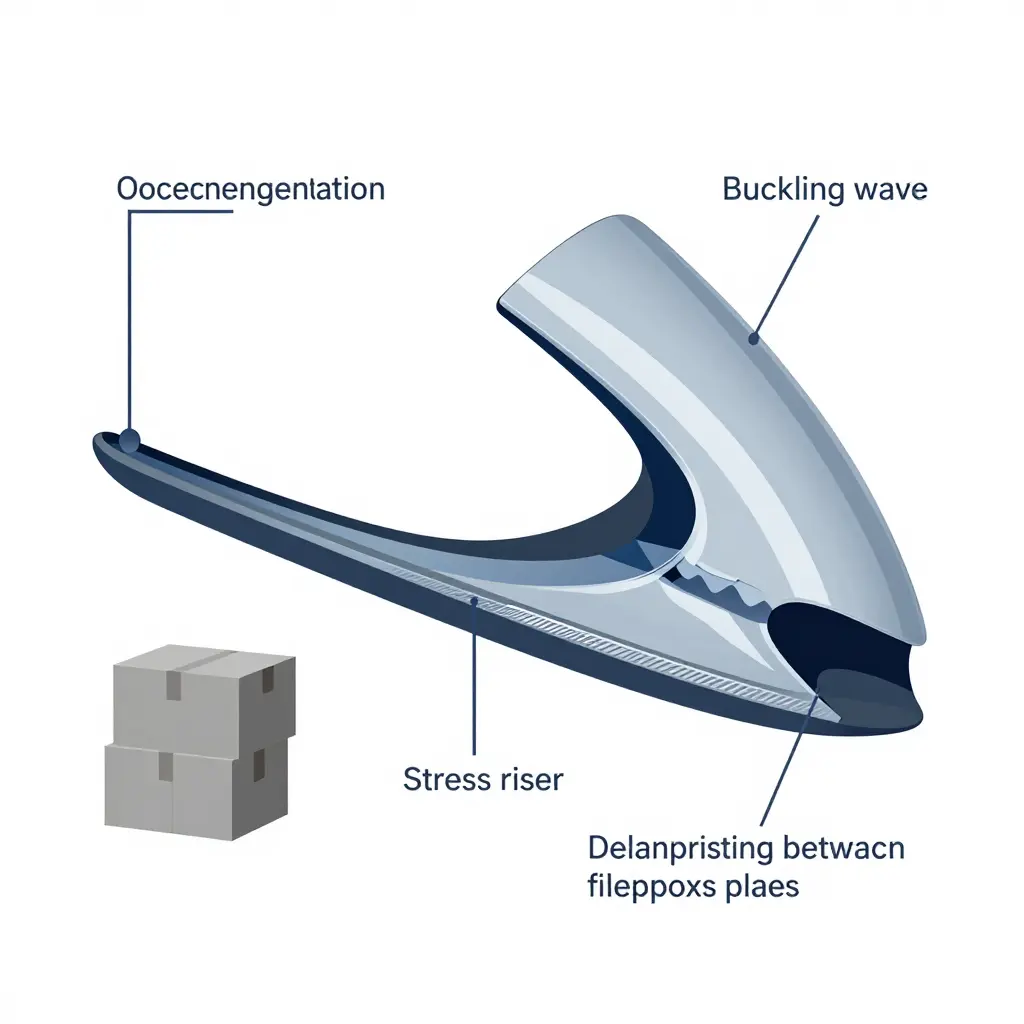
Three load types drive the damage
- Point loads. One hard contact—a bracket tip, a bolt head—pushes force into a tiny area. Local pressure runs far above the average load, so the panel gives way there first.
- Edge loads. Fairing rims are thin and unsupported. Force along a free edge creates a bending moment the shell can’t resist, so it flexes at the border.
- Uneven stacking pressure. When cartons stack, weight travels through the tallest contact points only. Small gaps in height route stress into a few pads, and those pads become the crush points.
Every path raises the concentration. The panel deflects, springs back, and deflects again with each mile of transit.
Tension, compression, and why thin panels buckle first
Bending a panel creates two zones: one face in compression, the other in tension. Thin ABS and fiberglass respond to each in different ways.
- Compression zone: resists through stiffness, not strength. A thin wall reaches its buckling load long before the material nears its fracture strength. The face bows, ripples, then kinks.
- Tension zone: stretches until it tears. Fiberglass delaminates between plies; ABS stretches and then tears.
That’s why a thin-walled shell buckles before it cracks: the failure is structural, not a matter of the resin alone. Transit vibration adds a cyclic load on top, and micro-cracks open at any stress riser—a scratch, a fastener hole, a mold seam. That’s fatigue crack initiation, and it grows quietly under every bump.
Transit damage resurfaces later as insurance claims and warranty disputes, which is why compliance failures and insurance costs concern logistics teams watching damage patterns.
Crush points are load-path events, then. The next step is knowing exactly where a given fairing is most vulnerable.
The Five Most Common Fairing Crush Zones
-
Nose and headlight tip. The forward-most section sticks out the farthest and usually carries the thinnest molded plastic, so it takes the first hit when a crate slides or a stacked carton drops. Because it leads every impact, it shows spiderweb cracks and hairline fractures before any other panel does. The fix is blunt: the crate needs a custom foam or molded cradle that holds this tip clear of the carton walls.
-
Mirror and turn-signal mounting tabs. These slim cantilevered tabs hold heavy accessories on a footprint barely thicker than a coin, so the load concentrates at one point. A sharp jolt during loading or a tie-down pulled too tight snaps a tab clean off and takes the attached hardware with it. Once it shears, repair is expensive—the tabs rarely re-bond cleanly, and the whole upper fairing set has to be replaced.
-
Lower cowl and belly pan edges. Sitting lowest in the crate and closest to the pallet floor, these edges meet forklift skids, carton bases, and dropped panels head-on. Any weight resting on the base pinches the flexible lips, and that’s the damage a buyer sees first when unboxing. Overload the bottom layer and the edges curl and gouge, which means rework or a rejected shipment.
-
Fastener and bolt-hole corners. Every drilled hole removes material and creates a stress riser, which makes the corners around bolts the weakest points on a panel. In transit, hardware rocks inside oversized holes until cracks radiate outward from each fastener. Isolate these points with rubber grommets and torque-safe spacers, or the panel arrives with a cracked corner at every mounting bolt.
-
Upper fairing seam near the windscreen base. This seam joins two rigid halves at the highest point of the assembly, right where stacked weight and flexing converge. A thin lap or clip holds the joint, so it separates under load, misaligns the windscreen base, and opens a visible gap. Support the seam from below in the crate and the assembled profile stays rigid from dock to dealer.
Packaging Methods vs. Crush Resistance for Motorcycle Fairings
The table below compares each packaging method by protection level, best-fit fairing type, and the way it tends to fail when freight gets rough.
| Packaging Method | Typical Crush Protection Level (Low/Medium/High) | Best Suited Fairing Type | Common Failure Mode |
|---|---|---|---|
| Single-layer bubble wrap | Low | Small, lightweight plastic panels | Wrapper punctured by mounting tabs; point-load cracks at edges |
| Foam sheet wrapping | Medium | Mid-size ABS fairing side panels | Foam compresses flat under stacked loads, letting panels touch |
| Molded EPS foam blocks | High | Large, heavy touring fairings | EPS fractures and sheds crumbs; unit cost climbs fast at volume |
| Custom-molded pulp trays | High | Fragile OEM fairings with complex curves | Moisture softening in humid transit weakens the tray walls |
| Double-wall corrugated boxes | Medium | Flat-packed panels and small fairing kits | Corner crush when boxes are double-stacked beyond rated load |
| Foam-in-place cushioning | High | Premium or pre-painted fairing assemblies | Over-expansion warps thin panels if the mix ratio drifts |
The Cost-Protection Tradeoff
Molded EPS blocks and foam-in-place cushioning give the best crush resistance, but at high volume they are rarely the cheapest route. They demand custom tooling, warehouse space, and material volumes that scale linearly with every unit shipped. A manufacturer exporting thousands of fairings a month often finds that double-wall corrugated boxes, foam sheet wrapping, and pulp corner trays in the right places get through real freight conditions at a fraction of the per-unit cost. Crush resistance is one variable, and the downstream costs of damaged or non-compliant shipments can swallow whatever the expensive cushioning saved. Dimensional weight, assembly labor, repacking speed, and return-logistics risk all count too. Match the protection level to the fairing and the route instead of defaulting to the strongest option on the shelf.
Why Panel Geometry Decides Where Cracks Start
Two fairings leave the same factory, molded from the same ABS, and ride in the same truck. One arrives flawless; the other splits at a mounting tab. The resin didn’t change. The geometry did.
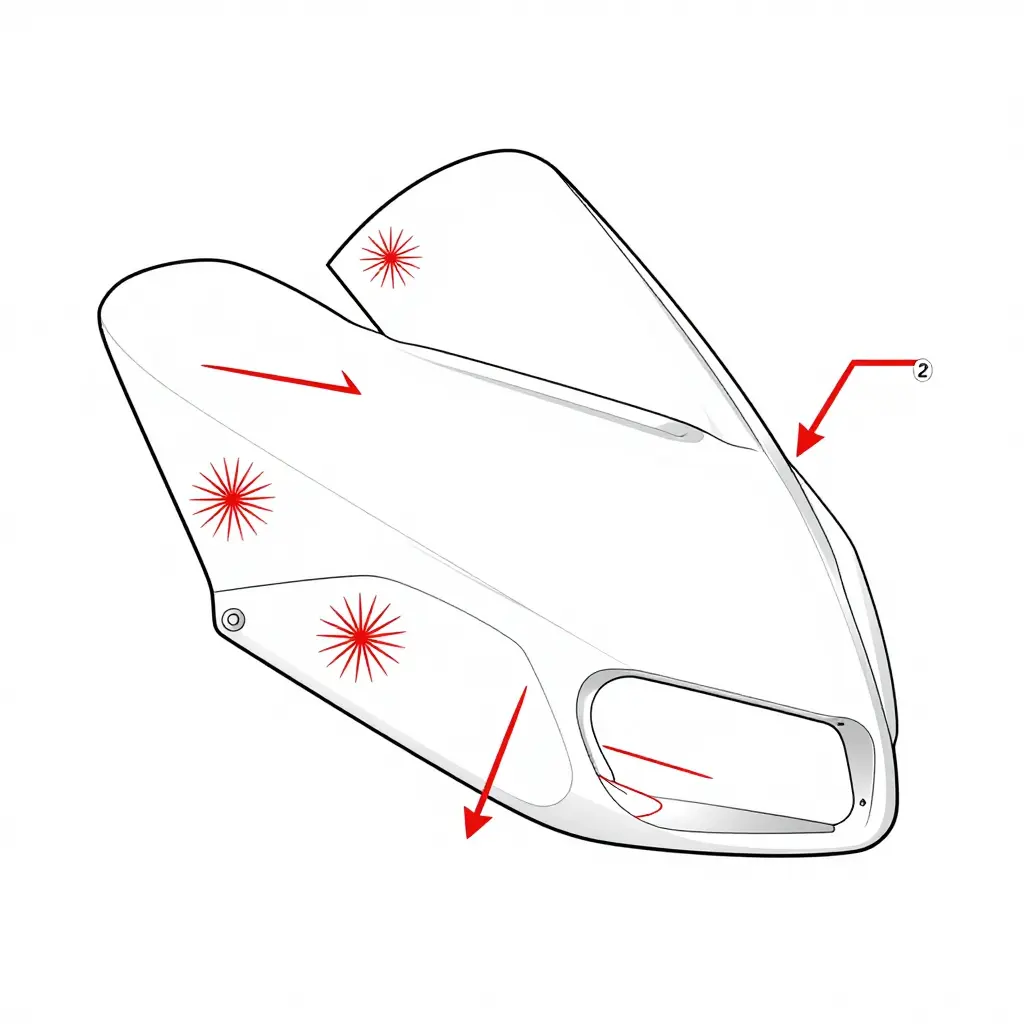
Start with curvature. A broad, gently domed surface spreads an impact over a wide area and lets the load dissipate. A tight edge radius or compound bend does the reverse: it funnels the same force into a narrow strip, and stress climbs almost instantly.
Thin mounting tabs are next. A slender tab carries the panel’s whole weight through a small cross-section, so even a modest bump produces enormous local pressure around the bolt eye.
Sharp interior corners concentrate force harder still. Every inside angle focuses stress at its apex, which is why cracks almost never begin in the middle of a flat panel—they start where the shape turns abruptly.
Drilled holes act like built-in weak points. A hole interrupts the smooth flow of load and can double or triple local stress at its rim long before the rest of the panel feels a thing.
That’s why two fairings of identical material can fail in completely different places. Failure follows the geometry, not the plastic: whichever shape focuses force hardest decides where the crack starts.
Stress is just force per unit area. Push a big load through a small area and the number explodes; spread it over a broad, gently curved surface and the number drops. Cracks track that number, not the total weight.
This is where the material question comes back. A tougher polymer only helps when the geometry-driven crush point is properly supported. Brace it and the material earns its cost; leave it unsupported and even the best resin tears along the same seam. Support the crush points first, and blame the blend later.
Next: how handling and stacking practices amplify every one of these geometric weaknesses, and why a well-designed panel can still fail on the dock.
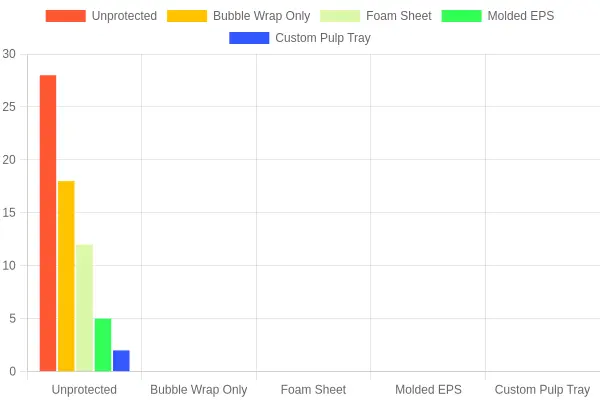
What the Numbers Say
The chart plots the share of fairing panels arriving cracked against five packaging methods. The pattern is hard to miss: as protection shifts from loose wrapping to molded, form-fitting cushioning, the damage rate falls.
| Packaging Type | Panels Arriving Cracked (%) |
|---|---|
| Unprotected | 28 |
| Bubble Wrap Only | 18 |
| Foam Sheet | 12 |
| Molded EPS | 5 |
| Custom Pulp Tray | 2 |
Why the Curve Drops So Fast
Fairing panels are large, thin, and curved—exactly the shape that concentrates freight pressure at crush points. Loose wrapping barely slows those forces. Bubble wrap absorbs a little impact energy but doesn’t hold the panel in place, so it can still flex and crack. Foam sheeting adds a cushioning layer and roughly halves the rate, but the panel can still shift.
Geometry does the heavy lifting. Molded EPS and custom pulp trays wrap the panel in a rigid, form-fitting shell that spreads load across the whole surface instead of a few contact points. That’s why the rate drops from double digits to single digits, and why the best custom trays reach 2%.
For a manufacturer, repair shop, or logistics team, the arithmetic is simple: tooling a molded or pulp tray usually pays for itself within a few shipments once you stop absorbing replacement panels, return freight, and customer disputes. Anyone comparing true landed cost should also understand compliance failures that quietly inflate shipping and claims costs, because underwriting and claims exposure tend to follow the same weak links in a supply chain.
Stacking Loads, Load Shifts, and the Moments Fairings Break
Fairings rarely crack because they were weak to begin with. They crack because ordinary weight quietly turns into a concentrated punch. Three forces usually work together: stacking pressure, road vibration, and sudden load shift.
Stacking pressure compresses the weakest span. When crates are stacked, the weight of every upper layer travels down through the pallet feet and box walls. If the fairing inside has no rigid bracing, that column of weight presses straight onto the widest, flattest panel—often the exact area flagged earlier as a crush point. A load that looks harmless on a static scale turns damaging the moment the vehicle moves.
Vibration wears down the material. Road transport floods a load with constant micro-impacts. Each bump is tiny, but thousands of them fatigue the ABS and polypropylene until stress cracks open along edges and mounting tabs. Vibration also settles the load, closing air gaps so the fairing slowly sinks onto whatever waits beneath it.
Sudden shifts turn bumps into crush events. Braking, cornering, and potholes jerk a shipment sideways and upward. A fairing that was only resting against a corner slams into it, delivering multiplied force across a tiny contact area. That’s the instant a routine bump becomes a localized crush. The chart below shows peak contact pressure climbing as alignment degrades.
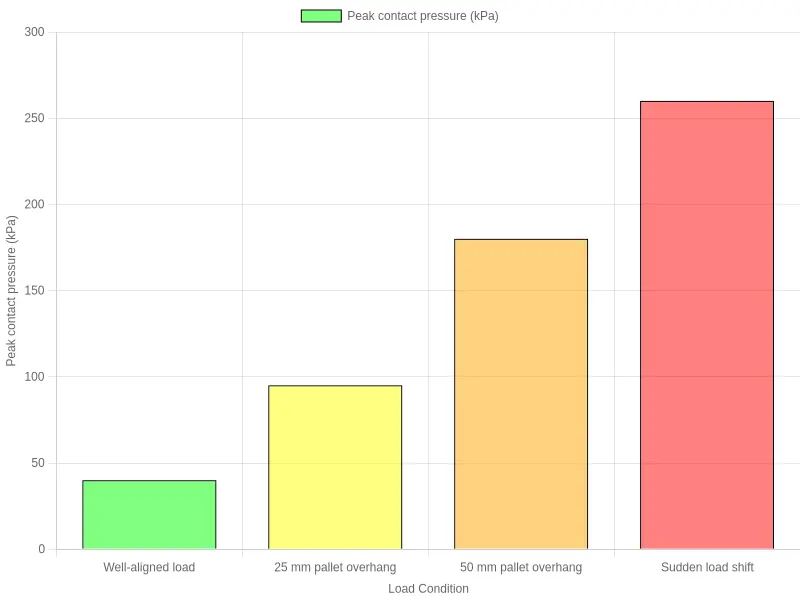
Overhang and corner misalignment focus the force. When a pallet overhangs its support or cartons sit misaligned, weight stops spreading across a broad surface and funnels into single points—the crush points flagged earlier. These point loads can exceed a panel’s tolerance even when the shipment’s total weight is modest, because pressure depends on contact area, not mass alone.
For fleet and logistics operators, a damaged shipment is more than a broken part. It generates claims, and repeated mishandling can magnify compliance failures and insurance costs. Fairings also have to arrive intact to be fit for roadworthy assembly, which ties into the condition checks behind state vehicle inspection requirements.
Crush damage is rarely bad luck. It’s the predictable result of pressure, vibration, and misalignment converging on a small area. Control those three variables, and the best practices further down show where to start.
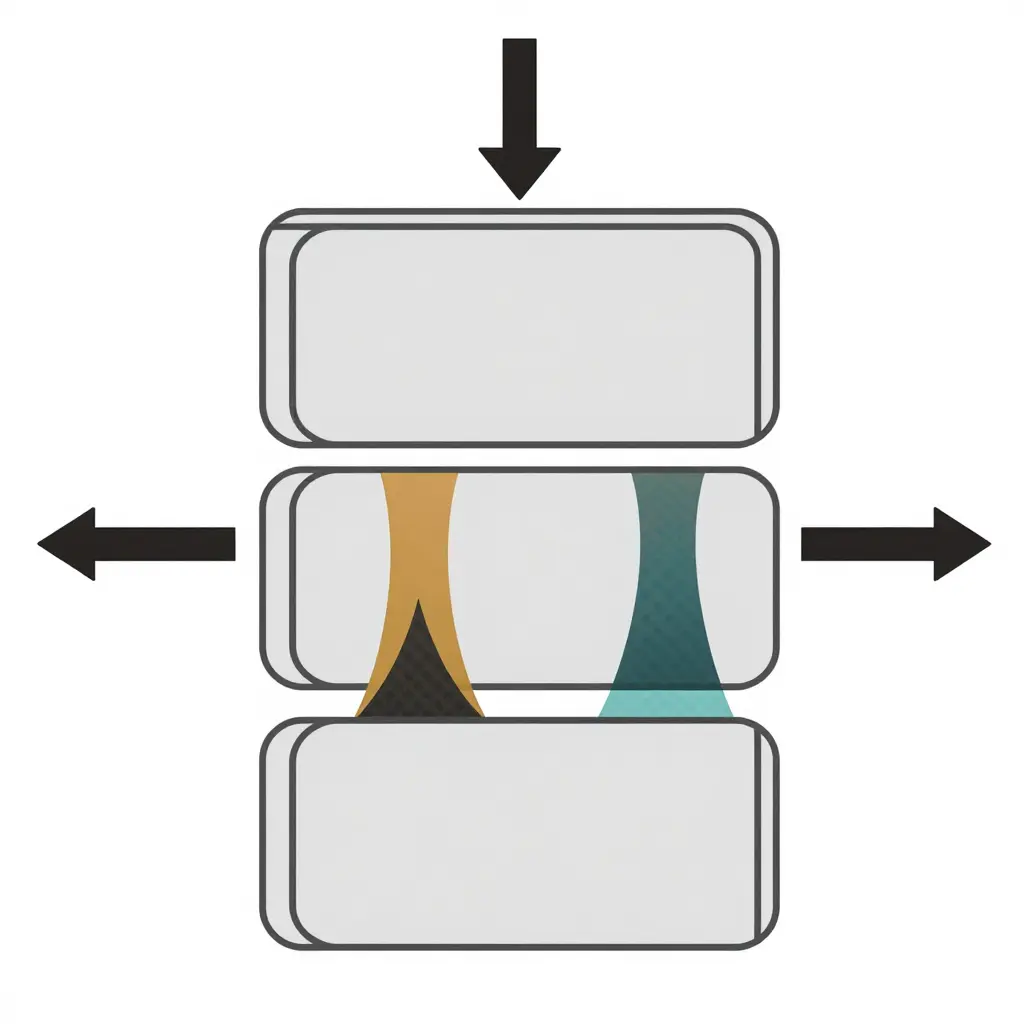
Reading the diagram
This schematic strips a fairing shipment down to its basic load path, so you can see that a cracked panel isn’t bad luck—it’s the endpoint of forces you can trace.
- Downward arrow: vertical stacking force from the cartons piled above.
- Lateral arrow: side load that shifts every time the truck brakes, corners, or hits rough pavement.
- Dark shaded zones: the panel edge where both forces converge, concentrating stress until the material gives.
Read it top to bottom: force enters from above, gets redirected sideways in motion, and pools at the least supported point on the panel. That convergence zone is the crush point, and it maps onto the stacking behavior above. Control starts with how the load is arranged, not just how it’s cushioned.
Frequently Asked Questions About Fairing Crush Points and Packaging
1. What exactly is a crush point on a motorcycle fairing?
A crush point is any spot where a concentrated load can exceed the plastic’s tolerance and cause a crack, dent, or stress fracture. These weak spots usually form where flat panels meet sharp curves, thin mounting tabs, or unsupported edges. In shipping, the weight of stacked cartons or one hard impact can turn an ordinary contact area into a crush point almost instantly.
2. Which fairing areas crack most often in transit?
The nose cowl, side panels near the mounting tabs, and the lower belly pan crack most often. These sections are thin, curved, and often rest against other parts or the crate wall with little protection. Rough handling and constant vibration on long hauls push stress straight into them.
3. Does thicker material alone prevent cracking?
No. A stiffer panel can still fail when load concentrates on one small area, and the extra weight sometimes worsens impact forces. What helps is spreading force across the whole surface with proper cushioning and structural support.
4. Is bubble wrap enough for high-volume fairing export?
Rarely. Bubble wrap cushions light contact but compresses under heavy stacking, leaving panels exposed to direct pressure. For bulk shipments, custom-molded foam or engineered inserts protect the whole crate far more reliably.
5. How should custom-molded foam be positioned for a curved fairing?
Molded foam should follow the fairing’s contours and support it at its strongest structural zones, not just the flat areas. Place it to fill empty gaps around curves and mounting tabs so the panel can’t shift inside the crate. The goal is full contact that spreads pressure evenly.
6. What packaging inspection step reduces claims?
A final pre-seal inspection does the most to cut claims, much like how vehicle inspection requirements catch problems before vehicles hit the road. Before closing each crate, check foam alignment, panel fit, and any loose hardware that could shift in transit. Photographing the check also resolves disputes faster if damage is reported later.
Good packaging protects every panel, and it’s part of our fairing export offering. We answer inquiries within six hours.
Preventing Crush-Point Cracks: A Practical Packaging Checklist
Transit damage is not bad luck. Crush points are geometry-driven and entirely predictable: they appear wherever a fairing’s thin, unsupported curvature meets a rigid surface, a tightened strap, or an adjacent panel. Because those zones obey physical laws rather than chance, packaging has to be engineered around the specific locations—not merely thickened and hoped over. More foam everywhere isn’t a strategy. The right foam in the right place is.
Operators who treat this as a checklist instead of an afterthought ship fewer damaged fairings. Work through it in order:
- Map crush points before a carton is designed. Identify every unsupported curve, tab, and stress concentration on the actual part, not a generic template.
- Use form-fitting cushioning. Cradle those zones with molded inserts so impact load spreads instead of landing on one brittle edge.
- Avoid pallet overhang. Overhang invites edge impacts and corner compression on the outermost units during handling.
- Standardize stacking height. Fixed tier limits keep weight predictable and stop top loads from buckling lower panels.
- Inspect at load-out. A thirty-second visual check before the truck departs catches misalignment and loose straps early, when fixes are cheap.
That last habit matters more than it looks. Damage claims rarely travel alone; they arrive tangled with compliance paperwork, insurance reviews, and documentation trails. Understanding how those threads connect protects margins, and it’s worth seeing how damage claims and compliance records shape insurance exposure for freight teams.
The same discipline applies to sourcing. Buying fairings that arrive properly protected removes a whole category of risk before it reaches your dock. Our fairing export range is packed with these geometry-driven zones in mind, offered at a consistent 10–40% price advantage over comparable suppliers and backed by a six-hour response whenever a shipment needs attention.
The evidence points the same way: treat crush points as a design specification, not an accident report, and standardize a packaging process that respects geometry above all else.