
Registering a Vehicle With a Suspended License: What the DMV Actually Checks
Many people assume a suspended license freezes everything at the DMV, vehicle ownership included. It usually doesn’t. The privilege to drive and the right to own and title a car are separate records, so a state agency can often process a registration for someone whose driving privileges are suspended, as long as the other requirements are met.
A suspension can still complicate the paperwork. When you file, the agency runs checks that go well beyond who is behind the wheel, and each state sets its own rules for when and how those checks apply. Some tie registration to unresolved fines, lapsed insurance, or reinstatement fees; others keep licensing and registration almost entirely apart. Ownership, insurance, identity, and unpaid debts all feed into the decision.
Suspended License vs. Suspended Registration: Key Differences
A suspended license and a suspended vehicle registration are two different actions, even though both use the word “suspended.” A suspended license takes away a person’s legal privilege to drive; it follows the driver, not the car. A suspended, revoked, or barred vehicle registration targets the vehicle, pulling the plates and the legal authority to run that car on public roads. One status answers who may drive; the other answers whether a particular vehicle may be driven or parked on public streets. The two can point in opposite directions: a driver with a valid license can have a suspended registration, and a driver with a suspended license can have a perfectly valid registration.
The DMV keeps them separate because they serve different purposes and start from different events. Licensing actions usually follow driving behavior or compliance failures: moving violations, DUI convictions, unpaid fines, lapsed insurance. Registration actions follow vehicle-specific obligations such as lapsed insurance, unpaid registration fees, skipped emissions or safety inspections, or tolls tied to the plate. Because the two databases track different actors, a suspension doesn’t automatically block registration everywhere. Some states let a suspended driver register a car, especially if another licensed driver will operate it; others cross-reference records and place holds.
Where the systems meet, the usual result is closer scrutiny, not automatic denial. That’s why DMV checks at the counter can reach past a driving record into insurance compliance, outstanding fees, and whether a license hold creates a registration restriction. Applicants often misread this relationship, and clarity on common legal misconceptions about driving habits can save a wasted trip. Knowing that a suspended license and a suspended registration follow different rules is what lets you predict what the agency will actually verify before it approves anything.
When someone with a suspended or revoked license tries to title and register a vehicle, the DMV reviews a broad set of records before approving the transaction, and those reviews go well beyond the driver’s own history.
- Proof of identity – the DMV confirms the applicant is who they claim to be using a valid ID, usually a driver’s license, state ID card, or passport, and checks that the name matches the supporting documents.
- Proof of ownership and title – the agency examines the title, bill of sale, or manufacturer’s statement of origin to confirm the vehicle can be legally transferred and that the applicant has the right to register it.
- Lien and loan status – any active liens or outstanding loans tied to the vehicle are checked, since a lender may hold the title until the debt is fully satisfied.
- Active insurance coverage – most states require proof of minimum liability insurance before issuing a registration, and some verify coverage electronically with the insurer.
- Emissions or safety inspection compliance – depending on the state, the vehicle may need to pass an emissions test or a safety inspection first. You can review how these requirements vary by state using this guide to vehicle inspection requirements.
- Residency or address verification – the DMV confirms the applicant lives in the state or jurisdiction, often through utility bills, lease agreements, or other documents.
- Outstanding fees, taxes, and tolls – unpaid registration fees, sales or use taxes, parking tickets, and toll violations can all block a registration or renewal.
- Registration renewal or delinquency status – the agency reviews whether prior registrations lapsed, whether penalties are owed, and whether the vehicle has been flagged for delinquency.
The point of these checks is to protect everyone involved and to make sure the state gets paid: the vehicle is legally owned, properly insured, and safe to operate. Because the DMV separates vehicle obligations from license status, someone registering a vehicle with a suspended license can complete the transaction once everything else is in order. A suspension limits your privilege to drive; it doesn’t necessarily limit your ability to own and register a car.
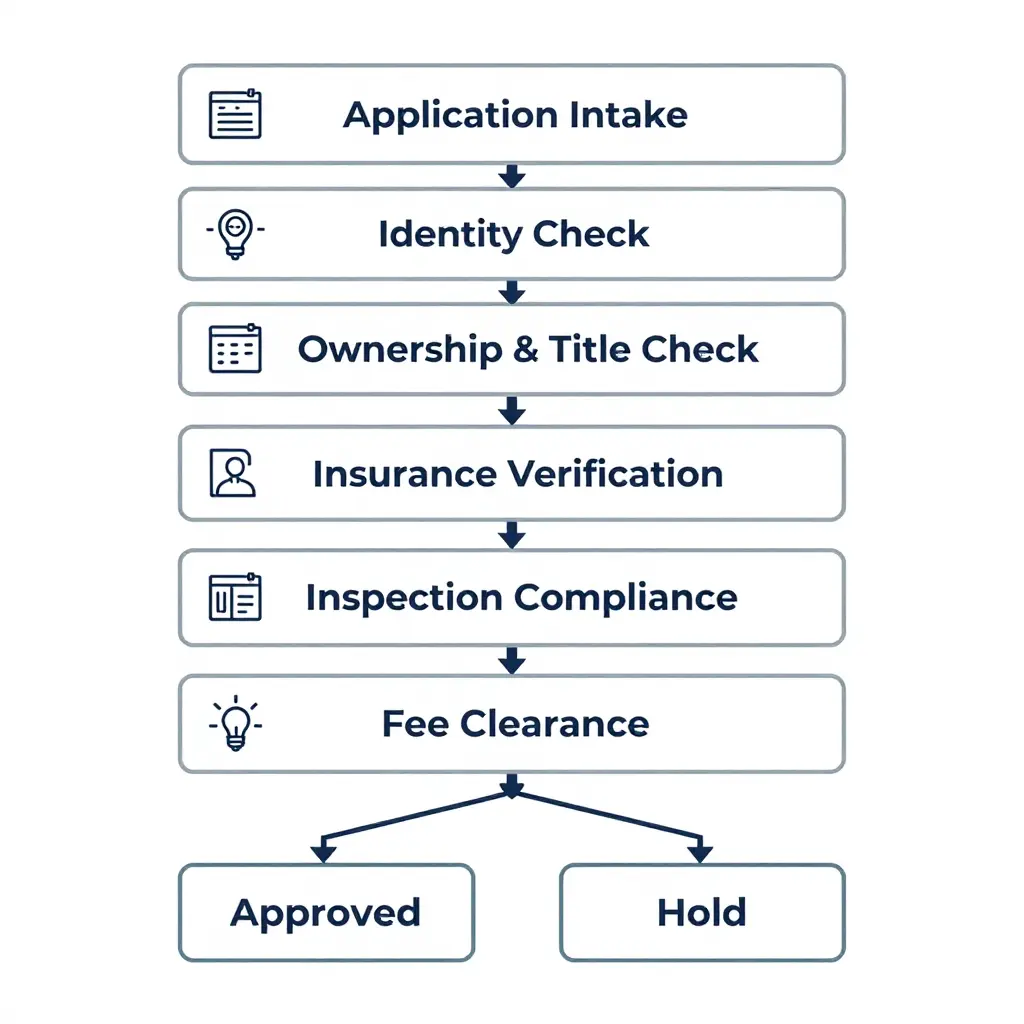
The diagram lays the process out as a series of gates: a snag at any one of them can stall the application before it ever reaches approval. Inspection is the step that varies most by location, so it’s worth reviewing the state-by-state vehicle inspection requirements before you go to the counter. The flow ends in only two places, a clear approval or a hold, and knowing the order helps you guess where your own application might slow down.
The table is a simplified snapshot of how six states handle vehicle registration checks when the applicant holds a suspended license. Treat it as an example set rather than a fixed nationwide rulebook; requirements vary by state and change over time.
| State | Insurance Verification Method | Inspection Required | Residency Proof Required | Outstanding Fees Check | Registration Eligibility With Suspended License |
|---|---|---|---|---|---|
| California | Real-time electronic verification through the DMV | Biennial smog (emissions) check in most counties | Yes – government ID plus address documentation | Unpaid parking and toll violations can block or delay | Often possible; license status alone usually is not an automatic bar, but unpaid fees must be cleared |
| Texas | Electronic verification via the TexasSure database | Emissions test in certain counties; annual safety inspection ended for most non-commercial vehicles in 2025 | Yes – valid ID and Texas address | Toll and some county fees can block | Generally handled separately from license status, though all other requirements must still be met |
| Florida | Real-time electronic verification (FRVIS) | No routine safety inspection; no statewide emissions test | Yes – ID and evidence of Florida residence | SunPass toll debt can suspend registration | Frequently allowed; unpaid tolls or fees may block |
| New York | Electronic verification (IIES) | Annual safety and emissions inspection | Yes – ID and address proof | Unpaid tolls can trigger registration suspension | Registration can be suspended over toll debt; otherwise the situation varies |
| Illinois | Electronic insurance verification | Emissions test in the Chicago metro area | Yes – ID and Illinois address | Tollway violations can block renewal | Varies; outstanding obligations may prevent registration |
| Ohio | Random-sample and electronic insurance checks (BMV) | Emissions test in select counties | Yes – ID and Ohio address | County and municipal fees may block | Varies; typically requires clearing other obligations first |
Read the table as a compliance checklist, not a legal verdict. Your driving record is one input among several, and insurance, inspection, residency, and fee checks each run on their own and can independently affect whether a vehicle can be registered. Because these requirements vary by state and change frequently, always confirm current rules with your state DMV, and it helps to understand how state rules shape the broader licensing picture. This overview is general information only and is not legal advice.
Identity, Ownership, and Title Verification
A clean driving record doesn’t guarantee an approved registration. DMV checks come down to two questions: is the applicant who they say they are, and do they actually own the vehicle? For people registering a vehicle with a suspended license, the real obstacle is often a paperwork mismatch rather than the suspension itself.
Verifying the Applicant’s Identity
Most states require a primary government-issued photo ID: a REAL ID-compliant driver’s license, a state-issued ID card, a U.S. passport, or a permanent resident card. The name, date of birth, and identification number on it must all match the application. Staff also run the ID through verification systems that cross-check it against federal and state databases. These practices differ from one jurisdiction to the next, so knowing the local rules helps you gather the right documents before you show up. This guide to identity verification practices across jurisdictions covers the variations.
Matching the Title to the Registrant
The name on the certificate of title must match the person seeking registration. A misspelled name, a nickname, a maiden name after marriage, or an unrecorded joint owner will stop the process. When ownership changes hands, the title has to be signed over, dated, and often notarized. The DMV records the odometer reading at transfer because odometer tampering is a federal offense; a missing, inconsistent, or clearly rolled-back disclosure can get the application flagged.
Recalls and Branded Titles
Agencies also screen for open safety recalls and branded titles. A brand such as salvage, rebuilt, flood, or lemon generally stays with the title and may require an inspection before registration. A vehicle with an unresolved manufacturer recall can be blocked until proof of repair is submitted.
Documents Commonly Requested
- Government-issued photo ID (driver’s license, state ID, passport, or green card)
- Proof of ownership: signed certificate of title or manufacturer’s statement of origin
- Completed odometer disclosure statement
- Bill of sale or proof of purchase
- Proof of insurance meeting state minimums
- Payment for registration and titling fees
Identity and ownership mismatches cause a large share of registration rejections, even when the driving record is spotless. A missing signature, an outdated address, or a name that doesn’t match the title can sink an otherwise valid registration. Checking your documents before the visit clears up most of these problems.
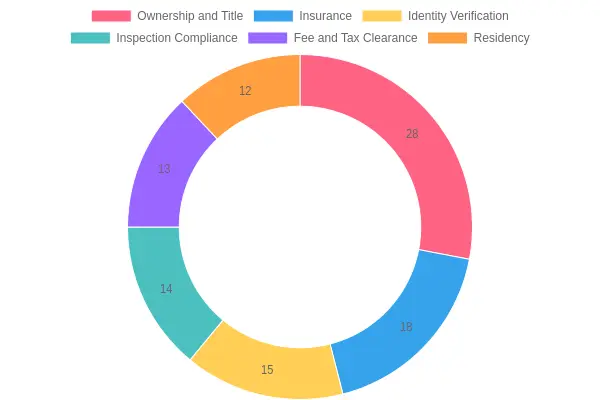
Figure: How DMV registration checks split your processing time. Your driving record is a small part of it; six verification categories account for most of the process.
Ownership-and-title validation (28%) and insurance confirmation (18%) account for nearly half of the time, followed by identity verification (15%) and inspection compliance (14%). If your registration is stuck, the delay almost certainly lives in paperwork, proof of ownership, or state inspection requirements, not in the suspension on your record.
Inspection, Emissions, and Recall Compliance Checks
Before the DMV finalizes a vehicle registration, it runs compliance checks on the vehicle rather than the person applying. They confirm the car meets safety standards, passes emissions testing where required, and has no unresolved safety recalls. In many states, the agency works with inspection and emissions programs that feed pass-or-fail results straight into the registration system. If you’re completing a registration while managing a suspended license, the vehicle’s compliance record is still judged on its own merits.
The compliance review usually has three layers:
- Safety inspection: Confirms that brakes, lights, tires, and structural components meet state minimums, following established state vehicle inspection requirements.
- Emissions testing: Measures tailpipe output and onboard diagnostic data to ensure the vehicle meets clean-air standards in participating areas.
- Open-recall verification: Cross-checks the VIN against manufacturer safety recall databases to flag unrepaired defects.
None of these layers depend on your driver’s license status. A suspension affects your privilege to drive, while inspection, emissions, and recall rules decide whether a specific vehicle is legally fit for the road. Because the two are tracked separately, resolving a license issue does not clear a failed emissions test, and a clean driving record does not excuse an open recall.
A vehicle with an open recall or a failed emissions test can be refused registration, because the state cannot confirm it is safe and compliant to operate. An unrepaired recall may point to a defect that risks a crash, and a failed emissions test means the car exceeds pollution limits. Until those issues are fixed and verified, the DMV typically withholds plates and renewals, which leaves the vehicle unregistered and illegal to drive on public roads.
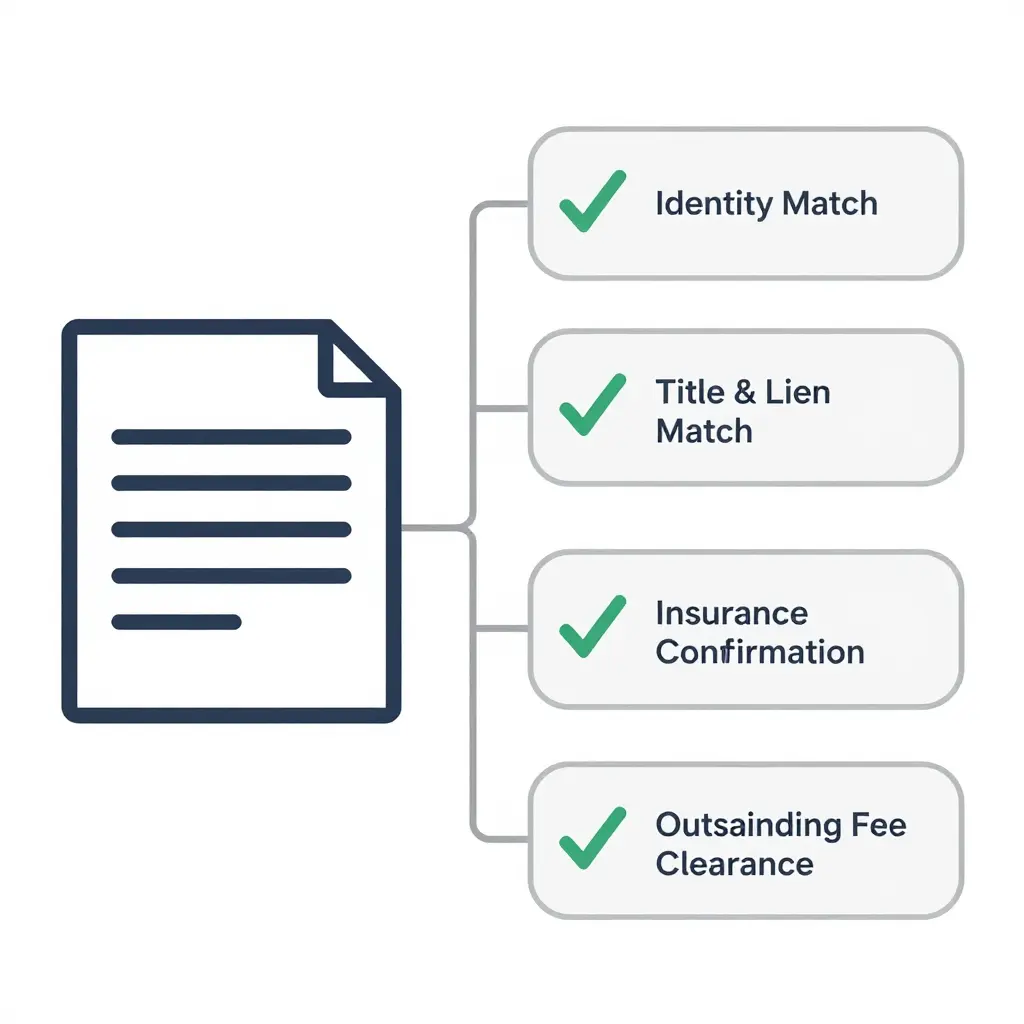
Outstanding Fees, Taxes, and Tolls Tied to Registration
Registration also involves money. Before approving a vehicle registration, the agency runs financial checks to confirm you do not owe anything tied to the vehicle, the plate, or a previous registration. Those obligations are cross-checked against state and local databases, so an unpaid balance in one system can surface even when you apply at a different office.
Common financial holds that can block registration include the following:
- Unpaid registration or renewal fees carried over from a previous registration period
- Delinquent property taxes or personal property taxes assessed on the vehicle
- Unpaid tolls and toll violations reported by state or regional toll authorities
- Reinstatement fees owed after a suspension, revocation, or insurance lapse
- Unpaid parking tickets or other municipal fines transferred to the motor vehicle agency
Each balance is verified automatically. Depending on the state, the motor vehicle agency shares data with tax collectors, toll operators, courts, and local governments. When a match appears, the system places a hold on the record and the applicant has to clear the debt before registration can proceed. That’s why people registering a vehicle with a suspended license often find their financial obligations matter just as much as their license status.
In practice, the DMV acts as a clearinghouse for these debts. Lifting a hold usually means paying the balance directly to the agency that reported it, then requesting that the hold be released. Because the rules differ so much between states, review the relevant state rules that govern registration and licensing before you apply, so you know which agencies to contact.
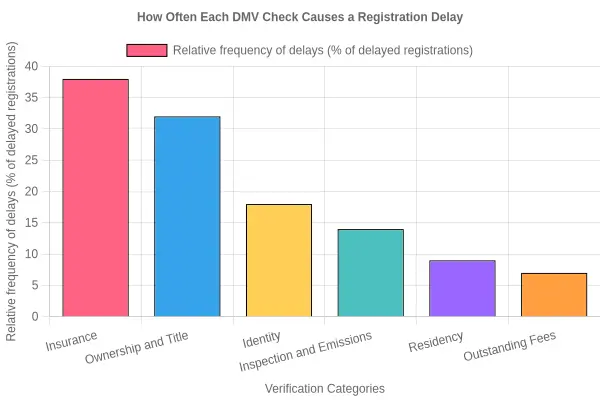
What This Chart Shows
The chart ranks the verification categories by how often they contribute to a delay or hold. Insurance is involved in 38% of delayed registrations and ownership and title issues in 32%. Identity (18%), inspection and emissions (14%), residency (9%), and outstanding fees (7%) come next.
So insurance and title problems, not your driving record, are the most common reasons a registration stalls. For applicants with a suspended license, the important part is that the DMV runs a whole stack of independent checks: a clean driving record alone won’t guarantee a smooth registration, and an unrelated paperwork gap can still stop you at the counter.
Frequently Asked Questions: Registering a Vehicle With a Suspended License
Registration and driver licensing are two separate processes in most states, but they interact in ways that catch applicants off guard. The answers below to common questions about registering a vehicle with a suspended license stay factual and neutral. They reflect general patterns only, so always confirm the rules for your own jurisdiction.
Can I register a vehicle with a suspended license?
In many states, yes. Registration is generally tied to the vehicle and its ownership, while a suspension is tied to your driving privileges, so the two are handled separately. That said, some states link the two and may block or delay a vehicle registration if your license is suspended. Because rules vary by state, the outcome depends on where you live.
Does the DMV check my driving record during registration?
Often it does. Many agencies run automatic DMV checks against internal databases when you register or renew, which can surface a suspended or revoked status. Other states complete registration without reviewing your driving history at all. The scope of those checks depends on local law and agency procedures.
What documents does the DMV require beyond my license?
Typical requirements include proof of ownership (such as a title or bill of sale), proof of identity, and proof of insurance. Some offices also ask for residency documents or a completed application form. Whether a valid license is mandatory for registering a vehicle with a suspended license differs across states.
Will an insurance lapse block my registration?
An insurance lapse frequently blocks vehicle registration. Most states require continuous coverage and may suspend your registration or refuse to renew it if coverage lapses. Reinstating insurance and paying any related fees is often necessary before registration can proceed.
Can outstanding fees stop my vehicle registration?
Yes, unpaid fees can block registration in many states. Unpaid tickets, tolls, taxes, or reinstatement fees may trigger a registration hold until they are resolved. These holds are typically lifted once the balance is cleared.
Does a suspended license affect my registration renewal?
It can. Some states allow renewal regardless of license status, while others deny it or flag the account. Renewal outcomes are shaped by state-specific rules, which this guide to how state rules impact driver licensing explores in more detail.
Key Takeaway
The relationship between a suspended license and vehicle registration is not uniform. Before applying, confirm your state’s requirements, gather the right documents, and resolve any outstanding fees or insurance gaps.
The Bottom Line: Registration Rules Run Deeper Than Your Record
When you’re registering a vehicle with a suspended license, it’s tempting to assume your driving history is the only thing in the way. In reality, the DMV checks triggered during vehicle registration reach far beyond a single record. Agencies typically review identity and legal name, ownership and title paperwork, proof of insurance, inspection and emissions compliance, residency documentation, and any outstanding financial obligations such as unpaid fees, taxes, or child-support holds. A clean driving record alone does not guarantee a smooth approval, and a suspended license does not automatically block every step either. The decisive factor is usually whether your paperwork and obligations are in order.
Don’t guess. Because requirements shift from state to state, the smartest first move is understanding state rules before you walk into an office or file online. Confirm exactly which documents and clearances your jurisdiction demands, then resolve any outstanding holds, fines, or missing certificates ahead of time. Applicants who verify requirements and settle obligations early avoid rejected applications and repeat visits.