
Vehicle Registration vs Driving License: Two Different Things
People often use the terms vehicle registration and driving license as if they mean the same thing. They do not.
A driving license is issued to a person. It proves that an individual has met the requirements to operate a vehicle.
Vehicle registration is issued to a vehicle. It proves that a specific car, truck, or motorcycle is legally recorded with the state and allowed on public roads.
The two records point at different subjects: one tracks a human being, the other tracks a machine.
What Is a License Number?
A license number is the unique identifier printed on a person’s driving license. It follows the driver, not the car.
Sell your car, buy another, or own three vehicles at once, and your license number stays the same. It is tied to you.
What Is a Vehicle Registration?
The registration is tied to the vehicle itself. It carries a plate number and a vehicle identification number (VIN), and it changes hands when the car is sold.
That difference resolves a common puzzle: because licensing is personal, your license number has no place on a vehicle’s legal paperwork, however much state rules shape how driver licensing works.
What This Article Covers
This guide explains why a license number never appears on a vehicle title, where each number belongs, and why mixing them up causes problems at the DMV.
What Is Vehicle Registration?
Vehicle registration ties a specific vehicle to a legally responsible owner and grants that vehicle permission to operate on public roads. In plain terms, it is the government’s way of saying, “We know this car exists, we know who is accountable for it, and it is cleared for the road.”
The Identifiers Behind Every Registration
Every registered vehicle carries a set of unique markers:
- License plate – the visible tag on the bumper that links the car to its registration record.
- Vehicle registration number – the alphanumeric code printed on your registration card and tied to your plate.
- VIN (Vehicle Identification Number) – a 17-character serial number stamped into the vehicle itself, hard to alter and permanent for the life of the car.
Together, those identifiers let authorities match a moving vehicle to a paper trail.
Who Issues Vehicle Registration?
Registration is issued by state agencies, usually the Department of Motor Vehicles (DMV) or an equivalent motor vehicle office. These agencies record the owner’s name, verify insurance and identity, and confirm the vehicle meets local standards. Many states also require routine safety or emissions checks, and you can review state-by-state vehicle inspection requirements to see how those rules differ.
Why Registration Matters
Registration does more than issue a plate. It supports three things:
- Taxation – registration and renewal fees, plus property or use taxes, fund roads and public services.
- Law enforcement – plates and VINs help police identify vehicles, trace stolen cars, and enforce traffic laws.
- Ownership records – registration builds a documented chain from a vehicle to its owner, which matters for titles, transfers, and liability.
Registration is not a title. Registration proves a vehicle is allowed on the road; a title proves who owns it. That distinction is why your driver’s license number appears on neither document.
What Is a Driving License Number?
A driving license number is a unique alphanumeric code that a state agency assigns to one person. It works as a permanent identifier for your driving record: once the DMV issues your license number, it stays with you through renewals and address changes in that state. No two drivers in the same state share a number.
The DMV generates the number when you first apply for a driving license, usually after you pass a written knowledge test, a vision screening, and a road skills exam. Each state builds the number from its own format, and some formats encode details about where and when you were licensed, so the digits can say more than a random ID would. You can explore how different state rules shape the licensing process to see how much these formats vary from one DMV to the next.
Functionally, the license number ties directly to your driving privileges. It links your record to your endorsements, restrictions, points, and suspension history. If you lose those privileges, that same number is how the DMV tracks the action against you.
A license number identifies a person, not a thing. A vehicle identifier, such as a VIN or a license plate, identifies a machine. A VIN is stamped onto a car at the factory and stays with that vehicle; a license number stays with a person. That structural difference is why your driving license number never appears on a vehicle title, which describes the car rather than the driver.
| Identifier | What It Labels | Assigned By | Follows |
|---|---|---|---|
| Driving license number | A person (the driver) | State DMV | The individual |
| VIN | A specific vehicle | Manufacturer | The vehicle |
| License plate | A registered vehicle | State DMV | Often the vehicle/owner |
Vehicle Registration vs Driving License: The Quick-Reference Table
They live in the same glovebox, but they answer different questions. Here are the two credentials side by side.
Table: Vehicle registration vs driving license – a side-by-side comparison of what each credential identifies and does.
| Dimension | Vehicle Registration | Driving License |
|---|---|---|
| What it identifies | The vehicle (VIN, plate, title) | The person (the driver) |
| Issuing authority | State DMV / motor vehicle agency | State DMV / licensing authority |
| Format example | Plate ABC-1234; VIN 1HGCM82633A004352 | DL No. D1234-5678-90 |
| Primary legal purpose | Proves the vehicle is legal to operate | Proves the person is qualified to drive |
| Where it appears on documents | Title, registration card, insurance | Citations, rental contracts, background checks |
| Renewal cycle | Annual or biennial (varies by state) | Every 4-8 years (varies by state) |
The takeaway: registration tracks the machine, a license tracks the person. That single distinction is why the two numbers rarely share space on official paperwork.
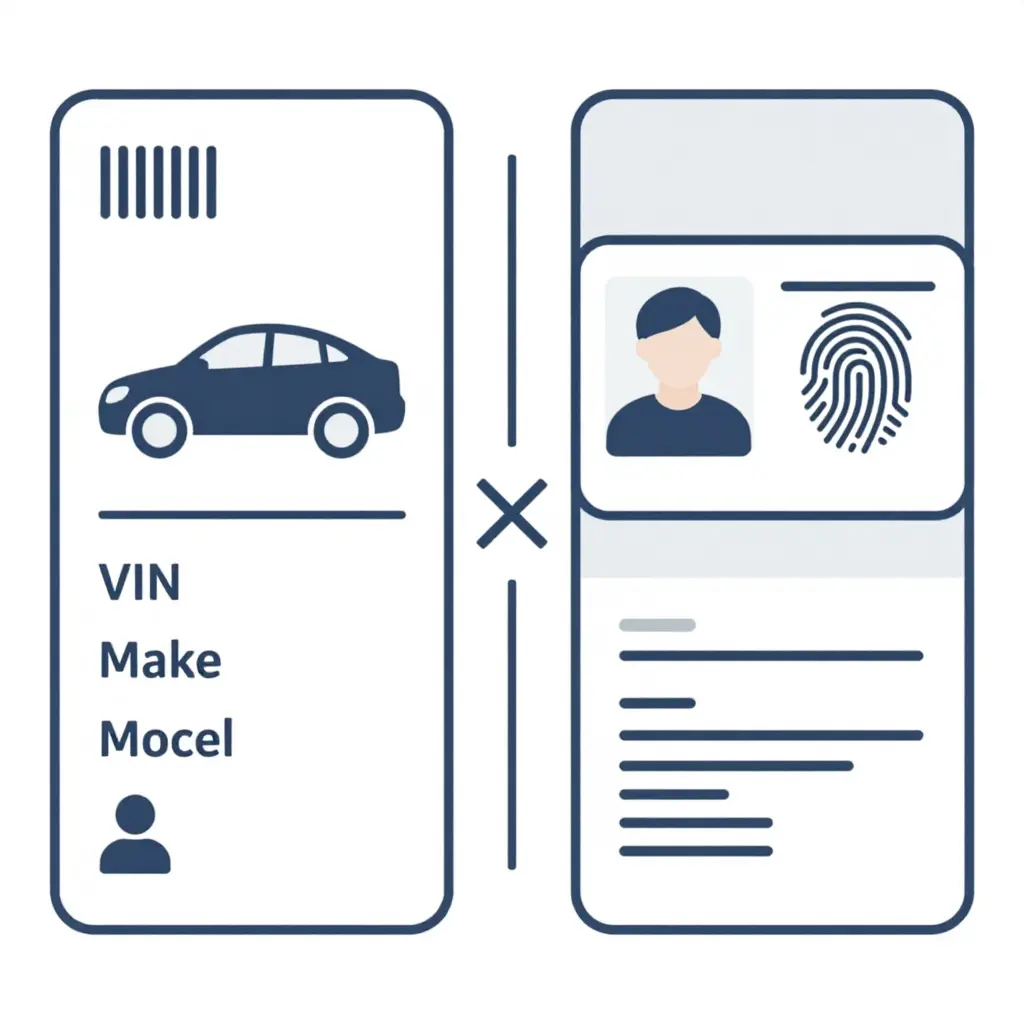
The block on the left represents the vehicle title, a record that describes a machine through identifiers such as its VIN, make, model, and owner name. The block on the right represents a driver’s license, a record that describes a person through a photo, fingerprint, and identity details. The bold cross and divider between them are not decoration; they mark a line that exists in real record systems. A title says which car; a license says which driver.
What Actually Appears on a Vehicle Title
A vehicle title is straightforward once you know what to look for. Each field confirms identity, ownership, or legal status.
- The Vehicle Identification Number (VIN) is a 17-character code that uniquely identifies your car.
- The make names the manufacturer, such as Ford, Toyota, or Honda.
- The model specifies the product line, like Camry or F-150.
- The model year indicates when the vehicle was built.
- The title number is a unique reference assigned to that specific vehicle title.
- The owner name and address identify who legally holds the vehicle.
- Lienholder details identify any lender holding a financial claim.
- The odometer reading records the mileage when ownership changed.
- State-issued title branding flags conditions such as salvage, flood, or rebuilt status.
Together, those fields make the document a reliable record for buyers, sellers, and lenders.
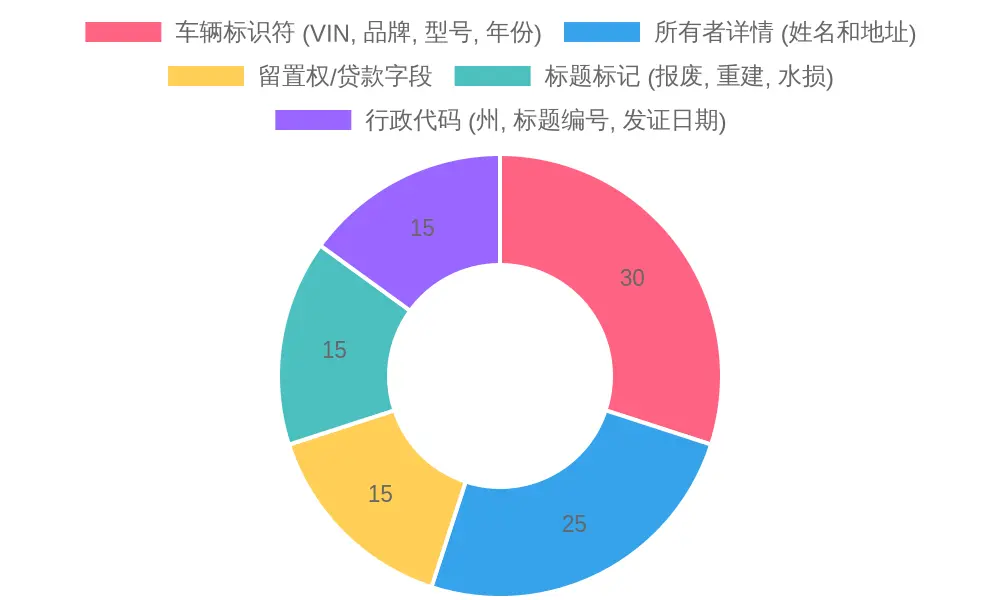
What Each Slice Represents
| Field Category | Example Contents | Share |
|---|---|---|
| Vehicle identifiers | VIN, make, model, year | 30% |
| Owner details | Registered owner name and address | 25% |
| Lien/loan fields | Lienholder name, loan status | 15% |
| Title branding | Salvage, rebuilt, flood history | 15% |
| Administrative codes | State, title number, issue date | 15% |
Every slice in the chart is either a vehicle fact or an ownership fact. There is no slot for a driver’s license number, because a title documents property, not a person’s privilege to drive. How states organize driver licensing varies, but none of those rules put a license number on a title.
Caption: This doughnut chart breaks down the standard vehicle title fields, showing the title is built from vehicle and ownership data rather than personal license information.
Common Misconceptions About Registration, Licenses, and Titles
Paperwork feels dull until something goes wrong at a traffic stop, an insurance claim, or a private sale. That is when muddled ideas about vehicle registration, driving license records, and the vehicle title cost time and money. Five myths are worth clearing up.
Myth 1: A title is enough to legally drive
A vehicle title proves who owns the car, not that it is legal to drive on public roads. Driving with only a title in your glovebox means you skipped vehicle registration, which brings its own plates, fees, and renewal cycle. Officers treat an unregistered vehicle as a compliance problem, and those gaps can get expensive fast. Compliance failures and insurance costs add up.
Myth 2: Registration equals ownership
Registration is a tax-and-tracking record tied to a vehicle, and it is usually issued to whoever keeps the car on the road: a lessee, a parent, or a company fleet. Ownership comes from the title. You can be a registered operator without being the legal owner, and the reverse. Buyers should always ask for the title, never just a current registration card.
Myth 3: Your license number is proof you own the car
A driving license number identifies a person’s privilege to drive. It says nothing about which vehicle belongs to you. People often assume the number appears on the title, but the title names owners, not licensed drivers. The confusion surfaces at resale and at the DMV window.
Myth 4: Insurance follows your license number
Auto insurance is typically attached to the vehicle and its registered owner, not to your driving license digits. You can carry a spotless license and still be uninsured for a specific car, or drive a friend’s covered vehicle under permissive-use rules. Habitual ticketing, though, does hurt every policy you hold. See which behaviors quietly raise your risk in this guide to surprising driving habits that get you ticketed.
Myth 5: One document covers everything
No single slip of paper does it all. The title proves ownership, registration proves road legality, and your license proves driving privilege. Keep all three current, and you will rarely be caught off guard.
Quick reference
| Document | What it proves | Issued to |
|---|---|---|
| Vehicle title | Legal ownership | The owner |
| Vehicle registration | Legal road use | Registered operator |
| Driving license | Privilege to drive | The driver |